
Last spring a woman from Carlsbad opened her video consultation by holding a notepad up to the camera. She had three columns written out: her jawline and neck, her lower eyelids, and her brow, which she said made her look angry in every photo her daughter took. Then she asked the question that fly-in patients ask me more than almost any other. “I can take one week off. Can we do all of it in one trip?”
For her, the answer was yes. For most healthy patients it is yes. And after 37 years and thousands of facelifts, I will go further: when the aging involves the whole face, doing the work in one carefully planned session is often the better surgery, not just the more convenient one. One anesthesia. One healing period. One trip across the border instead of three.
But “usually yes” is not “always yes,” and the difference between a beautiful combined result and an exhausted patient with a complication is not enthusiasm. It is planning, patient selection, and a surgeon who respects the clock. Let me walk you through how I actually decide.
The face ages as a unit, and it is honest to treat it as one
Nobody ages one region at a time. The same years that let the cheek descend and the jawline soften also let the brow settle, deflate the temples and midface, and stretch the skin of the eyelids. When a patient looks in the mirror and says “I look tired,” she is almost never describing a single structure. She is describing a pattern.
That is why an isolated procedure can sometimes create a strange mismatch. I have seen patients, some of them in my office seeking help, who had a well executed facelift years earlier but never addressed heavy upper lids or a low brow. The lower face reads as 48. The eyes read as 68. Friends cannot say what is wrong, but they sense that something does not add up. The reverse happens too: beautifully done eyelids sitting above jowls and a loose neck.
When I evaluate a face, I am not deciding whether you “need” three procedures. I am deciding what is actually producing the tired look, and whether correcting one area alone would leave a visible imbalance. Sometimes it would not, and I say so. A patient with strong brows and youthful eyes does not need me inventing work for the upper third. But when the whole face has aged together, treating it together is the more truthful plan, and it is what I recommend to the majority of my fly-in patients from California.
Is it safe to combine a facelift with eyelid surgery and a brow lift?
For a healthy, well selected patient, yes, and this is one of the better studied questions in facial surgery. A multicenter analysis published in the Annals of Plastic Surgery followed 6,126 patients who had blepharoplasty, a brow lift, or both together, and found that combining the two added no additional risk of major complications. The numbers were remarkably flat: major complications occurred in 0.4 percent of combined cases, 0.4 percent of blepharoplasty alone, and 0.7 percent of brow lift alone. Statistically, no difference.
Combining is also not exotic. It is the norm. A review of 13,346 facelift patients in the Tracking Operations and Outcomes for Plastic Surgeons database found that facelift patients underwent an average of 2.3 procedures in the same session, and that eyelid surgery was the most common companion procedure. Most facelifts in North America are already combined surgeries. The question is not whether combining can be done. It is whether it is being done thoughtfully.
And here I owe you the honest part, because the data does not say combining is free. A large study of 11,300 facelift patients in the Aesthetic Surgery Journal reported an overall major complication rate of 1.8 percent, with hematoma, a collection of blood under the skin, as the most common event, and it found that adding other procedures raised the complication rate compared with facelift alone. The same database review that showed how common combined surgery is also identified longer operative time and combined procedures among the risk factors it flagged.
It helps to know what those studies were actually counting. In the eyelid and brow analysis, a major complication meant something serious enough to require an emergency room visit, a hospital admission, or a return to the operating room within 30 days. These are not bruises and asymmetries; they are genuine events. That is the standard against which combined brow and eyelid surgery showed no added danger.
So how do both things fit together? How can brow plus eyelids add no measurable risk while “combined procedures” as a category adds some? The answer is that “combined” is a wide word. It includes a facelift with a 30 minute upper blepharoplasty, and it also includes a facelift bundled with body procedures stretching past the eighth hour under anesthesia. Complication risk tracks with total operative time, with the patient’s health, and with the judgment of the team far more than with the number of names on the surgical plan. A focused facial combination in a healthy patient behaves very differently from an everything-at-once marathon.
That distinction is exactly where my rules come from.
My rule is the clock, not the wish list
I do not decide what to combine by asking how much a patient wants done. I decide by asking what can be done excellently within a safe block of operating time, in this patient, on this day.
A deep plane facelift with the neck takes me a defined number of hours because I have done it for decades and my team runs the same sequence every time. Upper eyelids add a modest amount. Lower eyelids add more. A brow lift adds a predictable increment. Fat transfer adds surprisingly little because the harvest and preparation happen in parallel. Before I ever quote a plan, I add these blocks honestly and ask whether the total sits inside the window I consider safe for that patient’s age and health. If it does, we combine. If it does not, something comes off the table, and I tell the patient which item and why.
Every combined case I do is performed under general anesthesia with Dra. Nadiezhda Garcia Bonilla, a board-certified anesthesiologist who is present for every procedure I perform, at our Quad A accredited surgical facility. I want to be plain about this, because patients read about facelifts done awake under local anesthesia and ask whether that would be safer for a long combined case. Awake surgery is a legitimate approach in some hands for shorter procedures. For a combined session, in my judgment, it is the wrong tool. A three region operation demands a patient who is completely still, completely comfortable, and continuously monitored by a physician whose only job is her physiology. That is what a dedicated anesthesiologist provides, and it is precisely for longer combined cases that I consider her presence non-negotiable. Our surgical facility and anesthesia team are set up around exactly this kind of case, because for a combined procedure the facility is not a detail. It is half the safety story.
The clock rule also protects you from something patients are too polite to ask about: my own fatigue. A surgeon’s judgment at hour nine is not his judgment at hour three, no matter how experienced he is. I set my time window where I know my hands and my decisions stay at their best from the first incision to the last suture, and I staff combined cases with the same senior team every time so that no one in the room is improvising. Ambition is not a surgical skill. Endurance is not either. Planning is.
There is one more part of the clock rule that patients rarely think about: sequence. In a combined case I do not simply operate front to back. The order is designed so that swelling in one territory does not distort my landmarks in the next, and so the most judgment intensive work happens when the team and I are freshest. The plan is choreographed the day before, written down, and followed.
What I actually combine in one session
The combinations I perform most often for fly-in patients look like this.
The foundation is almost always the deep plane facelift with the neck addressed at the same time. That is the structural work, the repositioning of the deeper tissue layer that produces the natural jawline and cheek most of my patients are seeking in the first place.
Onto that foundation, the most frequent additions are upper and lower eyelid surgery, which corrects the hooded upper lids and the bags and hollows below the eyes that a facelift by itself does not touch. Patients are often surprised by this. A facelift, even a comprehensive one, does very little for the eyelids themselves. If tired eyes are part of your complaint, the eyes need their own procedure.
The third companion is the brow lift, and here I am selective rather than reflexive. A genuinely heavy, descended brow that compresses the upper lid deserves to be lifted, and doing it in the same session lets me balance the upper third against the refreshed lower face. But many patients who think they need a brow lift actually need only well judged upper eyelid surgery. Lifting a brow that was never low produces the startled look everyone fears. Part of my job in the consultation is telling a patient which of the two her face is asking for, and sometimes the answer is neither.
Fat transfer joins the plan so frequently that I discuss it in its own section below. And in selected patients I will add skin surface treatment, either CO2 laser resurfacing or Morpheus8 radiofrequency microneedling, to areas away from the freshly lifted skin, most often around the mouth. I am careful here. Aggressive resurfacing directly over widely undermined facelift skin in the same sitting is a risk I decline. Perioral resurfacing in the same session, over skin the facelift did not undermine, is generally reasonable. It is a good example of how “can these be combined” is really a question about anatomy, not scheduling.
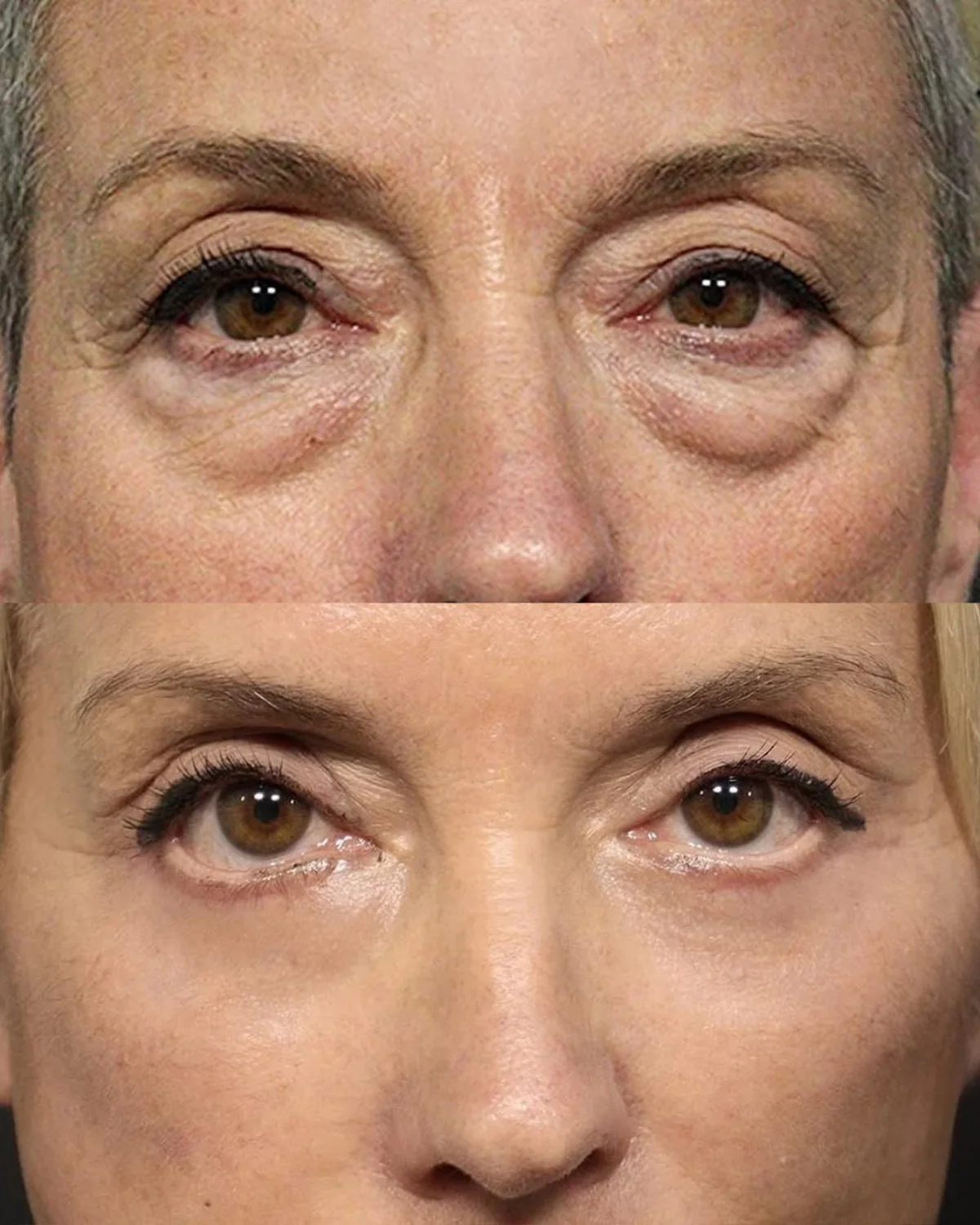
What does not belong in this list matters just as much. I do not bundle significant body surgery onto a full facial rejuvenation in a fly-in patient. Rhinoplasty alongside a full facelift, eyelids, and brow usually pushes past my time window, so it typically becomes the second trip. The face gives us plenty to do well.
Fat transfer is the quiet workhorse of a combined plan
Of everything I add to a facelift, fat transfer earns its place most easily, and it is the addition patients ask about least until I explain it.
A facelift repositions tissue that has descended. It does not replace tissue that has vanished, and volume loss is half of facial aging. The temples hollow. The midface deflates. The area under the eyes empties. If I lift a deflated face without restoring any volume, I get a tighter version of a deflated face. If I restore structure and volume together, I get a face that looks the way that patient actually looked years ago.
During a combined case, while I am working on the face, fat is harvested with gentle liposuction from the abdomen or thighs, prepared, and then placed in small amounts exactly where the face has emptied. Because the harvest runs in parallel with other stages, it adds far less operating time than patients imagine. It uses your own tissue, so there is nothing to dissolve or replace on a schedule, though I always tell patients that a portion of transferred fat does not survive and that the amount that takes varies from person to person. Individual results vary, and with fat grafting I mean that literally at the cellular level.
There is also a practical reason fat transfer belongs in the combined session rather than a later one: doing it at the time of the lift means the volume is placed while I can see the final position of the deeper tissues, so I am filling the face as it will actually sit, not as it sat before surgery.
Three procedures, and what that means for scars
A question I wish more patients asked: if we combine, am I signing up for three sets of scars at once?
Technically yes, and practically it is less alarming than it sounds. Facelift incisions are designed to live inside and behind the ear and along the hairline. Upper eyelid incisions sit in the natural lid crease, among the best hiding places on the human body. Lower eyelid work can often be done through the inside of the lid or just beneath the lash line. Endoscopic and temporal brow incisions hide in the hair. When I plan a combined case, I am also planning the incisions as one map, making sure the facelift and brow incisions cooperate around the temple rather than compete, which is one more quiet advantage of a single surgeon designing everything in one session.
The healing of those incisions is something I take personally, because my practice does not look like a textbook from a single demographic. A large share of my patients are Hispanic, and many have olive, tan, or deeper skin tones where incisions can heal with darker pigmentation or, less commonly, with raised or thickened scars. I have managed that reality routinely for decades, and it changes real decisions: how much tension I allow on a closure, where I let an incision sit relative to the hairline, how early we begin scar care, and how closely I follow pigment behavior in the first months. Combining procedures does not multiply scar risk in some compounding way, but it does mean more incision length healing at once, which is one more reason the nicotine rule and the health rules above have no exceptions. Individual results vary, and scar behavior is one of the most individual things in surgery.
One anesthesia, one recovery, one trip
Here is the arithmetic that ultimately convinces most of my California patients, and it has nothing to do with the operating room.
If you stage a facelift, eyelid surgery, and a brow lift as three separate procedures, you go under anesthesia three times. You take time away from work three times. You go through the swollen, bruised, do-not-want-to-be-seen phase three times, spread across a year or more. You travel three times, and if you are coming to me, that means three trips to Tijuana with three recovery stays. Every one of those recoveries has its own early risk window that must be respected before flying home.
If we combine, you do all of it once. The eyelid and brow recovery does not stack on top of the facelift recovery; it hides inside it. Eyelid bruising is typically resolving over the same days the facelift swelling is settling, so the combined patient and the facelift-only patient look socially presentable on roughly similar timelines. You heal everything during one block of quiet weeks instead of three separate ones. Individual results vary, and I will always give you a recovery estimate based on your own skin, health, and plan rather than a slogan.
Let me describe those first days honestly, because “one recovery” should not be mistaken for “an easy weekend.” The first night after a combined case you are watched, not merely lodged. Your head stays elevated, cool compresses cycle over the eyes, and a nurse checks you through the night, because the first 24 hours are when I am most vigilant for a hematoma. The published facelift literature reports hematoma as the most common complication, with incidence varying widely between series, and the way a careful practice keeps its own numbers low is unglamorous: blood pressure kept controlled, nausea prevented rather than treated, no straining, and a team close enough to act immediately if something changes. By the second morning most patients tell me the same two things: they are puffier than they expected and in less pain than they feared. Tightness, yes. Swollen eyes that make reading tedious for a few days, yes. Severe pain is not typical, and when it appears I want a phone call, not stoicism. Individual results vary.
The travel logistics for a combined case are nearly identical to a facelift alone, which surprises people. My fly-in patients stay in Tijuana about six days at minimum. Drains come out at 48 to 72 hours. Sutures come out around day seven, and I examine you personally before anyone talks about airports. I do not clear flying casually, because the days after any longer surgery carry an elevated risk of blood clots, roughly days five through 14 and lingering for weeks, and a combined case with its longer anesthesia is exactly the situation where that discipline matters most. Walking early, hydrating, and staying local until I clear you are not suggestions. The full schedule, from the first morning to the ride back across the border, is laid out in the itinerary my fly-in patients follow in Tijuana.
And because most of my patients live in Southern California, follow-up does not end at the border. I hold California medical license A 42463 and have held it since 1986, I see patients in coordination from San Diego, and I remain reachable through the entire healing arc. A combined procedure deserves combined follow-through. One operation, one surgeon watching all three areas heal, one person accountable for the whole result.
When I say no, or not all at once
I want this section to be as useful as the ones above, because the patients I turn down or slow down are the reason my complication numbers let me sleep.
I stage, trim, or decline a combined plan in a few recurring situations. The first is health. A patient with poorly controlled blood pressure, diabetes that is not well managed, a heart or lung condition, or a history of clotting problems may be reasonable for a shorter single procedure after medical optimization, but a long combined case concentrates stress on the body, and I will not stack procedures on a patient whose physiology argues against it. The large facelift studies are blunt about this: risk concentrates in patients with risk factors, and operative time is one of them.
The second is nicotine, in every form, including vaping. A facelift raises skin that depends on small blood vessels, and eyelid and brow surgery add their own healing demands. Nicotine constricts exactly the vessels that combined surgery leans on. A patient still using nicotine does not get a combined case from me; she gets a cessation plan and a later date.
The third is the overloaded wish list. When the requests grow past what fits in my time window, I do not stretch the window. I split the plan, and I am honest that the border between trip one and trip two is drawn by safety, not by salesmanship. Usually the face, neck, eyes, and brow travel together and anything else waits.
The fourth is the patient whose expectations need surgery more than her face does. If someone believes a combined procedure will erase every line, fix her skin texture, and hold still for decades, we talk longer before we operate, or we do not operate.
Here is how the sorting usually falls.
- Deep plane facelift with the neck plus upper or lower eyelid surgery: my most common combination, well supported by large studies
- Adding a brow lift when the brow is genuinely low: the strongest available data found no added major complication risk when brow and eyelid surgery are combined
- Fat transfer during the lift: parallel workflow, small added time, volume placed with the deep tissues already in position
- Perioral CO2 or Morpheus8 in the same session, on skin the facelift did not undermine
- Aggressive resurfacing directly over freshly undermined facelift skin in the same sitting
- Bundling significant body surgery or rhinoplasty onto a full facial plan in a fly-in patient
- Any combined case in a patient still using nicotine in any form, including vaping
- Extending the operative window past my time limit to fit one more request
If your surgeon, whoever he or she is, never says no to an addition, that is not flexibility. That is a warning sign.
If we stage, we stage in the right order
Sometimes staging is simply the correct answer, and when it is, sequence matters.
When a patient and I decide to split the plan across two trips, the structural work almost always goes first: the facelift and neck, usually with fat transfer, because that operation defines the new architecture of the face. Eyelids and brow, or resurfacing, follow on a second trip once the face has settled, typically several months later. Doing it in this order means the second procedure is planned against the face you will actually live in, not the one that is about to change.
The reverse order occasionally makes sense, for instance in a patient whose eyes bother her intensely now but who wants to schedule the larger operation around a life event next year. That is a fine plan too. What I resist is staging driven purely by fear of combining, when the patient is healthy and the combined plan fits comfortably inside my window. In that patient, staging does not reduce her total risk. It doubles her anesthesia events, doubles her recoveries, and doubles her trips, while the evidence says the focused combination would have served her safely. Staging is a tool, not a virtue.
One more honest note for fly-in patients: staging across an international border is more demanding than staging across town. Each stage needs its own local stay and its own clearance to fly. Patients who can absorb one longer absence more easily than two shorter ones often find the combined plan fits their real life better. Patients with rigid work calendars sometimes prefer two smaller absences. There is no universal answer, only your answer.
What one trip means for cost, without quoting you a number
You will not find prices in my articles, and that is deliberate. A surgical fee quoted to a stranger on the internet, before an examination, is a marketing device, not a medical plan. But I can teach you how the economics of combining work, because the structure is the same everywhere even when the figures differ.
Every trip to any operating room, in any country, carries costs that exist independently of the surgery itself: the anesthesia team’s time, the facility, the recovery care, your travel, your lodging, and your weeks away from normal life. Stage three procedures and you pay those fixed layers three times. Combine them and you pay them once. That is why, at any practice on either side of the border, a combined session costs meaningfully less than the same procedures purchased separately, and why the difference grows when travel is involved.
For my U.S. patients there is a second layer: surgery in the United States is expensive, and patients in my practice pay a lower percentage of what the same combined plan would cost them at home, with the same category of accredited facility and a dedicated anesthesiologist. I say that qualitatively and I will put precise figures on your individual plan only after I have examined you.
And I will close the money conversation with the same warning I give in consultation: never let the economics talk you into a bigger operation than your health supports. The combination has to earn its place medically first. If it does, the efficiency is a genuine and legitimate benefit. If it does not, no savings justify it. When a clinic leads with the discount rather than the examination, keep looking.
Bring me the whole list
That patient from Carlsbad, the one with three columns on a notepad, had her deep plane facelift with her neck addressed, upper and lower eyelid surgery, and fat transfer in one session. Her brow, when I examined her properly, did not need lifting; her heaviness was eyelid skin, and I told her so, which subtracted one procedure and one scar from her own plan. Drains out on day two, sutures on day seven, cleared to drive home on day eight. One trip. She sent me the next set of photos her daughter took.
So my answer to the question in the title is the answer I gave her. Yes, in most healthy patients the eyes, the brow, and the face can be treated in one session, one anesthesia, one recovery, and the research on combined facial procedures supports doing it that way when the plan is disciplined. The qualifier is the discipline.
When you come to a consultation, whether in person or by video from California, bring the whole list. Do not edit it down because you assume the extras are impossible in one trip, and do not assume everything on it will make the cut. Show me all of it, and I will tell you what belongs in one session, what should wait, and what your face does not actually need. That last category is my favorite one to deliver.