
The first three weeks after a deep plane facelift have their own article, my week by week account of early recovery, and I will not retell them here. This one begins where that one ends. You are past the drains, past the sutures, past the two week mark where most patients can move through a normal day without drawing attention. And still, the face in the mirror is not finished. It will not be finished for months. What follows is the calendar almost nobody explains to patients: what actually settles at one month, three months, six months, and a year, why the changes arrive in that order, and how to tell patient waiting apart from a change that deserves a message. If you keep one idea from this page, keep this one: from here forward, everything that changes is refinement, not correction. The structure of your face was rebuilt in the operating room. The months ahead simply let you see it. Individual recovery varies, and the sequence below is the pattern I have watched across 37 years, not a promise.
What does one month after a facelift look like?
At one month you look like yourself to everyone around you, while you still see a rounder, fuller version of your face that nobody else notices.
The obvious bruising left weeks ago, and the swelling that remains is not the dramatic kind from the first days. It is a soft, even fullness that lives in the cheeks, along the jawline, and in front of the ears, and it does something quietly frustrating: it blurs the very definition the operation created. The line from chin to neck has already been rebuilt underneath it. You simply cannot see all of it yet.
This is why I show early cases in my gallery of results with the time since surgery printed on the label. A photograph taken at one month, labeled honestly as one month, teaches something a curated later photograph never can: what a face looks like when the structure is done and the surface is still settling on top of it. Patients at this stage often tell me the same two things in the same visit, that their friends say they look rested, and that they themselves see only the swelling. Both are true at once. Friends are looking at the structure. You are looking, at close range and with a memory of every earlier morning, at the fluid.
One month also comes with its own quiet companions: a snug tightness in the neck, numb patches in front of the ears, firm spots your fingertips find before any mirror shows them. Each has its own timetable, and I take them one at a time below.
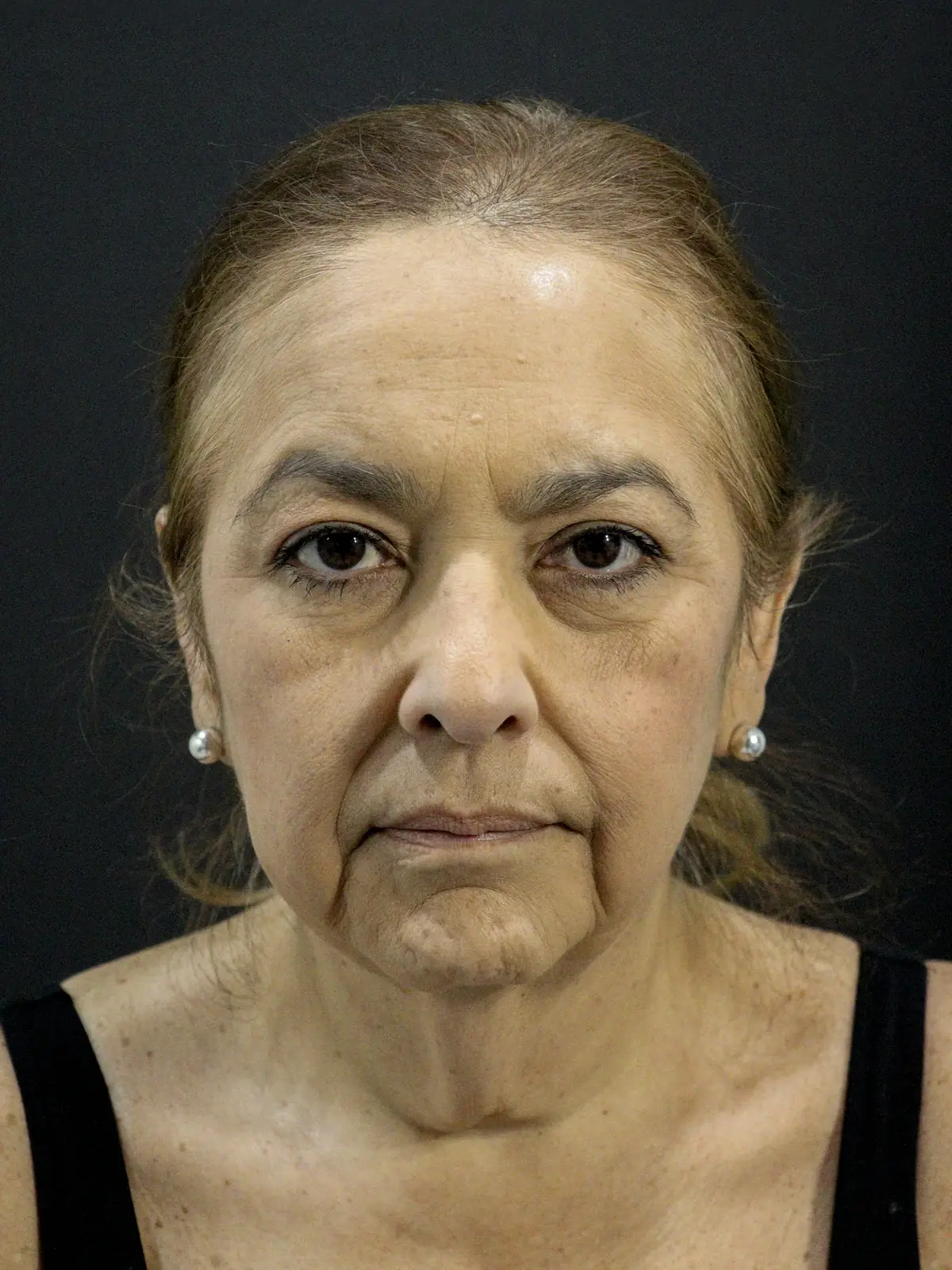
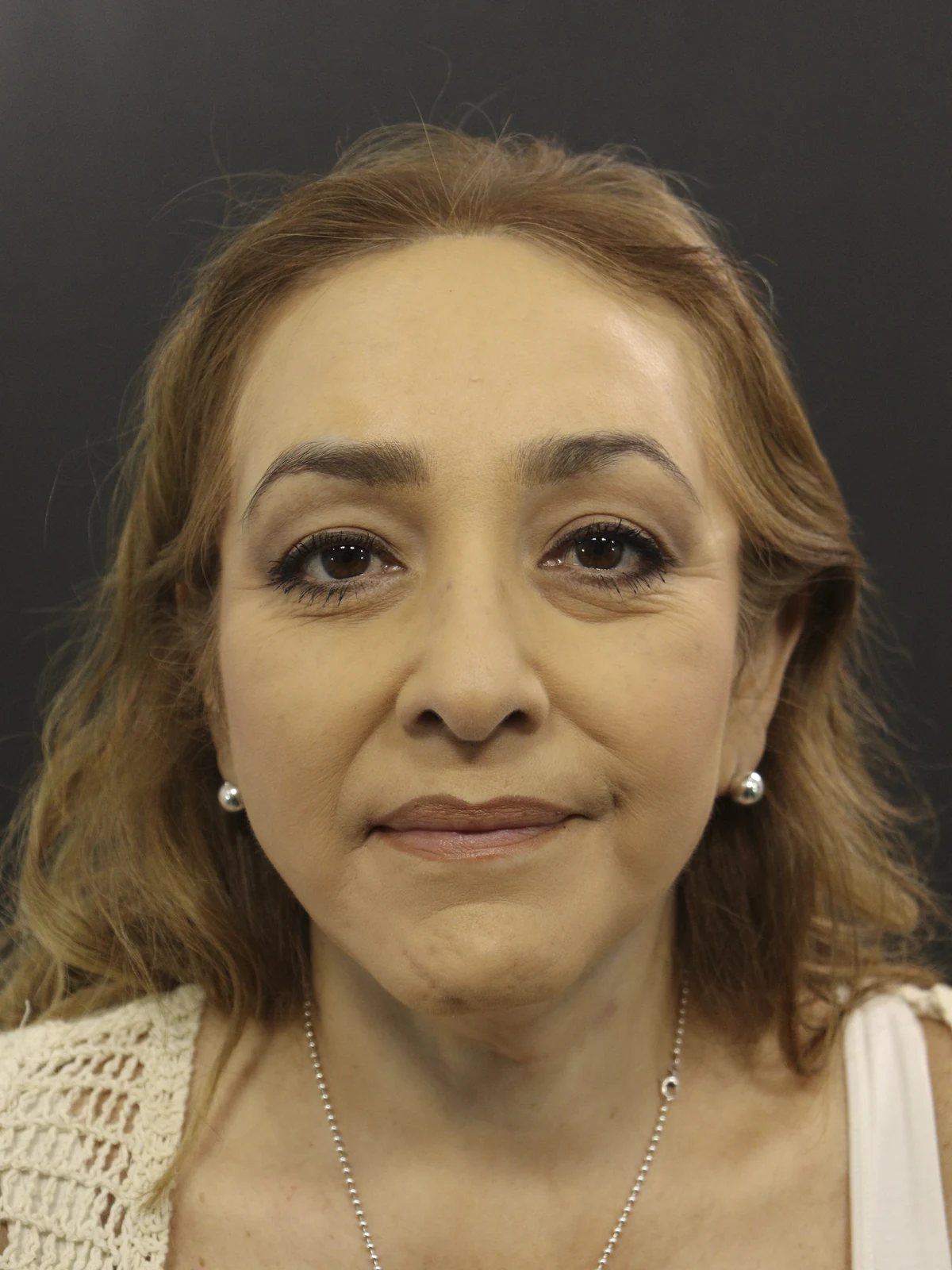 BeforeAfter
Drag to compare. A real deep plane result, photographed with consent. The face you see settles over months, not in the first two weeks. Individual results vary.
Why do I still look swollen six weeks after my facelift?
Because the swelling that remains at six weeks lives in the deep layer that was repositioned, and deep tissue releases fluid far more slowly than skin does.
A deep plane facelift works beneath the SMAS, the superficial musculoaponeurotic system, releasing the deep structure and moving it as one unit so the skin never carries the tension. I explain that layer in plain terms in my article on the SMAS. Working in that plane, the one Hamra described in 1990, is exactly what makes the result look natural and hold, and it is also why the settling runs on a longer calendar: the healing is happening deep, where fluid drains through small lymphatic channels that were necessarily disturbed by surgery and re-route themselves only gradually.
While those channels recover, the remaining swelling follows rhythms you can learn to predict. Fuller first thing in the morning after a night lying down. Fuller after a salty dinner. Fuller the day after your first real workouts back. Calmer by evening once you have been upright for hours. None of that is a setback; it is plumbing, and it improves week over week.
Six weeks is also, in my experience, the moment of quiet panic. The calendar says a month and a half, the mirror says not done, and patients begin to wonder if this is simply how it turned out. It is not. At six weeks nobody else in your life is seeing swelling. You see it because you study your own face closer and longer than anyone else ever will. The recovery overview sets the same expectation from the start: the real result is the face at several months, not the face at six weeks.
My face looks uneven one month after my facelift. Is my result ruined?
Almost certainly nothing is ruined: the two sides of a face never swell or settle on the same schedule, and mild, shifting unevenness through these months is the rule, not the exception.
One cheek drains ahead of the other. The side you sleep on stays fuller. The side you chew on moves more and often settles differently for a stretch. None of this touches the repair itself. The symmetry of what I rebuilt was set on the table and does not wobble from week to week; what wobbles is the fluid sitting on top of it, and fluid obeys gravity and habit, not fairness.
There is a simple test I give my patients. Take two photographs a week apart, same room, same light, same angle. If the fuller side is the same side it was last week, only softer, you are watching settling do its slow, lopsided work. That pattern, gradual, roughly symmetric over time, and improving, is the signature of normal healing.
The opposite pattern is the one that earns a message instead of patience: unevenness that arrives suddenly, clearly favors one side, worsens from one hour to the next, or brings building pressure or pain with it. I describe those signs, and exactly how to reach us when you see one, in my article on facelift warning signs. Months into recovery they are uncommon, but the rule never expires, and I would always rather look at a photograph than have you argue with a mirror alone.
How long do tightness and numbness last after a facelift?
Tightness usually eases over the first few months, and numbness, most often in front of and below the ears, fades over several months as small sensory nerve endings recover; individual recovery varies.
They are different sensations with different clocks, so let me separate them.
Tightness is the snug, banded feeling many patients notice under the chin and along the neck, most obvious when turning the head or yawning. It is the repair holding, not the repair failing, and it loosens gradually as the deep tissues soften and settle into their new position. Most of my patients stop noticing it in ordinary life within the first months, long before it is entirely gone if they go hunting for it.
Numbness follows the slower clock of nerves. Lifting and repositioning the deep layer temporarily puts small sensory branches in the skin out of service, and small nerves recover at their own unhurried pace. The surgical reference literature describes this as a temporary, self-limited loss of sensation that typically resolves over weeks to months, which matches what I see. The numb patch does not switch back on all at once; it shrinks from the edges inward, and the earlobes are often the last territory to wake. On the way back, sensation misbehaves: tingling, itching, odd electric flickers, patches that feel briefly oversensitive. Patients frequently fear these sensations mean damage. In my experience they usually mean the opposite, nerves reporting back to work.
One clean distinction to hold: numbness is about feeling, not movement. If anything about the way your face moves concerns you at any point, that is never a wait-and-see question. Send the message and let me look.
What changes between one and three months?
The deep swelling leaves in stages, the jawline and neck sharpen almost week by week, and somewhere in this stretch the face stops looking like a recovery and starts looking like a result.
Month two is when the even fullness begins to thin, though not uniformly and not on anyone’s preferred schedule. Some faces clear through the cheeks first, others along the jaw. The firm, sometimes ropey spots under the skin that fingertips found at one month begin to soften. Expression returns fully to itself; you laugh in a photograph and recognize the laugh.
By three months, definition is legible. This is the earliest label I consider genuinely informative in a before and after, and it is why several cases in my gallery carry the three months mark. A three month photograph already reads as the result to most eyes. I still would not call it the honest final picture, because the quietest refinements are still ahead, but this is typically the stage when patients stop thinking about recovery every day and simply live.
Two notes for this stretch. First, the scars are usually still pink at three months. That is expected and it is not their final color; I cover where the incisions sit and how they mature in my article on facelift scars. Second, progress here is measured in weeks, not days. Comparing this morning to yesterday morning will always disappoint you. Comparing this month to last month rarely does.
- Month 1Still swollen, still yours. The shape is there under the swelling, but this is not the result yet. Most of the puffiness is water that has not left.
- Month 3The face reappears. Deep swelling recedes and the jawline and neck sharpen. This is where most patients start to recognize themselves.
- Month 6Refinement. The last firmness softens and the result settles into something natural and unremarkable, in the best sense.
- 1 yearThe honest photograph. This is the face I would document as the result. Individual results vary.
What changes between three and six months?
Subtraction: the last of the general swelling drains away, firm areas under the skin soften toward normal, and the scars begin their slow turn from pink toward pale.
Nothing new appears between three and six months. Instead, the remaining noise is removed from a picture that is already good. The residual fullness that only you could see releases its last hold, most often around the ears and in the neck, and the contour I built stops being something you take on faith and becomes something you see in every photograph.
Scar maturation is the headline of this stretch. Scar tissue keeps remodeling long after skin has closed, on a calendar the scar literature measures in many months, with full maturation often taking up to a year or longer. The line that looked pink and present at three months is usually quieter at six, and quieter still later. Rushing this process is not in anyone’s power, including mine; protecting it, mostly from sun, is in yours, and we go over exactly how at follow-up.
Sensation keeps filling back in through this window as well, patch by patch, and the firm spots that worried you at two months are increasingly hard to find. By six months, in my experience, most faces move, feel, and photograph like themselves, only rested and rebuilt. Individual recovery varies, and a face that runs a few weeks behind this description is not failing; it is healing on its own schedule.
What happens between six months and one year?
Refinement so gradual you will need photographs to notice it: the contour finishes settling, sensation continues returning, and the scars keep fading toward their final pale line.
Nothing dramatic should happen in this window, and that is precisely the point of it. The changes between month six and month twelve are the kind you catch by holding a month six photograph next to a month ten photograph, not the kind you see across a breakfast table. The deep tissues complete their settling, the last numb territories wake, and the scars continue maturing toward the thin, pale line they were designed to become.
This is also the window in which the settled result begins its long tenure. A deep plane repair is commonly described in published data as holding for about ten to twelve years, against about five to ten for surface and SMAS techniques, which is much of why I operate in the deep plane at all. In one objective comparison, Kamer and Frankel found that deep plane lifts needed a later revision far less often than SMAS lifts. Individual results vary.
If something still bothers you at eight or ten months, it deserves sorting rather than silent worry, and it sorts into three honest boxes. It may be late settling, which is rare by then but real. It may be a feature the operation was never designed to change, a distinction I explain in what a facelift does not fix. Or it may be a question for me directly, which is what follow-up is for. All three boxes start the same way: with a message and a photograph, not with months of private doubt.
When will I see the final result of my facelift?
Most of the change reads clearly by three months, but the honest photograph of a facelift is at about a year, once the deep swelling has fully resolved and the scars have matured.
Two weeks and one year are two different photographs of the same operation. Neither one is a lie, but only one of them is the result. This is the whole reason my gallery works the way it does: nearly every case carries the time since surgery on its label, and I show cases at two weeks, one month, and three months on purpose, next to cases photographed many months out. The early ones teach you what settling looks like. The late ones show you what settling was for.
That convention is also a tool you should carry into every other gallery you study, including any surgeon’s you are comparing with mine. Ask when the after was taken. An undated after photograph tells you far less than it appears to, because you cannot know whether you are looking at a result or at a stage.
And apply the same fairness to your own mirror. Judging your outcome at six weeks is judging a photograph taken too early, of a face you are still meeting. The face at several months to a year is the one the operation was always aiming at. Individual results vary, and the timeline bends person by person, but the destination does not move because you stare at the road.
When is a change worth a message to the team instead of waiting?
Whenever a change breaks the settling pattern: settling is gradual, roughly symmetric, and improving, so anything sudden, one-sided, or worsening is worth a message the day you notice it, at any hour.
By the month stage, messages are far rarer than in the first weeks, and most of the ones we receive end in reassurance, which is exactly how I like it. But the pattern rule never retires. A lump that grows quickly. An area that turns red, warm, or newly painful. Swelling that arrives suddenly on one side months after everything had quieted. A true fever. None of those belong to settling, and each one is a same-day message, not a note for your next appointment. The full guide to those signs, and to what a hematoma feels like in the early window, lives in my warning signs article.
Everything else, the slow, lopsided, two-steps-forward business of months one to twelve, is what follow-up is built for. My team coordinates from San Diego, follow-up continues remotely through all of these months, and one number reaches us: +1 (619) 738-2144, by phone, SMS, iMessage, or email. Those are the only channels we use, so nothing sits unread. No settling question is too small for that line. Settling questions are what it is for.

How should I track my own settling from month to month?
Take one photograph a month, in the same place, in the same light, at the same angle, and judge the trend rather than the day.
The mirror at close range every morning is the least reliable instrument you own. It has no memory, it exaggerates whatever you are already worried about, and it is lit differently every time you consult it. A monthly photograph series has none of those flaws. It shows direction, and direction is the only honest question during a settling year: not is it perfect today, but is it quieter than last month.
You will notice this is the same discipline behind the dated labels in my gallery, applied to your own face. Bring the series to your follow-ups; a row of monthly photographs lets us answer in seconds what an anxious description cannot settle in an hour.
Across 37 years and more than 3,000 facelifts, I have watched this calendar repeat with a consistency that still satisfies me: structure first, settling second, refinement all year. The operation is the fast part. The year that follows is where the result quietly becomes yours, and where patience is repaid with a face that looks like you were never operated on at all, only rested. Individual recovery and results vary, and my team and I stay with you through every month of it.