A facelift repositions descended deep structure. It does not resurface skin, restore lost volume, or change the eyes or the brow. That one sentence would have spared most of the disappointed patients I have met over 37 years, because in my experience much of the disappointment I have seen comes not from a surgical failure but from a boundary that was never explained before surgery. So here is the map drawn honestly: what the operation actually fixes, what it leaves alone, and which procedure owns each territory it does not enter.
What does a facelift actually fix?
A facelift corrects descent, meaning the deep structure of the face that has slid downward with time and the loosened jawline and neck that descent leaves behind. The deep plane facelift does this at the structural level, releasing the deep layer beneath the SMAS, the superficial musculoaponeurotic system that Mitz and Peyronie defined in 1976, and repositioning it as one unit so the skin is not under tension, and a neck lift does the equivalent work below the jaw. Those pages explain in full what each operation treats. This page is about everything else, because a face ages in more ways than one, and a lift answers exactly one of them.
 BeforeAfter
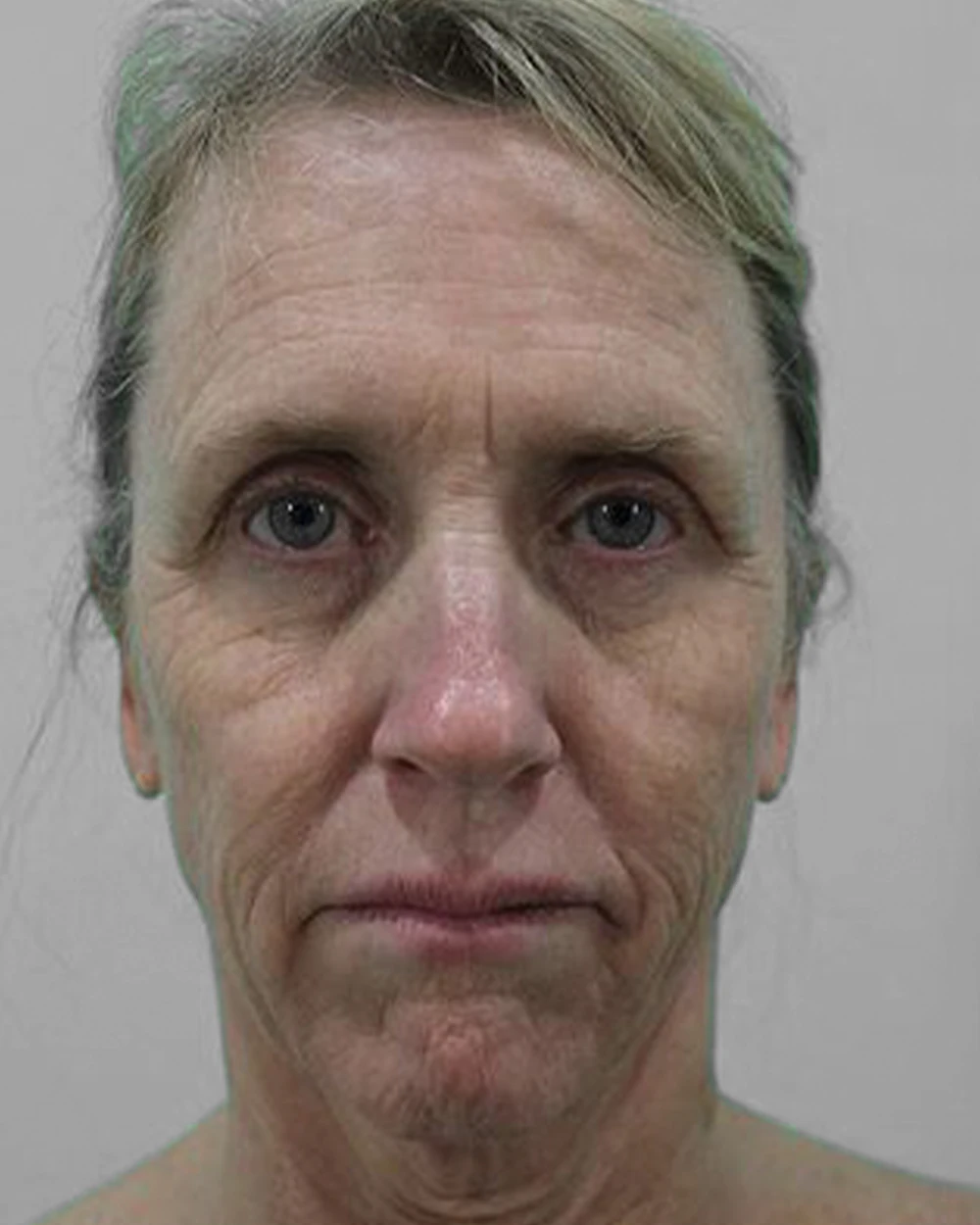
Drag to compare. A lift repositions structure, so the jawline and neck change. Skin quality, tone, and fine surface lines are a separate conversation. A real result, photographed with consent. Individual results vary.
Does a facelift get rid of wrinkles and sun damage?
No, a facelift does not treat wrinkles or sun damage, because those live in the surface of the skin and a lift works beneath it. Repositioning the deep structure relieves the folds that sagging creates, but it does not change the quality of the skin itself. Fine etched lines, crepe texture, and the pigment left by years of sun are all still there after a lift, resting on repositioned structure. They belong to skin care and resurfacing treatments, which work on the surface layer a facelift deliberately leaves undisturbed. A surgeon who tells you a facelift will give you new skin is describing an operation that does not exist.
Does a facelift fix under-eye bags or hooded eyelids?
No, a facelift does not fix under-eye bags or hooded lids, because the eyes are their own territory and a facelift does not enter it. Puffiness and bags below the eyes and heavy or hooded upper lids are addressed by eyelid surgery, which works on the lids directly. When the heaviness actually comes from above, from a brow that has descended and now crowds the upper lid, the owner is a brow lift, not the eyelid at all. Sorting out which is which is part of reading a face, and it is one of the first things I look for in photographs. Dark circles deserve their own honesty: they often come from pigment and thin skin, and no lifting operation removes them. When it makes sense, eyelid or brow surgery can be planned alongside a facelift, but that is a decision made face by face, never a package.
Will a facelift erase nasolabial folds and marionette lines?
A facelift softens nasolabial folds and marionette lines, but it does not erase them. These folds have two parents. One is the cheek tissue that has descended and now presses into the crease, and that weight is exactly what a deep plane lift repositions, which is why the folds commonly soften after surgery; improving the nasolabial fold was in fact the specific problem the deep plane release was built to solve when Hamra described it in 1990. The other parent is the crease itself, a natural feature of the face that is present when a face in its twenties smiles. Erasing it entirely is not a surgical goal, because a face with no nasolabial fold at all does not look young. It looks altered. I aim for softer, not gone, and individual results vary.
Can a facelift lift the corners of my mouth or change my lips?
A facelift does not change the lips, and the corners of the mouth respond only indirectly. When descended tissue gathers in the marionette area, its weight can pull the expression downward, and relieving that weight may let the corner of the mouth rest more neutrally. That is an indirect effect, and I will not promise it as a result. The lips themselves, their shape, their fullness, and the vertical lines that form around them, sit entirely outside the operation. If the mouth is the feature that bothers you most, say so early, because the honest answer may be that a facelift is not the operation you are looking for.
Does a facelift restore lost volume?
No, a facelift does not restore lost volume, because it repositions what has descended rather than adding back what has deflated. Faces age in two distinct ways: things fall, and things deflate. The lift answers falling. The deflation is a separate problem: when Rohrich and Pessa mapped the face’s independent fat compartments in 2007, they showed the tissue does not thin as one confluent mass, and hollowed temples, a flattened cheek, and deflation around the eyes and mouth are not corrected by repositioning, because there is nothing in those areas left to reposition. Volume is its own conversation with its own tools, and whether your face actually needs it is a question I answer by studying your photographs, not by default. Some faces need repositioning alone. Others need volume considered separately. A plan that starts with the diagnosis rather than the operation is the only kind worth having.

Which procedure owns each problem a facelift does not fix?
Every territory a facelift leaves alone has an owner, and naming that owner is how a plan stays honest. Here is the map in one place:
- A descended jawline, jowls, and deep structure that has slid: the deep plane facelift.
- A loose or banded neck and a soft angle under the chin: the neck lift.
- Under-eye bags, puffiness, and hooded upper lids: eyelid surgery.
- A heavy or descended brow crowding the eyes: the brow lift.
- Wrinkles, sun damage, texture, and pigment: skin care and resurfacing, not surgery of any kind.
- Lost volume: a separate assessment, made only if your face actually shows deflation.
What a good result looks like when these boundaries are respected is its own subject, and the facelift results page shows how I think about it. The short version: the operation done well makes you look like yourself, rested, with your own face returned to its position. It does not hand you new skin, new eyes, or a new shape, and after more than 3,000 facelifts I consider saying so plainly to be part of the work. If you want to know which of these territories your own face involves, that is what the consultation is for: photographs from every angle and my direct read on what belongs to the lift and what does not, before anything is planned. Individual results vary.