
The question usually arrives at the end of a first phone call, quieter than the ones before it: what if I have to come alone? A husband who cannot take the week off, grown children with lives in another state, or simply a preference for keeping this private. More than once, the person asking had already half decided against the surgery she wanted because she could not picture the trip without a hand to hold. So let me answer the question the way it deserves to be answered, hour by hour: who meets you, who watches your first night, who answers at 2am on day three, and how your family stays close from hundreds of miles away. The short answer is that no companion is required, and the plan was never built around one. It is built around staff.
Can you have a facelift in Tijuana with no companion?
Yes. No companion is required at any point in the trip, and the plan you would be stepping into was designed so that it does not need one. From the moment you land in San Diego to the drive back after your sutures come out, every hour that matters has a named person in it whose job is to be there: a driver who knows your arrival time, nurses who work the night because it is their shift, an anesthesiologist who is present for every procedure I perform, and a coordinator who holds the whole week together. A companion is welcome, and later in this article I will be honest about what one actually adds. But the medical safety of your week does not rest on whether the seat beside you is occupied.
I also want to name the image that stops most solo patients, because I have heard it described so many times: being wheeled out of an operating room in a foreign city and dropped at a hotel, alone, with a phone number and a bag of gauze. Whatever clinic that image came from, it is not how I work. You are not in a hotel at all. The operating room, the first monitored night, the recovery suites, the laboratory, and the follow-up visits all happen inside one accredited building, and you do not leave it until you are ready to head home.
Is it safe to travel alone to Mexico for plastic surgery?
A companion is comfort. They are not a safety system, and treating them as one misunderstands where the risk actually lives. Over my 37 years and more than 3,000 facelifts, I have learned that the things that keep a patient safe are settled long before anyone packs a bag: whether the surgeon is genuinely credentialed, whether the facility is licensed and accredited, whether a board certified anesthesiologist is in the room, and whether trained staff are watching the first nights. The American Society of Plastic Surgeons frames the danger of going abroad the same way I do: in its briefing on cosmetic surgery tourism, the hard part is verifying a surgeon’s training and confirming an accredited facility, and it warns that many vacation-style packages leave a patient with little follow-up once home. When U.S. surgeons have catalogued the cosmetic tourism complications they end up treating, the recurring lesson is that the gap is usually in continuity of care after the trip, not the operation itself, which is exactly the gap this practice is built to close. An unverified surgeon is not made safe by your sister in the waiting room. A verified surgeon, operating in an accredited facility with nursing around the clock, is not made unsafe by her absence.
So do the verification first and the companion question second. The full safety argument, including how cases go wrong when nobody checks, lives on whether a facelift in Mexico is safe, and the step by step lookup of any surgeon’s public records, mine included, is in how to verify a plastic surgeon in Mexico. If those checks do not come back clean, no companion fixes it. If they do, the question stops being whether Mexico is safe alone and becomes the practical one this article exists to answer: who, exactly, takes care of you.
Who meets you, and who moves you door to door?
You are met on the United States side of the border, and you are driven the entire way; patients who come alone ride the same free private practice transportation as everyone else. There are four pickup points: the San Diego International Airport, the Santa Fe Depot Amtrak station downtown, Border Station Parking in San Ysidro, and Farmacia Roma in Tijuana for anyone already across. The service runs Monday through Saturday, with no Sunday service, which is why I want you to raise your flight options with your coordinator before you buy any ticket. If you would rather drive your own car, that works too, and the practice issues a pass for the border’s dedicated medical lane on the way home.
Notice what is absent from that paragraph: there is no taxi line, no rideshare app in a country you do not know, no negotiating with luggage in one hand and nerves in the other. From the arrivals curb to the front door of VIDA Wellness & Beauty, someone from the practice is driving. The whole journey, with the border documents, the route, and every step from consultation to crossing home, is laid out on the trip for US patients. This article assumes you have read it, or will, and stays with the narrower question of the empty seat.
Who watches you the first night after surgery?
Your first night after surgery is a monitored hospital night inside VIDA Wellness & Beauty, the same accredited facility where I operate, and it is covered by the surgical quote rather than sold separately. You are not transferred anywhere. You wake up in the building where the operation happened, with nursing on duty and the team that just took care of you nearby. The night before surgery is spent there as well, which is when the pre-operative labs and EKG are done and evaluated before I operate.
The building matters here, so let me say it plainly once: VIDA Wellness & Beauty was the first facility in Mexico accredited by Quad A, formerly AAAASF, and it is licensed by COFEPRIS, Mexico’s federal health authority. My anesthesiologist, Dra. Nadiezhda Garcia Bonilla, board certified through the CNCA and CONACEM, is present for every procedure I perform. For a patient with no companion, that first night is the one that carries the most imagined dread, and my honest answer to the dread is architectural: you sleep where the team is. What that facility looks like, room by room, is on the facility and anesthesia page.
Who is there at 2am in the days that follow?
Nurses are, awake and on your floor: after the hospital night you move, within the same building, into the Recovery Boutique, where nursing is available 24 hours a day with scheduled checks and the surgical team in the building. The rooms have hospital-type adjustable beds, which matter more than they sound because you will sleep with your head elevated in the early days, and meals are chef prepared and brought to you, so a patient with no companion is not foraging for food with a bandaged face. The rhythm of the stay is roughly six nights in Tijuana: one before surgery and one after in the hospital, covered by the surgical quote, then about four in the Recovery Boutique. Drains typically come out at 48 to 72 hours and sutures around day seven, just before the crossing home. Individual recovery varies.
At 2am, what this looks like is unglamorous in exactly the way you want. If something feels wrong, or simply feels uncertain, you are not lying in the dark performing triage on yourself with a printout. You call, and a nurse who already knows your case comes, looks, and decides whether the night needs anything more than reassurance. The single most valuable thing the Recovery Boutique gives a solo patient is not the bed or the meals. It is that the question is this normal is never yours to answer alone. What each of those days feels like from the inside, swelling, tightness, the emotional dip around day three or four, is walked through in deep plane recovery week by week.
- Night 1In the Recovery Boutique. Not a hotel room alone. Nursing is on hand around the clock through the night that matters most.
- 48 to 72hDrains out. The first checkpoint passes with someone watching, not with you guessing.
- Day 7Sutures out. By now the part people fear is behind you.
- HomeYou fly back. Follow-up continues remotely by phone, text, iMessage, and email. Individual recovery varies.
What are the nurses actually watching for while you sleep?
Mostly the ordinary work of early recovery, and one uncommon thing above all: bleeding under the skin, a hematoma, the complication where minutes of trained recognition matter most. Across the published literature, and in the largest reviews of facelift complications, a hematoma remains the single most common one, which is the honest medical reason I keep early recovery inside the building instead of scattering it across a city. A companion in a hotel room, however much they love you, cannot reliably tell one sided tightening pain from ordinary post-operative soreness. A nurse can, and when a nurse is unsure, the team is in the building rather than across town. I teach every patient the warning signs before they leave, and I have written them out, along with what actually happens if one appears, in the warning signs every facelift patient should know.
The rest of the watching is quieter: drains emptied and measured at the right hours, medication given on schedule rather than whenever you remember it, and the slow accumulation of small observations that tells an experienced team a recovery is proceeding normally. Most nights pass without a story to tell. The point of the arrangement is that someone qualified is present for the night that has one, whether or not anyone traveled with you. The longer arc, from these first nights through the months of settling, is on the facelift recovery page.
How do you stay in touch with family back home?
The Recovery Boutique has WiFi and free international calls to the United States and Canada, plus free unlimited local calls, so being out of the country does not mean being out of reach. Your family can see your face on a video call the day after surgery, swollen and bruised and unmistakably fine, which does more for a worried spouse than any secondhand report. And the geography is kinder than the word international suggests: Tijuana keeps the same clock as San Diego, so nobody is doing time zone arithmetic at midnight.
For surgery day itself, do not leave the update plan to assumption. Decide with your coordinator, before the operation, who gets contacted when I finish and on which channel: phone, SMS, iMessage, or email, which are the channels the practice uses. Your family can also reach the coordination team directly at +1 (619) 738-2144 at any point in the week. I have found that the families of solo patients worry less than the patients expect, provided one thing: the plan for who hears what, and when, was made explicit before anyone said goodbye at an airport.
What if you change your mind and want a companion after all?
Bring them; the itinerary simply gains a passenger. The practice transportation seats one companion on every leg, and the Recovery Boutique accommodates a companion in your room, priced plainly by the night on the facility page rather than folded invisibly into anything. Nothing about the plan has to be rebuilt, so this is a decision you can change late.
Let me be equally honest about what a companion is for, because it clarifies the whole question. A companion is morale: a familiar voice on day three or four when the swelling peaks and the mood dips, someone to watch television with while your face does its slow work. What a companion is not, in my practice, is your monitoring system. The nights are watched by nursing whether or not someone you love is asleep in the chair beside you. Patients who understand that division stop treating the companion as a requirement and start treating them as what they are: a comfort, worth having if the right person is available, and safely skipped if not.
What should a solo patient confirm in writing before booking?
All of the following, and in writing, because a plan you can reread at midnight is worth ten reassurances on the phone. I would ask any practice, mine included, for these before paying anything:
- The pickup. Which of the four points you will use, the scheduled time, and whom to contact if your flight is delayed. Confirm your arrival day is not a Sunday, because the transportation runs Monday through Saturday.
- The surgery day update. Who from the team contacts your person at home when surgery ends, and on which channel. Agree on it explicitly rather than assuming a default exists.
- The nights, one by one. Which nights are hospital nights covered by the surgical quote, which are Recovery Boutique nights arranged separately, and what the schedule of overnight nursing checks looks like.
- The 2am number. Whom you call from your room if something feels wrong, and whom your family calls from home if they cannot reach you.
- The privacy rules. Some patients tell no one at home. Tell the practice exactly who may be given any information about you, and who may not, and have that noted.
- The way home. The expected suture removal day, whether you return by the practice shuttle or your own car through the medical lane, and how follow-up continues after you cross: on what channel, and how quickly messages are answered.
- The what-ifs. How the itinerary bends if drains stay in longer or you want an extra night before traveling. Recovery has a typical shape, drains out at 48 to 72 hours and sutures out around day seven, but individual recovery varies, and a good plan flexes without drama.
A practice that puts these in writing without friction has told you something important about itself. A practice that hesitates has told you something too.
What about traveling alone as a woman?
Read the itinerary again and notice what is missing from it: there is no taxi rank, no unfamiliar street after dark, no hotel corridor, and no hour in which you are navigating Tijuana by yourself. When women raise this question with me, it is almost never about the operating room. It is about the spaces between: how do I get from the airport to the clinic, who is around me at night, what happens if I need help and am in no condition to advocate for myself. This plan closes those spaces by design rather than by reassurance. You are met on the United States side by the practice’s own transportation and driven to the door. Surgery, the laboratory, your bed, your meals, and your follow-up visits are all inside VIDA Wellness & Beauty, one accredited building, and the nights there are staffed by nursing that is awake. When it is over, you are driven back the way you came.
And do not extend trust on my say so. Run the public checks on my credentials, read what patients say, look at who I am and where I trained, and then, at the consultation, ask the coordinator every blunt question you have, including the ones that feel awkward: who will be in the room during surgery, who staffs the overnight shifts, how the practice handles a patient whose family does not know she is here. A solo woman planning this trip is not being paranoid. She is doing exactly what I would tell my own daughters to do, and a serious practice will answer her in writing without being offended.
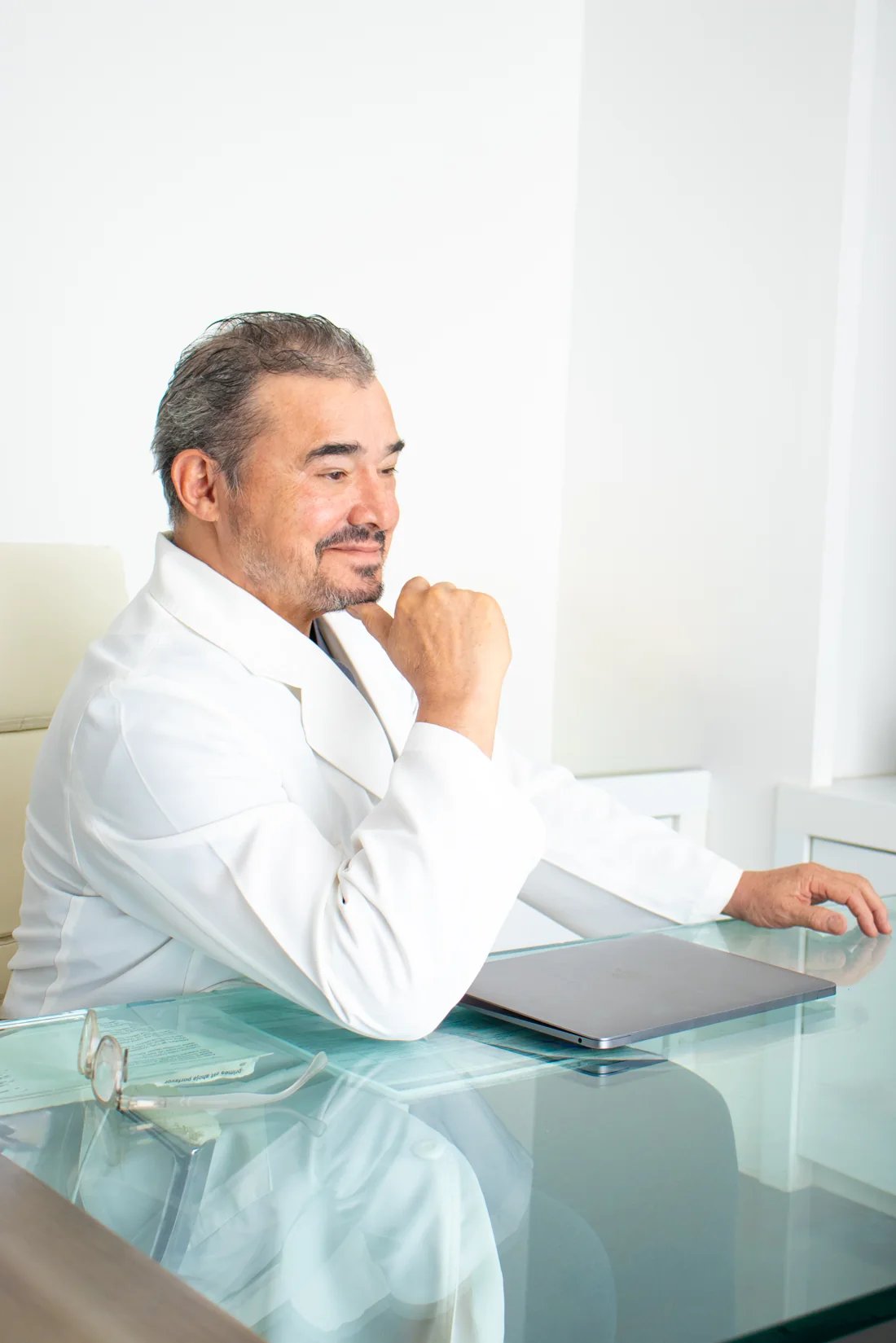
How do you start, if you are planning to come alone?
Start where every patient starts, alone or accompanied: a virtual consultation from home, photographs first, before any money and before any travel. I study your photographs and tell you honestly what I see, whether that is a plan for surgery or a reason to wait, and whether the operation you are imagining is the right one at all, a question that belongs to the deep plane facelift page. If we go forward, the quote is itemized so nothing is discovered later, and one coordinator builds the week around your dates, your pickup point, and written answers to the list above. Every channel is one you already use: phone, SMS, iMessage, or email, at +1 (619) 738-2144.
After 37 years of doing this, here is the distinction I offer every patient who asks the question this article began with. You may well be traveling alone. You will not be recovering alone, because the eyes that watch a recovery here were never the companion’s eyes in the first place. Those are two different things, and the difference is the entire design.