
Three names get used for nearly the same region of the face, and they confuse more patients than almost anything else I discuss in consultation: the SMAS lift, the deep plane, and the newer one you may not have heard yet, the preservation facelift. These are not three brands of the same operation. They are three different answers to one anatomical question, which is what a surgeon does with the layer beneath your skin and the anchors that hold it to your skull. I want to teach you what each one actually does at the level of tissue, because once you can see that, the marketing falls away and you can tell what you are being sold. I will lead with preservation, since nothing else on this site has covered it, and then set all three side by side.

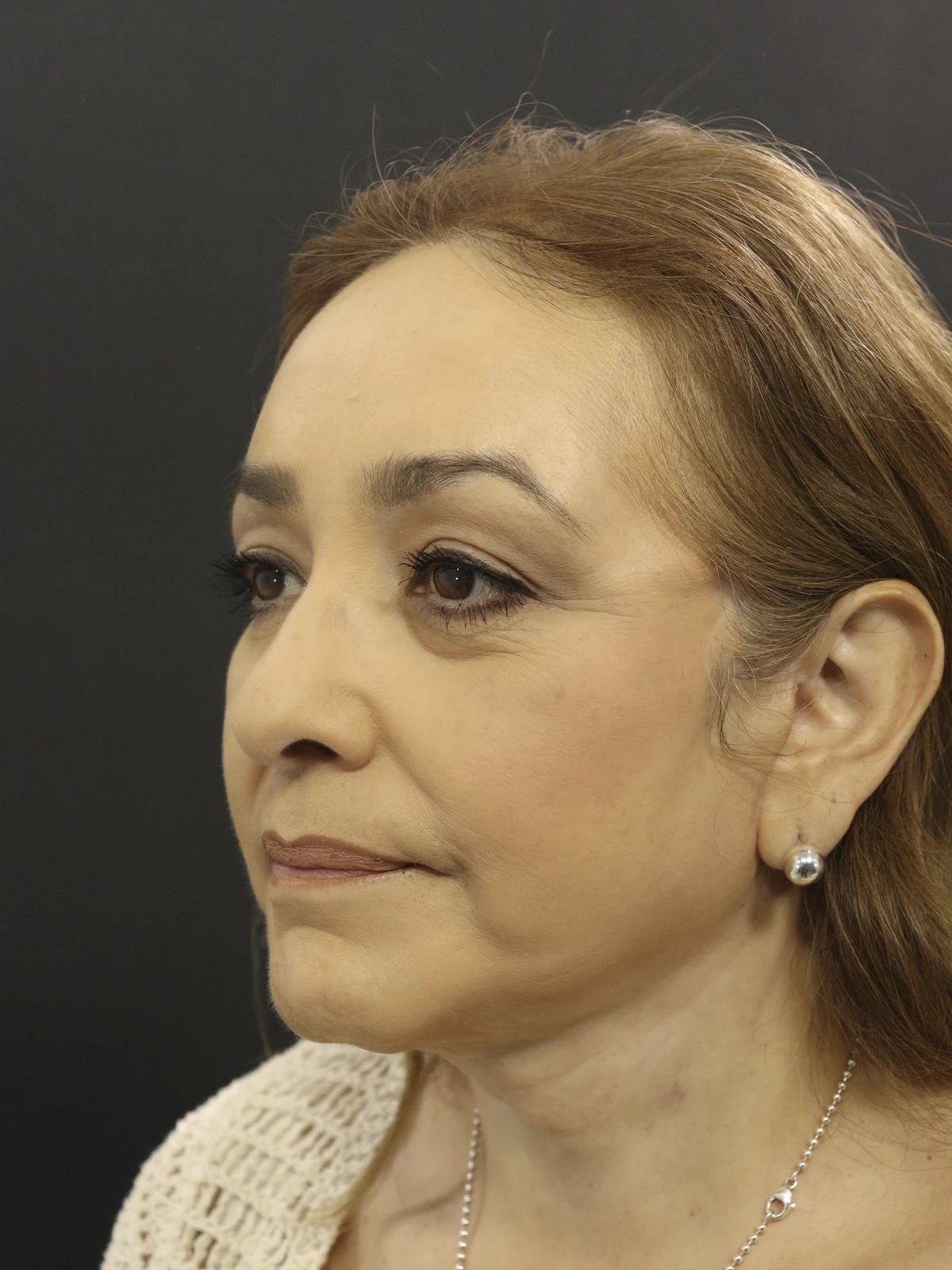 BeforeAfter
Drag to compare. This is what repositioning the deep structure achieves when the anatomy calls for it. A real result, photographed with consent. Individual results vary.
What is a preservation facelift?
A preservation facelift repositions the face while sparing the retaining ligaments and the SMAS attachments rather than cutting them, and it lifts mainly by suspending tissue upward instead of releasing it wide. The name is doing exactly what it says. Where an older operation would divide the anchors that hold your soft tissue to the bone and lift the freed layer into a new position, a preservation approach tries to keep those anchors intact and move the face by pulling it up and resuspending it, with as little cutting of the deep structures as the anatomy allows. This is also the source of a phrase you may see, no SMAS excision: no strip of the sheet is cut out and thrown away.
Two definitions make the rest of this page readable. The SMAS, short for the superficial musculoaponeurotic system, is a continuous sheet of muscle and thin fibrous tissue that sits beneath your skin and fat and connects to the muscles that move your face; it was named by Mitz and Peyronie in 1976, and it is the layer every modern facelift is organized around. The retaining ligaments are short, strong fibers that run from the facial bones up toward the skin and tether the soft tissue at fixed points, the way tent lines hold a tent. Almost everything that separates these three operations comes down to what each one does with those two structures. If you want the anatomy on its own, I wrote a plain-language primer on the SMAS.
The preservation idea did not appear from nowhere, and it is worth naming its lineage honestly rather than treating it as a single branded product. It grew out of short-scar, vertical-vector methods such as the minimal access cranial suspension, or MACS, lift described by Tonnard and Verpaele in the Aesthetic Surgery Journal in 2007, which lifted the lower and middle face with a pure vertical pull and no lateral tension. A few years later Funk described the PRESTO lift, in 2016, which set out explicitly to preserve the retaining ligaments and what he called the SMAS tethering, naming those ligaments the guardians of facial identity. When you hear preservation today, that is the family of thinking behind it: move the face, but keep its scaffolding. It is a real philosophy, not my personal trademark, and different surgeons execute it differently.
The three techniques, read at the level of tissue
Picture your cheek as a short stack, from the outside in: skin, then a layer of fat, then the SMAS sheet, then the retaining ligaments tying that sheet down to the bone. Every facelift ever designed is a decision about which of those layers to touch and how. Read that way, the three operations stop sounding like competing brands and start sounding like what they are, three depths of the same stack.
A SMAS lift works on the sheet from above. I lift the skin, then tighten the SMAS itself, by folding it over on itself, stitching it, or removing a strip and closing the gap, and redrape the skin over the firmer foundation. It is a real structural operation, older and well proven, and the full head-to-head between it and the deep plane belongs to a page of its own, which I will point you to in a moment.
A deep plane facelift works beneath the sheet. Instead of tightening the SMAS from above, I develop the plane under it, release the retaining ligaments that hold it down, and move skin and SMAS together as one connected unit into a new position, so the skin itself carries no tension. This is the operation Hamra described in 1990, and its logic is the whole reason deep plane results are described as natural and long lasting: a face moved at the structural level still behaves like a face.
A preservation lift keeps the anchors. It works in the same territory but tries not to divide the ligaments or the SMAS tethering; it suspends the composite upward, along a more vertical vector, and relies on that suspension rather than on wide release to hold the new shape. Less is cut, so in principle less has to heal.
One boundary I will hold to on this page: I am not going to re-argue the deep plane against the SMAS lift here, because that two-way comparison has its own home. If that is the decision in front of you, read deep plane versus SMAS, where I take it apart citation by citation. This page exists to add the third option and to orient all three.
How does a preservation lift differ from a deep plane and a SMAS lift?
The dividing line is a single verb: release or preserve. A deep plane and a preservation lift are close cousins, because both care about the deep structure rather than skin alone, but they part ways at the ligaments. The deep plane divides them on purpose, to buy full mobility of the layer. The preservation approach leaves them, accepting less mobility in exchange for less dissection, less potential disturbance of the blood supply, and a face whose native attachments are largely undisturbed.
Against a classic SMAS lift, the difference is more about vector and tethering than about depth. Many older SMAS operations pulled the tissue up and back, toward the ear, which is part of why an overtightened lateral result can look wind-swept. The preservation methods that grew out of the MACS lineage deliberately pull more vertically, straight up, which tends to read as a face restored to where it sat a decade ago rather than a face pulled sideways. The vector, the direction of the lift, is one of the most underappreciated words in this whole conversation, and it is worth asking any surgeon about directly.
Which technique lasts longer, and for whom
Durability tends to follow how much structure a lift actually repositions: in published ranges, deep plane results are commonly described as holding about ten to twelve years and surface or SMAS lifts about five to ten, while a preservation lift, gentler by design, is generally less powerful when laxity is heavy. Those year ranges are orientation, not a contract, and I want to be exact about why.
The more of the deep structure you release and move, the more corrective work the lift does and the longer it tends to hold, because you have repositioned the scaffolding rather than borrowed tension from the skin. That is the deep plane’s advantage in a heavier face. A preservation lift, by keeping the anchors and relying on suspension, does less structural moving; in a lighter face with good skin that can be plenty and can heal beautifully, but in a heavy neck or a deeply descended midface it can leave correction on the table or relax sooner. A recent review in the Journal of Personalized Medicine, in 2025, framed the tradeoff cleanly: ligament-releasing techniques such as the deep plane allow greater tissue mobilization, while ligament-preserving techniques such as MACS and PRESTO are safer and less invasive but give more limited correction in severe laxity.
Broadly, the more structure a lift repositions, the longer it tends to hold: surface and SMAS lifts about five to ten years, the deep plane about ten to twelve, with preservation sitting between, gentler on purpose. These are published ranges, not promises. Individual results vary.
I will not hand you a number for your own face, and I would be suspicious of anyone who does before examining you. Head-to-head studies that follow the same patients on the same measuring stick are still few, the outcome scales rarely line up between papers, and healing runs on each person’s own clock. Individual results vary.
Is newer better, or just newer?
A patient came to my consultation not long ago with a printout of a preservation deep plane, certain it was a full generation ahead of everything else and slightly worried I would talk her out of it. I did not, because there was nothing to talk her out of. Much of the time, preservation deep plane is a marketing phrase for a deep plane facelift in which the surgeon spares certain blood vessels and select ligaments, which careful deep plane surgeons have always tried to do. It is a real and sensible refinement. It is not a different species of operation, and the newness is often in the brochure more than in the tissue.
Here is the honest reading. The preservation philosophy is legitimate and useful, and for the right face it is a lovely, low-morbidity operation. It is also not universally superior, and the dates give it away: the MACS lift it descends from is from 2007 and the PRESTO from 2016, while the deep plane is from 1990 and the SMAS from 1976, and none of those older operations has become obsolete. The same 2025 review that praised preservation for safety concluded that success hinges on a tailored approach, matching the technique to the patient’s anatomy rather than to the calendar. Newer is a fact about a publication date. Better is a fact about your particular face, and only an examination settles it.
If the smaller, gentler end of this spectrum is what you are weighing, that decision has its own page: a mini lift compared with a deep plane walks through when less is genuinely enough and when it quietly is not.
What my fellowship taught me about all three
I did my fellowship with Bruce F. Connell, in Santa Ana, California, in 1983 to 1984 and again in 1986, and it shaped how I think about every one of these techniques. Let me be precise about what that lineage is and is not, because it gets blurred online. Connell was a master of the face and neck lift and one of the most important teachers of facial anatomy of his generation. He was my mentor. He did not originate the deep plane; that description belongs to Hamra, in 1990. Two different men, two different contributions, and I keep them straight out of respect for both.
What Connell drilled into me was not a single named operation to sell for the rest of my life. It was the anatomy first, always: know the plane, respect the retaining ligaments and the facial nerve beneath them, understand the vector before you make a single cut. That training is exactly what lets me stand outside the brand-name argument. I am not a deep plane surgeon or a preservation surgeon the way someone is a brand loyalist; I am a facial surgeon who chooses the depth and the vector your face needs. Over my 37 years and more than 3,000 facelifts, the faces that taught me the most were the ones where the fashionable answer was the wrong one.

How do I tell what a surgeon is actually offering?
Ask two plain questions and pay attention to how they are answered: at what plane do you dissect, and what do you release or preserve. A surgeon who works in real anatomy will answer both without hesitating, in ordinary words, because the answer is simply a description of what happens once you are asleep. An answer that retreats into a trademark, a slogan, or a promise is itself a finding, the same way a hesitation over a license number is a finding.
The reason this works is unglamorous: brand names are unregulated and anatomy is not. Two practices can sell different operations under one name, or the same operation under two names, and no authority stops them. The plane of dissection and the fate of the ligaments are not marketing; they are verifiable facts about your surgery, and they let you compare any two surgeons directly no matter what each calls the lift.
- Names the plane without hesitating: above, on, or beneath the SMAS
- Tells you plainly what will be released and what will be preserved
- Explains the vector, why your face is lifted in the direction it is
- Sells a brand name but cannot say what it does to the ligaments
- Answers an anatomical question with a slogan, a trademark, or a promise
I keep a fuller list for the consultation itself, covering credentials, the facility, the anesthesia, and the revision policy, in the questions to ask a facelift surgeon, and a companion piece on how to verify a plastic surgeon in Mexico if you are checking a surgeon on this side of the border.
The honest limits of all three
No technique on this page is free of cost, and I would rather you hear the tradeoffs from me than find them afterward. Every facelift, whichever plane it uses, carries real risk: bleeding or a collection of blood under the skin, temporary or, rarely, lasting changes in the facial nerve, scarring that heals on its own timetable, asymmetry, and a recovery no one can promise in advance. The deep plane’s deeper dissection asks for exact anatomical knowledge and an experienced hand, which is a reason to weigh the surgeon at least as heavily as the technique. A suspension-first preservation lift, done on a face that actually needed more release, can loosen earlier than hoped, because the correction was gentler than the laxity. If you want to know what a worrying early sign looks like, I wrote about the warning signs after surgery.
Who preservation is not for is the easiest part to say plainly. It is not the operation for a heavy, deeply descended face or a heavy neck; those need release, not just suspension, and a preservation lift sold into that anatomy is a disappointment waiting to happen. By the same logic, a deep plane is more than a light, early face needs, and a gentler operation may serve that patient better and heal faster.
What we still do not know is worth stating too. The studies that would let anyone rank these three cleanly, following the same patients on the same measures for a decade, mostly do not exist yet; the outcome scales differ from paper to paper, and much of what is published is a single surgeon’s series rather than a controlled comparison. So the year ranges I gave you are honest orientation and nothing more. Individual results vary.
When I study your photographs, I am not deciding which brand to defend. I am reading three things: how good your skin is, how far the deep tissue has fallen, and where your ligaments still hold. Those readings, not the newest name in the search results, tell me whether your face wants the release of a deep plane, the gentler suspension of a preservation lift, or work on the SMAS from above. If you want that read on your own face, my consultation begins remotely, from photographs, before you travel anywhere. The full deep plane facelift page describes the operation I perform most often and will tell you whether it is likely the right depth for you. Call or text +1 (619) 738-2144, by phone, SMS, iMessage, or email.