
Patients ask me for a number, and I understand the wish behind it. A number feels safe. It turns a frightening, personal decision into a rule that applies to everyone, and a rule is easier to live with than a judgment. But after 37 years and more than 3,000 facelifts, the most honest answer I can give you is that there is no best age for a deep plane facelift. Age is not the thing that decides. Your tissue decides. When I study your photographs, I am not reading the year you were born. I am reading the quality and elasticity of your skin, the descent of your midface and jawline, and the state of the deep structure beneath the surface. What follows is the long version of that answer, and it is also an honest account of something I have watched change across my career: the faces asking me this question are getting younger, and there are real reasons why. I want to give you both halves, the medicine and the culture, because you deserve to understand the current you are swimming in before you decide whether to act.
What is the best age for a deep plane facelift?
There is no single best age for a deep plane facelift, because age is only a proxy for the thing that actually matters, and it is a poor one. The thing that matters is your tissue: how much elasticity your skin still holds, how far the deep fat and soft tissue of the midface and jawline have slid down off the bone, and how loose the deep structure beneath the SMAS has become. Those things change with time, yes, but they change at wildly different rates from one person to the next. I once studied the photographs of a woman of forty-eight whose face had descended further than that of a man of sixty-five sitting in the same waiting room, because her skin was thinner, her weight had swung, and her family aged early. If I had operated by the calendar, I would have offered her nothing and offered him a lift he did not need.
When people press me for a range anyway, I give them the truth about the middle of the curve. Most patients who genuinely benefit from a deep plane facelift are somewhere in their forties, fifties, and sixties. But that describes where the tissue tends to arrive, not a rule about when you should book. Plenty of faces in their fifties are not ready, and a handful in their early forties already are. The range is a coincidence of biology, not a permission slip. If you take one idea from this piece, let it be this: I would rather tell you no, or not yet, than perform an operation your face has not asked for.
There is no single right age. Across every decade, the face in front of me, not the birthday on the chart, decides. Individual results vary.
The tissue decides, not the birthday
Let me show you what I am actually reading when you sit across from me, because it is never your birthday. First, skin quality: elasticity, thickness, sun damage, the way the skin recoils when I lift it and let it go. Thin, sun-worn, deflated skin behaves differently on the table and afterward than thick, resilient skin does, and two people the same age can sit at opposite ends of that spectrum. Second, descent: how far the malar fat and the deep soft tissue have migrated down and forward, softening the cheekbone and blunting the jawline, and how much of the jowl is fallen tissue rather than fat that never moved. Third, the deep layer: the state of the SMAS and the retaining ligaments that tether it, because a deep plane lift releases those ligaments and repositions skin and structure together as one unit, so the skin is never the thing under tension.
None of those three readings comes back to me with a birthday attached. A thirty-eight-year-old who lost eighty pounds and spent two decades in the sun can show me all three at once. A well-preserved sixty-year-old who stayed out of the sun, held a stable weight, and inherited thick skin may show me none of them strongly enough to warrant a lift. The birthday is a story about how long you have lived. The tissue is a story about what living did to your particular face. Only the second one tells me what to do.
So why does it feel like everyone is asking younger?
They are. It is not your imagination, and the professional bodies that track this have the numbers to prove it. The American Academy of Facial Plastic and Reconstructive Surgery surveys its members every year, and for some time it has reported that surgeons are seeing rising numbers of patients under thirty asking about cosmetic work, part of the early-intervention mindset the field now calls prejuvenation, slowing aging before it has fully arrived. The American Society of Plastic Surgeons, which tracks procedure volumes rather than attitudes, has separately documented a large wave of patients seeking facial and aesthetic care after dramatic weight loss on the new class of weight-loss medications, hundreds of thousands of aesthetic patients now on these drugs. Two different vantage points, the same picture: the faces asking are younger, and a new force is deflating them.
I can corroborate all of it from my own consultation room, but I want to be careful, because a trend and a tissue finding are not the same thing. More young people asking does not mean more young people should be operated on. It means the culture that produces the question has shifted, and a responsible surgeon has to understand that culture in order to protect patients from it as often as to serve it. So the rest of this piece does two things. First it takes each force pushing the age down seriously, one at a time, because each is real and deserves a fair hearing. Then it walks back into the operating room, where the tissue, not the trend, has the last word.
What is Ozempic face, and why has it changed who walks into my consultation?
Ozempic face is the hollowing, deflation, and skin laxity that can follow the rapid, large weight loss produced by the GLP-1 medications, and it is the single biggest reason the faces in my consultation room have gotten younger. The name is casual. The anatomy is not. Medications such as semaglutide and tirzepatide, sold under names the public now knows well, produce weight loss quickly and at a scale that used to require surgery to reach. The face is not spared. It carries discrete pads of deep and superficial fat that give the cheek its fullness and hold up the skin above them, mapped carefully in the plastic surgery literature by Rohrich and Pessa in their anatomical work on the fat compartments of the face. Lose a great deal of weight fast and those pads shrink, so skin that was draped over a fuller structure is suddenly draped over less.
A published systematic review of the plastic surgery literature on GLP-1 weight loss described exactly this pattern of facial volume loss and accelerated facial aging, and clinical commentary in the aesthetic dermatology literature has taken up how to manage it. The scale is what makes it new. A national survey found that roughly one in eight American adults have taken a GLP-1 medication, a level of exposure the face has never met before, and many of those people are in their thirties and forties.
They come to me having done something genuinely good for their health, delighted with their bodies and startled by their faces, which look a decade older than they did two years earlier. That is not vanity. It is a real, visible change in a real timeframe, and it has uncoupled facial aging from chronological aging in a way I had not seen before in this career. When a patient like that sits down, I am not thinking about her age at all. I am reading her tissue, which is telling a story her birthday no longer predicts. Our team coordinates many of these consultations from San Diego, and the specific question of what a face needs after major weight loss has its own detailed home on facelift after weight loss.
Fillers can only do so much once a face has truly deflated
Picture a curtain that has grown too big for its window. That is what significant deflation does, and it is why a syringe eventually stops helping. I value fillers in the right hands and at the right moment, and for a face with early, modest hollowing and skin that still fits its frame, replacing lost volume can be exactly right. I will tell you plainly when it is. But there is a threshold, and past it the logic breaks. When a face has lost a large share of its deep fat and the skin has gone slack over the shrunken structure underneath, the problem is no longer an empty compartment waiting to be refilled. Inject volume into that face and you push the slack tissue outward, widen the face, and add weight the loosened ligaments and skin now have to carry. The result reads as puffy and heavy rather than young, and it does nothing for the descent along the jawline.
This is where patients get trapped, and I see the trap often. They chase the deflation with round after round of filler, because each one helps a little at first, and they end up with a face that is both overfilled and still sagging, having spent a great deal of money moving further from what they wanted. For a truly deflated, lax face the honest answer is usually repositioning, not more volume: releasing the deep structure and lifting it back onto the bone where it belongs, which is what a deep plane lift does and a needle cannot. Knowing which of those two faces is yours, the one that needs volume or the one that needs repositioning, is most of what a careful consultation is for. Individual results vary, and what a facelift can and cannot solve deserves its own honest treatment, which I give it in what a facelift does not fix.
How does GLP-1 weight loss change the age conversation?
It changes the conversation by producing, at a younger age, the exact tissue findings that used to arrive slowly with the years, so the birthday and the tissue now disagree far more often than they once did. For most of my career, when a face showed real laxity and midface descent, it had usually accumulated over decades, which meant age was at least a rough shorthand for readiness. GLP-1 medications broke that shorthand. A patient can now present the skin laxity and volume loss of a much older face while still in her thirties, because the change came from rapid weight loss and not from time. If I clung to age as my guide, I would tell her she is far too young for a facelift and send her back out to keep chasing the deflation with filler. Reading the tissue instead, I might find that a face and neck lift is genuinely the sound answer, because the structure has descended and the skin no longer fits it, whatever her age.
The reverse holds just as firmly, and I hold to it. A young patient who lost weight but whose skin snapped back well, whose descent is minimal, and whose deflation is modest is not a candidate simply because she is unhappy with a softer face. For her the right answer may be time, volume, and attention to skin quality, not an operation. GLP-1 has made both judgments more common: more genuinely young candidates than I used to meet, and more young people who feel like candidates but are not. The medication has not changed my method at all. It has only made the method more necessary, because the one thing that used to help me guess, the birthday, no longer points where the tissue is.
The always-on camera introduces you to a face that was always there
For nearly all of human history you saw your own face for a few seconds a day, in a bathroom mirror, held still, lit softly, viewed from the one angle you had learned to accept. You almost never watched yourself talk, react, frown, or listen. Then the camera moved into the center of ordinary life. Video calls put a live feed of your own face in the corner of the screen for hours at a stretch. Front-facing phones became a mirror you carry everywhere and photograph yourself with dozens of times a day. So people now study their own faces more than any generation before them, and study finds things: a jowl you never noticed, a fold that deepens when you speak, a softness under the chin that only shows at the angle the laptop sits. None of it is new to your face. It is only new to your attention.
That distinction matters enormously for the age question, because attention, not aging, is often what brings a younger person to my door. The dermatology and facial surgery literature has taken this seriously enough to give it names, and I take it seriously too, because I meet these patients constantly. Someone in their late thirties will tell me their face fell apart in the last two years, and when I study older photographs the face has barely changed. What changed is that they began seeing it all day long, from below, in motion, under office lighting. The camera did not age them. It introduced them to a face that was always there, the one that most people, in kinder times, never had to meet. Part of my work now is telling the difference between a face that has genuinely descended and a face that has merely been over-examined, because only the first one belongs in an operating room.
What is Zoom dysmorphia, and do I see it in my consultations?
Zoom dysmorphia is a term coined by dermatologists for the distorted, more critical self-image people developed from watching themselves on video calls, and yes, I see its fingerprints in my consultation room regularly. It was described by Rice, Graber, and Kourosh in a commentary in Facial Plastic Surgery and Aesthetic Medicine, built around the idea of zooming into the perception of our own appearance. Their argument, which matches what I observe, is that a video call combines two harmful things at once. You are forced to look at your own face for the entire length of a conversation, which never happens in ordinary life. And the image you are looking at is distorted, because laptop and phone cameras sit close and use short focal lengths that warp proportion and shadow the face unflatteringly. Month after month, people absorbed a self-image that was both over-scrutinized and technically wrong, and many came away convinced their faces held problems that were partly an artifact of the lens.
In my room this arrives as a particular kind of patient: articulate, faintly apologetic, pointing to features they have watched on screen and slowly grown to hate. My responsibility is to slow that down. I look at the actual face across the table, in good light and from a proper distance, not the one that haunted them in the corner of a screen, and often the two are meaningfully different. Sometimes there is a real finding underneath the distortion, and we talk about it honestly. Sometimes the finding lives mostly in the webcam, and the kindest, most professional thing I can do is say so and decline to operate. A surgeon who treats the screen instead of the face will happily operate on a distortion. I will not, and you should be wary of anyone who would.
The selfie effect is optics, not opinion
This one is not a matter of lighting or mood. It is geometry, and it has been measured. Ward, Ward, Fried, and Paskhover published a study in JAMA Facial Plastic Surgery modeling how a photograph taken at the short distance of a selfie enlarges whatever sits closest to the lens. At roughly twelve inches, the distance at which people actually take selfies, they calculated that the nasal base appears about thirty percent wider, and the tip about seven percent wider, than the same nose photographed at a normal portrait distance of about five feet. Same nose. Only the distance changed. The face you photograph at arm’s length is not the face other people see when they look at you; it is a lens-warped version of it, with whatever is nearest the camera exaggerated.
Why does that feed the younger-patient trend? Because a whole generation built its self-image out of exactly these images and then carried the complaints those images generated into consultation rooms. Someone convinced their nose or their midface is wrong after years of selfies is reacting to a distortion, not a deformity. When I assess a face, I do it in person and in standardized photographs taken at a proper distance, precisely because I refuse to plan surgery around a picture that is lying. I would far rather show a patient what their face genuinely looks like undistorted, and watch some of the urgency drain out of the room, than nod along with a photograph that was never telling the truth. Good surgery starts from an accurate picture of the problem. Half of what walks in from the camera age is an inaccurate one.
What is Snapchat dysmorphia, and why does it worry me more than it flatters me?
Snapchat dysmorphia is the phenomenon, named in the medical literature, of patients seeking surgery to look like the filtered, digitally smoothed and reshaped version of themselves, and it worries me because it asks surgery to chase an image that was never a real face. The term entered the literature through Rajanala, Maymone, and Vashi, in an article in JAMA Facial Plastic Surgery about living in the era of filtered photographs. Their concern, which I share, is that filters and editing apps now let anyone smooth their skin, enlarge their eyes, slim their nose, and sharpen their jaw in a fraction of a second, and that these edited images have become so ordinary that people began measuring their real faces against them. When the standard of comparison is a face that does not obey anatomy, the real face will always fall short, and some people carry that shortfall to a surgeon and ask to close it.
Here is the line I will not cross with a young patient. A filter is not a surgical plan; it is a fantasy rendered in software, and it frequently reshapes a face in ways no operation can safely or naturally reproduce. When someone shows me a filtered photograph of themselves as the goal, I treat it as important information, though not the kind they were hoping for. It tells me to slow down and to ask whether what troubles them is really their face or their relationship to the image of it, because the literature is clear that operating into that mindset tends to disappoint rather than satisfy. Individual results vary, but a face is a face and a filter is a wish, and my job is to work honestly with the first and gently decline the second. Sometimes the most protective thing a surgeon can tell a young patient is that the version of themselves they are chasing does not exist and never did.
Public figures moved this from secrecy to a maintenance ritual
For most of my career, cosmetic surgery lived under a code of silence. People had work done and let the world credit clean living and good genes, and that secrecy carried a message: this is something to be ashamed of, something you do late and quietly, once decline is undeniable. That code has largely collapsed. Public figures now discuss their tweaks, their preventive routines, and sometimes their surgery with a candor that would have been unthinkable a generation ago. Whatever you make of it, the effect on ordinary people is real. Once intervention is visible and talked about rather than hidden and denied, it stops feeling like a last resort and starts feeling like an item on a menu, available earlier and without the old stigma.
The word the field uses for the early end of that menu is prejuvenation, the idea of stepping in before significant aging to slow its arrival. As an attitude I do not dismiss it. Caring for your skin, your sun exposure, your weight, and your health early is genuinely wise, and much of prejuvenation is exactly that. My caution is narrower and specific to my operation. The cultural permission to start early suits skincare and conservative, reversible steps beautifully. It does not automatically extend to a deep plane facelift, which is major structural surgery, not a maintenance ritual. Normalization is a good thing when it removes shame and lets people ask questions without embarrassment. It becomes a problem only when it quietly implies that because intervention is normal and early, surgery too should be early. The culture can move the conversation earlier. Only the tissue can move the operation earlier, and those are not the same thing.
The mindset has shifted from correcting age to preventing it
The broader culture around aging has moved from acceptance and correction toward prevention and optimization, part of a larger longevity mindset, and that shift pulls the whole timeline of intervention forward. People increasingly treat their bodies as projects to be maintained and improved across decades rather than left alone until something breaks. They track their sleep, their bloodwork, their fitness, and their skin, and they think in terms of slowing decline rather than accepting it. Aging itself has been recast by a great deal of cultural energy as something to be managed and postponed rather than simply endured with grace. Inside that frame, waiting until your face has clearly fallen before doing anything starts to feel less like patience and more like neglect, like failing to maintain an asset.
I have real sympathy for this, and I want to be fair to it, because much of it produces sound behavior: sun protection, a stable weight, not smoking, genuine care for skin quality, all of which slow facial aging and all of which I encourage. Where I put my foot on the brake is at the boundary between prevention and surgery. Preventing aging and operating on a face are different categories of action, and the longevity mindset sometimes blurs them, treating a facelift as one more optimization to schedule in advance rather than a structural repair to perform when structure has actually failed. A deep plane lift is not a preventive treatment. It is a corrective one, appropriate when the deep structure has descended enough to need repositioning. The mindset that pulls skincare earlier is healthy. The same mindset, aimed uncritically at major surgery, is how a person ends up operated on years before their tissue ever called for it.
Does workplace ageism really push people toward the operating room earlier?
A patient will sit down and, somewhere past the small talk, tell me quietly that they are worried about their job. Not their health, their job. I would be dishonest to pretend that pressure is purely internal, because it is not, and the fear is not baseless. Age discrimination in employment is well documented. In a large AARP survey of workers over the age of forty-five, about sixty-one percent, three in five, reported having seen or experienced age discrimination on the job, and many believe it is common. People absorb that reality. In industries that prize a youthful image, in careers lived partly on camera, and in job markets where a face is part of a first impression, patients tell me plainly that they fear an aging appearance will be read as declining capability. When a live video feed of your face sits beside younger colleagues in every meeting, that fear has a screen to feed on daily. So the wish to intervene earlier is not always vanity or distortion. Sometimes it is a rational response to a real bias in the world.
I hold two things at once when a patient brings me this. I take the pressure seriously, because it is real and it is not their fault, and I do not lecture them for feeling it. But I also refuse to let an outside pressure override an internal, anatomical reality. Workplace anxiety is a reason a person wants to look refreshed. It is not, by itself, evidence that their tissue needs surgery. If the face has genuinely descended and a lift would honestly serve them, their career concern is a perfectly legitimate part of the decision. If the face has not descended, no amount of workplace pressure changes what my operation can appropriately do, and cutting into a face to soothe an economic fear rather than to correct a structural finding would be a failure of my judgment, not a service to the patient. I can hear the fear with full sympathy and still answer it from the tissue.
Three tissue findings decide candidacy, and none is your age
Three tissue findings decide whether you are a candidate for a deep plane facelift, and none of them is your age. When you sit across from me, I am reading:
- Skin quality: its thickness, elasticity, sun damage, and how it recoils when I lift it and release it, because skin that has kept its elasticity redrapes beautifully over repositioned structure while thin, heavily deflated skin behaves less predictably.
- Descent: how far the deep fat and soft tissue of the cheek have slid down and forward, softening the cheekbone and building the jowl, and how much of the heaviness along the jawline is truly fallen tissue that repositioning would restore.
- The deep layer: the state of the SMAS and the retaining ligaments that anchor it, because the deep plane operation works by releasing those ligaments and moving skin and structure together as a single unit, so the skin carries no tension.
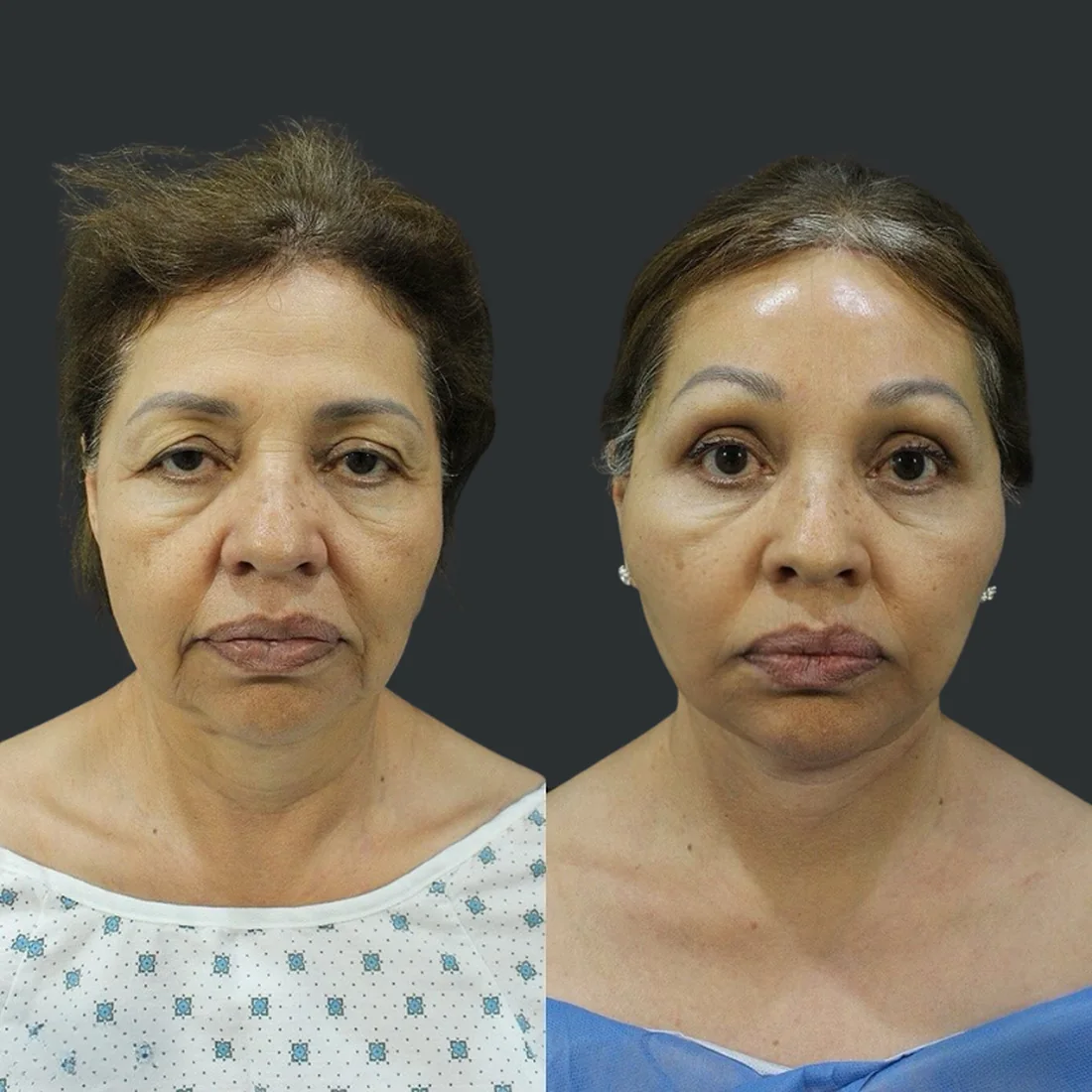
A candidate is a face where those findings line up: enough laxity and descent that repositioning will make a real, visible difference, and enough skin quality that it will redrape well over the lifted structure. When those things are present, the operation is powerful, and the published data describe its results holding for a long time, commonly in the range of about ten to twelve years, longer than a surface or SMAS lift, which is often described in the range of about five to ten. When those findings are absent, the same operation has little to reposition and little to gain, and doing it anyway is not a smaller version of a good idea; it is a different and worse one. You can see what the results actually look like and how they hold on the facelift results page. Individual results vary, always.
The deep plane follows structure, not the calendar
An old-fashioned skin-only lift pulls on the cover. That is the whole difference, and it explains a great deal. A skin lift’s logic and its limits are bound up with the skin itself, which is why it can read as tight and why it fades relatively fast. A deep plane lift ignores the cover as the load-bearing element entirely. It enters the plane beneath the SMAS, releases the retaining ligaments, and moves the deep soft tissue back up onto the bone, letting the skin simply redrape over structure that has been restored to where it belongs. Because the thing being corrected is descent of structure, the operation is appropriate whenever structure has descended, whether that descent came from four decades of gravity or from two years of rapid weight loss in a much younger person.
That is exactly what makes the deep plane the right operation for the younger candidate created by GLP-1 weight loss, and the wrong operation for a face that has not descended at any age. The technique does not care how old you are. It cares whether there is descended structure to reposition and whether your skin will redrape well over it. When both are true, a well-chosen deep plane lift serves a forty-year-old and a sixty-five-year-old by the very same logic, because it is answering the same anatomical question in both. When neither is true, no amount of youth makes the operation appropriate, and no amount of age makes it appropriate either. It follows the structure, not the calendar. That is a strength and also a responsibility, because an operation that ignores age demands an honest surgeon to decide when structure genuinely calls for it.
When would I tell a younger patient not yet, and why is that the kinder answer?
I say not yet when a face does not have enough laxity or descent to need repositioning, because operating on a face that has not fallen spends an intervention the face did not require and cannot get back. This is the hardest conversation I have, and I have it often now that younger patients arrive convinced they are ready. Someone sits down, motivated and sincere, and I study the photographs and find a face that is soft or deflated but has not truly descended. The skin still fits the frame. The jowl is minor or absent. The midface sits close to where it belongs. For that face a deep plane lift has almost nothing to reposition, which means it offers little real benefit while carrying every bit of the reality of major surgery. Telling that patient yes would be easy, and it would flatter us both. Telling them not yet is harder, and it is the honest answer, so it is the one they get.
I call it kinder because it protects something the patient cannot yet see. A person newly fixated on their face, often through the camera, a filter, or a recent weight loss, is not in the best position to judge whether their tissue has actually changed enough to warrant surgery. Part of my job across 37 years has been to hold that judgment steady when a patient’s own is running ahead of their anatomy. Not yet is not a rejection of the person. It is a refusal to perform an operation their face has not asked for, and it never comes empty: it comes with a plan for what to do now, what to watch for, and when to come back so I can look again. The patients who thank me most, years later, are often the ones I told to wait.
Operating too early can cost you later
A facelift is not a renewable resource. Each lift draws on the skin’s elasticity and the tissue’s capacity to heal and to hold, and both of those are finite. Operate on a face that has genuinely descended and you are cashing that capacity in for real gain, which is precisely what it is for. Operate on a face that has not yet descended and you are spending the same finite capacity for very little in return, and it does not fully replenish. The face keeps aging afterward, as every face does, and when it finally reaches the point where a lift would have made a large difference, part of what you had is already gone, sometimes on an operation that changed almost nothing.
The face has a limited number of good operations in it, and where you spend them changes the arc of how you age for the rest of your life. This is the quiet cost the younger-patient trend rarely mentions, and it is why my caution is protective rather than conservative for its own sake. A patient lifted too early has not bought a permanent head start; they have bought an early result that fades on schedule, and then they meet the aging they were always going to meet with fewer resources to answer it. Sequencing matters. Getting it right is a large part of what a careful surgeon is for, and it is why I would rather you have your first lift at the right time than have it early and regret the arithmetic later. The recovery and the long horizon of a lift are covered further on facelift recovery, because the timeline does not end when the surgery does.
Should you get a facelift at 40?
Sometimes, but far less often than the sheer number of forty-year-olds now asking me would suggest, and the answer still comes from the tissue rather than the birthday. Forty has become a real inflection point in my consultation room, and I understand why. It is an age heavy with meaning, it often coincides with a career at full stretch and a face lived on camera, and increasingly it arrives after significant GLP-1 weight loss that has genuinely changed the tissue. So I take the question seriously and answer it face by face. Some forty-year-old faces do show real laxity and descent, usually driven by major weight loss, heavy sun exposure, thin skin, or genetics that age early, and for those a deep plane lift or a face and neck lift can be entirely reasonable and can hold well. When the tissue is truly there, forty is not too young, and I will say so plainly.
But many of the forty-year-old faces that ask me this have not descended enough to need a lift, and for them the honest answer is not yet, paired with a plan that respects both their concern and their anatomy. That plan might be careful volume replacement where a compartment has genuinely emptied, work on skin quality, sun protection, and simply watching the face over time so that I act when the tissue calls rather than when the birthday does. The forty-year-old decision is really this whole article compressed into one anxious age: the pressure to act is cultural, the readiness to act is anatomical, and my task is to tell the two apart for the specific face in front of me. If you are forty and wondering, the right next step is not to book an operation or to rule one out. It is to let me study your face honestly and tell you which of the two forties is yours.
When is a younger patient genuinely a candidate rather than an exception I talk out of it?
Let me describe the clearest young candidate I see. Someone lost a large amount of weight, on a GLP-1 medication or otherwise, and their face genuinely deflated and descended as a result. I study it and find real laxity, a real jowl, a midface that has fallen, and skin that will redrape well. That is a yes, and their age has nothing to do with it. I do operate on younger patients, and I want that on the record so this article does not read as a blanket refusal of anyone under some number. Age never disqualifies a face that has objectively descended.
What separates that patient from the one I gently talk out of surgery is two things arriving together: unambiguous tissue findings and grounded expectations. The genuine candidate is reacting to a face that really changed, not to a webcam angle or a filtered image, and they want to look like a rested version of themselves rather than like someone else entirely. When both conditions are met in a young person, I proceed with the same confidence I would bring at any age, because I am answering an anatomical question, not making an exception. When they are not met, when the findings are thin or the expectations are anchored to a distortion, I decline or I delay, whatever the person’s age. The distinction was never young against old. It is a face that has descended and a mind that sees clearly, set against a face that has not or a mind chasing an image. I owe every patient the same reading, and the reading, not the year, decides.
The smaller steps I offer when a lift is not yet right
Declining to operate is not the same as sending someone away with nothing, and I never do the second. When the tissue does not call for a lift, there is still real and appropriate work to do:
- Targeted volume where a specific compartment has genuinely emptied, restoring what was lost without falling into the trap of chasing deflation endlessly.
- Attention to skin quality and steady protection from further sun damage, which guards every future option the face still has.
- Time, with a trained eye on it, seeing you again so that if and when the tissue does descend, I meet it at the right moment rather than early.
This staged honesty is not me withholding my best operation. It is me sequencing a lifetime of a face correctly, spending the reversible steps first and reserving the structural operation for when structure has actually failed. A patient who comes to me at forty and is not ready is not a patient I turned down; they are a patient I have started caring for, on a longer timeline than a single surgery. Some of them I will operate on in a few years, some in fifteen, and some never, and each of those is a good outcome if it matches the tissue. The measure of a surgeon is not how many faces he lifts. It is whether the faces he lifted needed it, and whether the ones he did not lift were protected. That is the standard I hold myself to, and the standard you should hold me to when you sit across from me.
How do we begin, if you want my honest read on your own face?
If you have read this far, you already know most of what I will and will not do. I will not hand you a best age, because it does not exist. I will not operate on a distortion from a screen or a wish from a filter. I will not spend an operation your face has not earned simply because you asked for one, and I will not refuse one your face genuinely needs simply because you are younger than the average. What I will do is read the three things that actually decide this, your skin, your descent, and your deep structure, and give you my honest judgment, whether that judgment is a yes, a not yet, or a smaller step that serves you better right now.
That honesty is the whole practice. Across 37 years and more than 3,000 facelifts, I have earned my patients’ trust mostly through the operations I declined to perform, and I intend to keep earning yours the same way. My work is performed at VIDA Wellness & Beauty, the first Quad A accredited facility in Mexico and licensed by COFEPRIS, and our team coordinates consultations for United States patients from San Diego so the logistics never rush the decision. When you are ready for a genuine reading of your own face, arrange a consultation, or reach us directly by phone, text, iMessage, or email at +1 (619) 738-2144. Bring your questions and your real face. I will bring 37 years of telling people the truth about theirs, and we will decide, together, from the tissue and not the birthday.