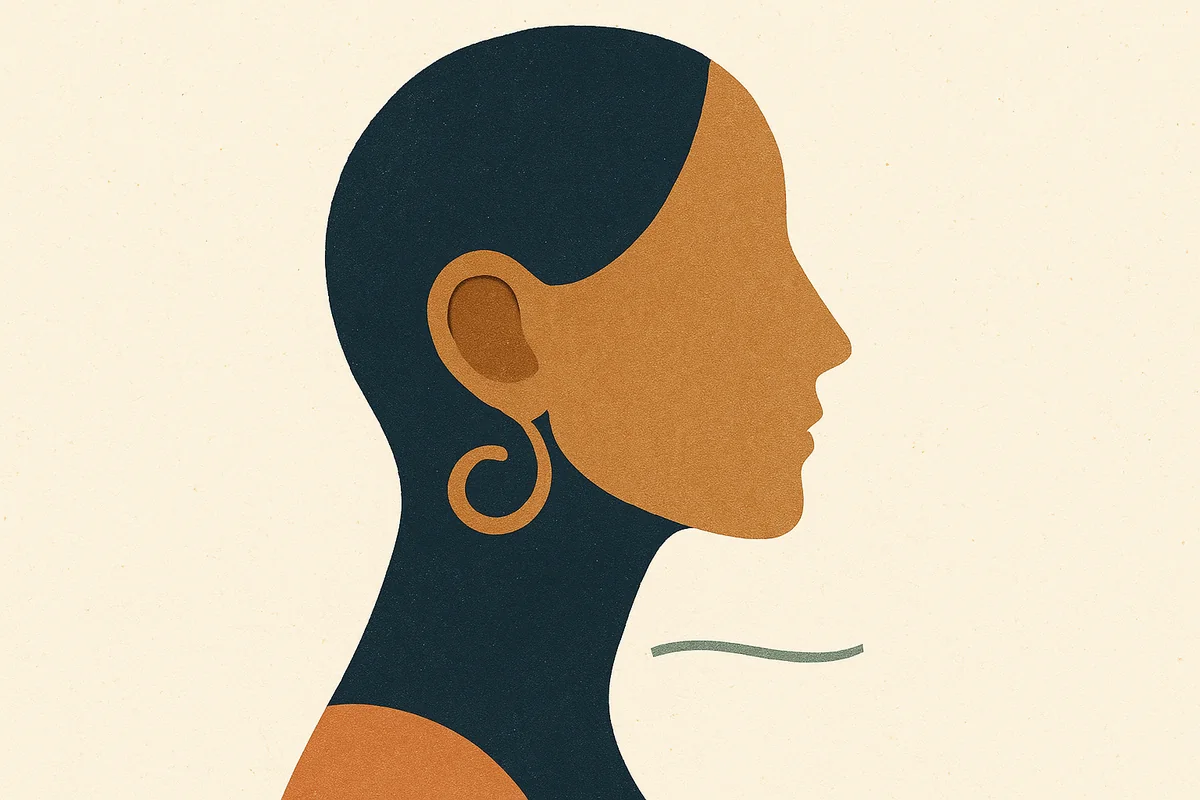
There is a moment in many revision consultations when the patient stops describing her jowls or her neck, reaches up, and simply pulls her hair back. She turns her head, shows me her ear, and waits. She does not need to explain. The earlobe has been pulled downward and forward, stretched thin, and its lowest edge has healed fused into the cheek, so the ear no longer looks like it hangs from her face. It looks like it is being dragged by it. Surgeons call this the pixie ear deformity, and it is one of the most recognizable signs that a face has been operated on.
Here is the short version of this entire article. A pixie ear is what happens when the tension of a facelift closure is left hanging on the earlobe, the one part of the ear with no cartilage inside it to resist. It is not bad luck, and it is rarely a healing problem. It is a design problem, decided in the operating room by where the pull of the lift was asked to live. That means it is largely preventable. And when it has already happened, it is usually correctable.
I have performed more than 3,000 facelifts over my 37 years in practice, and I still inset every earlobe myself, at the end of the operation, without tension, on both sides, every time. This article explains why. We will cover what the pixie ear actually is, why earlobes stretch when nothing else on the ear does, how the deep plane approach changes the physics, what I do in the last minutes of surgery to protect the lobe, how to read earlobes in any surgeon’s gallery, and what your options are if a previous facelift left you with one.
The earlobe as evidence
In 2024, a group of plastic surgeons published a review in the journal Surgery that gathered everything written about the pixie ear, and it opens with an uncomfortable observation: the deformity is “a telltale sign of a facelift procedure,” identified in about 5 percent of reported earlobe inset cases. Sit with that for a moment. An operation whose entire ambition is to be undetectable produces, in a meaningful minority of published cases, a permanent marker that trained eyes, and increasingly untrained ones, can read across a dinner table.
The name is descriptive. The stretched, pointed, tethered lobe recalls the ear of a storybook pixie. Some authors call it the satyr ear. Others describe the whole ear as looking “stuck on,” because a lobe sewn into the cheek under tension also fixes the ear’s position, so it reads as pinned rather than softly hanging. Whatever the label, the visual grammar is the same: the soft comma of a natural earlobe replaced by a taut, continuous line running from ear into jawline.
The deformity received its formal definition in 2005, when researchers at Southern Illinois University published an analysis in Plastic and Reconstructive Surgery describing it in objective terms rather than impressions. What migrates is the attachment point itself: the place where the earlobe meets the cheek travels downward, the lobe loses its free lower edge, and the transition between ear and face becomes a stretched sheet of skin. That attachment point has an anatomical name, the the lowest point where your earlobe attaches to the skin of the cheek. In a natural ear it sits above the lobe’s free hanging edge. In a pixie ear it has been dragged down toward the jawline, taking the lobe with it., and its position is very nearly the whole story. When it drops, the ear reads as operated.
One distinction matters before we go further. Some people are born with attached earlobes. It is a normal inherited variant, and an attached lobe on an unoperated face has substance and a relaxed, gradual blend into the cheek. A surgical pixie ear looks different: the lobe is stretched and thinned, the blend is taut rather than soft, and there is usually a fine scar line running into it. If your lobes have been attached since childhood, nothing on this page describes a problem. If they hung free before a facelift and are tethered after one, that is what this article is about.
Why do earlobes stretch after a facelift?
Earlobes stretch after a facelift because the lobe is the only part of the outer ear with no cartilage inside it, so when a skin closure is placed under tension, the lobe becomes the softest anchor on the line and slowly gives way. The rest of the ear keeps its architecture through a framework of springy elastic cartilage. The lobe is skin and fibrofatty tissue, nothing more. That is what makes it soft enough to pierce, pleasant to the touch, and completely defenseless against a sustained pull.
Now picture the end of a facelift. The incision has traveled down in front of the ear, curved around the earlobe, and climbed into the fold behind it. The repositioned cheek and neck skin is being sewn back along that line. If the operation asked the skin to do the lifting, every centimeter of that closure is carrying load, and the earlobe sits at the corner of it, at the lowest point of the pull, anchored to nothing rigid. The temple has the hairline. The tragus has cartilage. The mastoid has thick, fixed skin over bone. The lobe has nothing.
Two forces then go to work over time. The first is mechanical creep: living skin under constant tension elongates, the way a heavy earring stretches a piercing over years, only faster and with more force. The second is scar contracture. Every scar shortens as it matures, and a maturing scar wrapped around the base of the lobe keeps pulling the attachment point down and forward for months after the operation.
This is why a pixie ear is often invisible at suture removal. The lobe can look acceptable on day 7 and then declare itself between the third and the ninth month, as the swelling that was quietly splinting the tissues resolves and the scar does its slow work. Patients who develop one sometimes torture themselves looking for the mistake they made: sleeping on that side, a pillow, an earring worn too early. Almost never. The pull was built in at the closure. Time only revealed it. The pace of that reveal differs from person to person, and individual healing varies, but the mechanism does not.
Does a deep plane facelift prevent the pixie ear?
A deep plane facelift removes the main cause of the pixie ear, because the lift’s tension is carried by the repositioned deep layer rather than the skin, which lets the skin around the earlobe close at rest. It does not make the deformity impossible, because the earlobe inset still has to be done with care.
The longer version starts with why the deep plane exists at all. Since Hamra formally described the deep plane rhytidectomy in Plastic and Reconstructive Surgery in 1990, the central argument for operating in that plane has been a separation of jobs: the SMAS and the tissues riding on it are released and repositioned as the load-bearing layer, fixed deeply where they will hold, and the skin is laid back over the result as what it actually is, a covering. In a deep plane facelift, the strength of the lift lives in that deep fixation. The skin gets trimmed only where it is genuinely redundant, and when I close around the earlobe, the edges should meet the lobe the way a sheet lies on a bed: touching everything, pulling on nothing.
Contrast that with an operation in which the skin itself is the engine. Skin-only lifts and many abbreviated, short-scar variations concentrate their effect in the skin envelope, which means their closure has to carry structural load somewhere along its length, and the earlobe sits directly on the route. This is not an accusation of malpractice; a careful surgeon can execute a skin-tightening operation with a protected lobe, and careless hands can deform one after beautiful deep work. But the margin for error is completely different. One approach must actively defend the earlobe against the operation’s own physics. The other has quietly moved the physics somewhere stronger. I have written in more depth about how deep plane, preservation, and SMAS techniques divide the work, and the earlobe is one of the places where that division stops being theory and becomes something you can see at a dinner party.
Honesty requires two admissions here. Pixie ears have been reported after every facelift technique, including deep plane lifts. And a deep plane operation can still produce one in a single careless moment: trim too much skin around the lobe, and the surgeon arrives at the inset short of material, forced to stitch the lobe down under pull to close the gap. The technique buys margin. The last step of the operation decides whether that margin is spent well. So when patients ask me whether choosing a deep plane lift protects them from pixie ears, my answer is that it removes the standing cause, and then the surgeon has to decline to reintroduce it by hand at the finish.
The last minutes of the operation
By the time I turn my attention to the earlobes, the facelift is essentially decided. The deep work is done and fixed. The skin has been redraped and secured at its anchor points above the ear and behind it, on strong tissue, where tension belongs. What remains is the inset, and I treat it as its own small operation, on both sides, unhurried.
The sequence matters. I set the anchor points first, precisely so that by the time the lobe is addressed, the flap is already hanging from somewhere else. Then I trim the skin around the lobe more conservatively than anywhere else on the closure, leaving a deliberate small cuff, because skin here can always be removed and can never be put back. I set the lobe fractionally higher than its final intended position, since everything in a lifted face descends slightly as it settles, and a lobe set perfectly on the table can sit a millimeter low a year later. I respect the natural axis: a native earlobe does not point straight down, it tilts gently backward, and reproducing that tilt is part of why a well-set ear looks unremarkable. And before the final sutures, the head comes up, because an earlobe judged only with the patient flat is being judged in the one position nobody will ever see her in.
The test I care about is tactile. The last stitches at the lobe should reach without any force at all. A stitch that needs tension to close is not a stitch, it is a message, and the correct response is to go back upstream, redistribute the skin, and return when the message has been dealt with.
None of this is exotic. It costs a surgeon nothing but attention and a little skin he might otherwise have trimmed. Which is why I keep insisting that the pixie ear is not a complication in the way a hematoma is a complication. A hematoma can happen to a careful surgeon on a careful night. A pixie ear is a decision the closure made.
How to read earlobes in a surgeon’s gallery
You do not need medical training to audit this. You need profile and three-quarter photographs, taken months after surgery rather than weeks, and the discipline to look at the ears before you look at the jawline. I tell prospective patients to do this with my gallery, and with every other gallery they are considering, because the earlobe is one of the few places where the quality of a closure is legible to anyone.
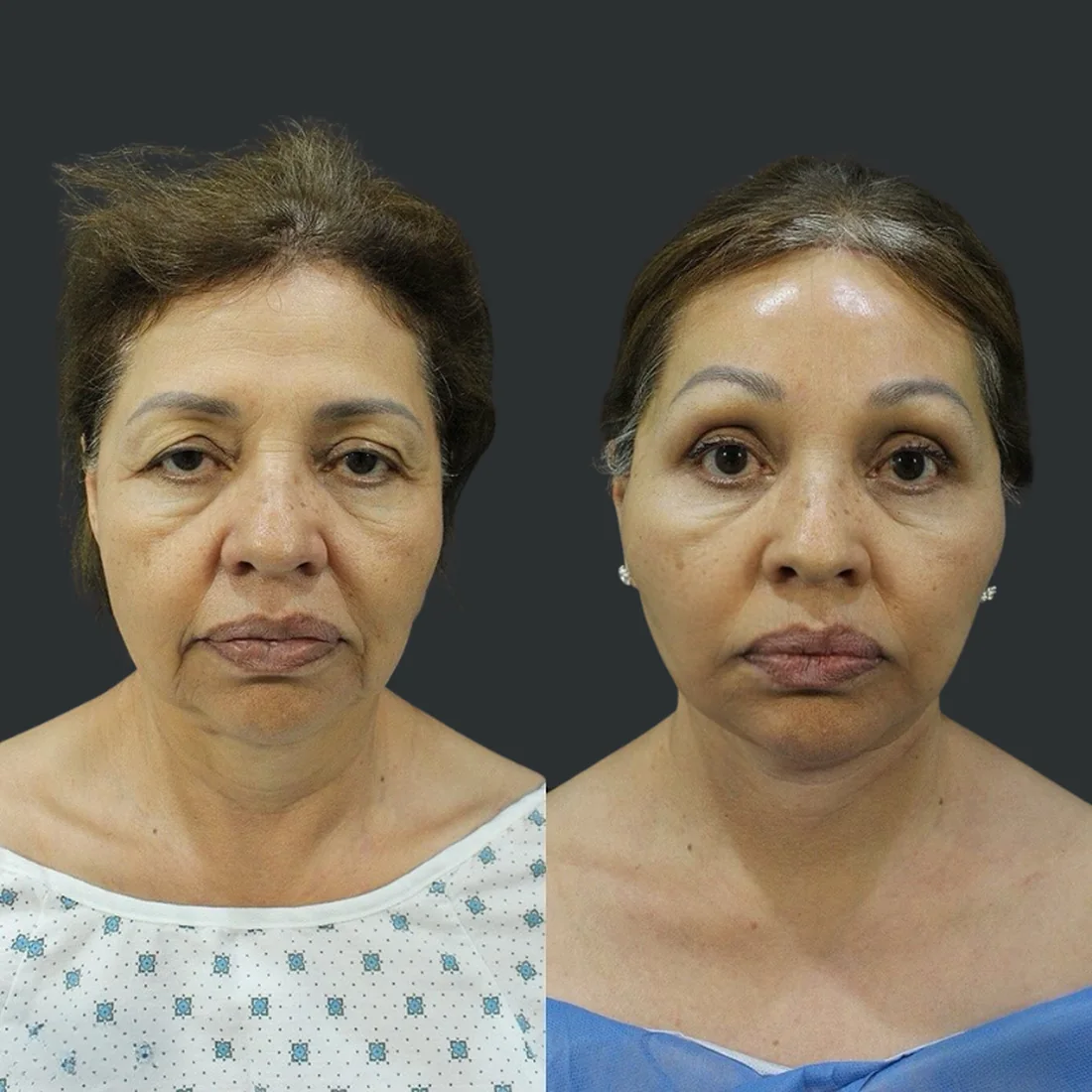
- The lobe hangs with a free lower edge, the kind you could slip a fingertip behind
- The point where the lobe meets the cheek sits level with, or above, where it sat in the before photo
- The lobe keeps its original size and softness instead of looking longer and thinner than before
- The ear reads as relaxed and mobile, consistent from photo to photo across the gallery
- The lobe runs into the jawline in one continuous, pulled line with no notch between ear and face
- A visible scar travels from the base of the lobe down into open cheek skin
- The lobe looks stretched, pointed, or thinner in the after photo than in the before
- Every after photo happens to be cropped, angled, or shadowed so you cannot actually see the earlobes
That last line deserves emphasis. Galleries are curated, which is fair; every surgeon shows their good work. But ears are hard to hide across an entire gallery, and a portfolio that never lets you see one is telling you where not to look, which is itself information. At a consultation, you can simply ask to see healed ears. I consider it a reasonable request, and I would be suspicious of any surgeon who bristles at it.
While you are looking at the ear, notice that the lobe is not its only testimony. The tragus, the small cartilage flap in front of the ear canal, should keep its crisp edge and its shadow; a tragus that looks blunted, pulled forward, or erased is a sign the incision in front of it closed under load. The sideburn should still exist where it always did; a sideburn lifted high onto the temple, or a step in the hairline behind the ear, means skin was shifted farther than the hair could follow. These signs and the pixie ear are siblings. They come from the same economy of tension, and a gallery that shows quiet tragus edges, undisturbed hairlines, and free lobes is showing you a surgeon whose closures rest.
What a pixie ear does not mean
Let me lower the temperature before we talk about fixing anything. A pixie ear is not dangerous. It does not hurt, it does not threaten hearing or health, and it carries no urgency at all; nothing about it worsens by being observed patiently for a year. It also does not automatically mean your entire facelift failed. I have examined faces with genuinely good deep work, a clean neck, and a natural midface, where the only false note was an earlobe inset under pull in the last minutes of an otherwise well-judged operation. The reverse exists too, the ear as the visible corner of a lift that asked skin to do everything. Part of my job at a revision assessment is telling you honestly which one you have, because the answer decides whether you need a small repair or a larger conversation.
Can a pixie ear be corrected?
Yes. A pixie ear can almost always be improved, and the repair ranges from a small release done under local anesthesia to a full revision facelift. Which one applies to you depends on a single question: is the surrounding skin still under tension, or is the lobe the only problem left?
When the lobe is the only problem, the repair is one of the more satisfying small procedures in facial surgery. Skin relaxes considerably over the first year after a facelift, and often the tension that created the deformity has largely dissipated, leaving a lobe that healed in the wrong position with slack now available around it. In that situation the lobe can be released from the cheek, the scar excised, nearby skin rearranged, most commonly in a V to Y pattern, and the free edge rebuilt. It is done awake, it is brief, and patients walk out the same day with a dressing smaller than a coin. What it leaves behind is a fine scar in the crease where lobe meets cheek, which is where a scar was always meant to be.
The published literature adds a refinement I agree with: a durable repair should anchor to something firmer than skin. A 2019 study in Aesthetic Surgery Journal followed 105 facelift patients, 210 ears, using a posterior rotation flap for the lobe combined with a suspension stitch securing the lobe’s base to the firm cartilage behind it, and reported low complication rates with stable lobe position. The exact technique matters less than the principle: skin sewn only to skin, in scarred territory, invites the same drift that caused the problem.
When the surrounding skin is still tight, the honest answer is different, and I give it even when it is unwelcome. An isolated lobe repair borrows adjacent skin, and if there is no adjacent skin to spare, the repair either cannot close properly or closes under the very tension that created the deformity. In those faces the real correction is a revision facelift, in which the deep layer takes over the load it should have carried the first time and the lobe is inset properly with skin to spare. That is a much larger conversation, with its own candidacy questions, and it is not urgent. A pixie ear is a cosmetic problem, never a dangerous one, and nothing is lost by waiting until the tissues are genuinely ready.
On timing: I rarely operate on a pixie ear before 6 months and I prefer closer to a year, because early tethering can soften meaningfully on its own as swelling resolves and the scar matures. I have described that whole arc in how a facelift settles month by month, and the earlobe follows it like everything else. Repairs done into an immature, still-contracting scar are repairs done against a moving current. Individual results vary, and the right moment is found by examining the tissue, not the calendar.
The repair that fails
Every surgeon who corrects pixie ears has seen the version that comes back, and it comes back for one reason: the lobe was fixed while the force that deformed it was ignored. Release a tethered lobe, inset it beautifully, and hand it straight back to a tight skin flap, and the flap will do to the repair exactly what it did to the original ear, only now through scarred tissue with less give. It is retying a boat with the same short rope and expecting a different tide.
This is the context for a question I now hear regularly from patients who had surgery elsewhere, usually phrased almost exactly as it appears on patient forums: can pixie ears after a deep plane facelift be easily repaired? The answer is usually encouraging, and the reason is the physics we have already covered. If the deep support of the original lift is holding, the deformity is most often an inset error rather than a tension problem, the skin reserve exists, and a small local repair tends to do well and stay corrected. But “usually” is doing real work in that sentence. I have to examine the ear, feel the laxity, and see the scar before I will say it about any particular face. Individual results vary, and no surgeon can promise a scar’s behavior in advance.
It is also worth saying that surgery is not the only response. Some patients, once they understand the deformity is stable and harmless, simply decide it is not worth another procedure, and manage it with a hairstyle that covers the lobe or a well-chosen stud that visually restores the lobe’s lower edge. I consider that a fully legitimate outcome of a consultation. My role is to lay out what a repair can and cannot do; the decision about whether a small scar bothers you enough to operate on belongs entirely to you.
There are also patients I advise not to repair at all, and I want to be plain about who they are. The patient whose deformity is so subtle that she finds it only in a magnifying mirror, at an angle nobody else will ever occupy, may be better served by leaving a healed, quiet ear alone than by trading it for fresh surgery and a new scar. The patient whose skin is still tight needs time, not a procedure. The patient using nicotine in any form needs to stop well before I will operate on a lobe, because the repair lives or dies on blood flow through small vessels in scarred skin, and nicotine constricts exactly those vessels. And the patient who expects a corrected lobe to look as though nothing ever happened needs a more honest framing before surgery, not after: a good repair gives you back a free, natural-hanging earlobe with a fine scar in its crease. Better, sometimes dramatically better. Not unmarked.
Earlobes have their own aging story
Even without a scalpel, earlobes change. They elongate with age as their elastic fibers fatigue, they deflate as they lose fatty volume, and decades of earrings stretch them further, sometimes into a visible slit at the piercing. It is one of those details, like the backs of the hands, that quietly dates a face even when everything else has been cared for.
This has two practical consequences for facelift patients. The first is that an elongated, deflated lobe can be reduced and reshaped during a facelift, through the same incision that already wraps around it. It is a small maneuver, a few minutes, and I offer it when the lobe’s proportions have drifted from the rest of the ear, because a crisp jawline next to a long, slack lobe is a mismatch someone’s eye will eventually catch. Done conservatively, it simply returns the lobe to the proportions of its own earlier decades. Done aggressively, it creates a tiny, tight lobe that is its own tell, so restraint governs here as everywhere.
The second consequence is about earrings during recovery. A healing lobe is a lobe being asked to hold its new position while scar forms around it, and it should spend those weeks unloaded. In my practice, earrings stay out until the incisions around the lobe have fully sealed and my team has confirmed it at follow-up, and heavy or dangling earrings stay away considerably longer, until the scar has real strength. Existing piercing holes are almost always preserved through surgery, but tell your surgeon about them beforehand, especially stretched or gauged piercings, which change how the lobe can be trimmed and inset. Individual recovery varies, and your surgeon’s guidance on your own tissue overrides any general timeline, including mine.
If your pixie ear came from an operation somewhere else
A meaningful share of my practice is revision work on faces first operated elsewhere, and the pulled earlobe is one of the most common complaints these patients arrive with. Some noticed it themselves in a photograph. More painfully, some had it pointed out. If that is you, I want to leave you with a realistic picture of the path forward.
The first step is assessment, not surgery. Clear photographs of both ears, from the front and in profile, together with when your facelift was done and, if you can find them, photos of your ears from before it. Whether you still feel tightness in the cheek or neck tells me almost as much as the pictures do. My patients from Southern California often drive down for this, and fly-in patients start with photographs and a video consultation before anyone books anything. What I am deciding in that first look is which category you are in: the settled face that needs a small local repair, the tight face that needs time, or the under-supported face where the earlobe is one symptom of a lift that asked skin to do a deeper layer’s job.
You may also encounter something frustrating on the way here: surgeons who decline to touch another surgeon’s result. Some of that reluctance is prudent, since revising scarred tissue is genuinely harder than operating on an untouched face, and I share the caution in one specific form. I take these cases when the examination convinces me I can genuinely improve the ear, and I say no when the tissue is not ready or the likely gain does not justify new surgery. A revision surgeon who never says no is not offering you judgment, only availability.
I will end where I began, with the woman pulling her hair back in my consultation room. The earlobe is a structure you can hide behind a thumb, and I spend the last minutes of every facelift on it, on both sides, because it is the operation’s signature. A face that has been lifted well keeps its own counsel, and a soft, free-hanging earlobe is a large part of how. That detail is small only until it is missing.