
Patients ask me this near the end of almost every consultation, usually quietly, as if the question itself might be rude: what happens when it wears off? After 37 years I answer it the same way every time. A facelift resets where you are aging from. It does not stop aging, and it does not wear off the way a product wears off. Nothing dissolves, nothing expires, and nothing snaps back to where it was. The face simply keeps doing what faces do, which is age, except that it is now aging from a structurally better starting point. Ten years after a deep plane lift you will be ten years older, but ten years older from the reset, not from where you began, and there is no version of that arithmetic in which you end up worse than if you had never had surgery. Individual results vary, and the rest of this article is the honest version of that trajectory: what actually changes, when it changes, and which parts of it are in your hands.
Does a facelift wear off, or does the face just keep aging?
The face keeps aging; the facelift itself does not wear off, because there is nothing in a facelift that can wear off. Wearing off is vocabulary borrowed from injectables, and it fits them, because they are designed to fade. Botox quiets a muscle temporarily, and the body gradually absorbs filler. Both are temporary on purpose. Surgery belongs to a different category. In a deep plane facelift I release the structure beneath the SMAS, the superficial musculoaponeurotic system that Mitz and Peyronie mapped in 1976, and reposition it as one unit, the way Hamra described his deep plane in 1990, so the skin itself carries no tension. That repositioned structure heals where I place it. It is not a substance your body metabolizes and not a stitch holding back a spring. It becomes your anatomy.
So when a patient pictures the result expiring on some schedule, like a lease, I stop them. What changes over the years that follow is not the surgery. It is you. Skin quality keeps evolving, volume keeps shifting, gravity keeps pulling, and the same slow forces that built your jowls the first time go back to work on the new position. The correct picture is not a product fading. It is a clock that was set back and then allowed to run.
- Day 0The reset. The repositioned structure heals where I place it, and your starting point for aging moves back years, not to a frozen face.
- 5 yrsStill ahead. You have aged five years, but from the reset, not from where you began. Most patients still look like themselves, rested.
- 10 yrsA refresh becomes a conversation. In published data a deep plane result is commonly described as holding about ten to twelve years before a revision is considered. Individual results vary.
Will you look worse than before once the result fades?
No. There is no mechanism by which a properly performed facelift leaves you worse off than if you had never had surgery, and in more than 3,000 facelifts I have never watched aging produce that outcome. Here is the thought experiment I give patients. Imagine two photographs of you taken on the same day, ten years from now. In one life you had the lift; in the other you did not. Same genes, same sun, same years. Both faces aged at the same rate, because surgery does not change the rate. But one face spent those ten years aging from the reset point, and the other spent them aging from where it already was. In my experience the operated face stays ahead of the unoperated one for as long as the comparison runs, and I have not seen it cross back. Individual results vary in degree, but I have not seen the direction reverse.
So where does the fear come from? From lifts that were never held by structure. When a surgeon tightens skin at the surface and relies on that tension to carry the result, the skin gives way, sometimes quickly, and the relapse can feel abrupt. Worse, a pulled surface lift can leave its own signatures as it relaxes, and a face with visible signs of surgery on it can genuinely read as worse than an untouched one. That is a failure of method, not a property of facelifts, and it is one of the reasons I lift structure rather than skin.
What does aging on a reset foundation actually look like?
It looks like your own aging, replayed from an earlier point, and most of it moves too slowly to watch. Patients imagine a cliff somewhere in the future, a date when the result is revoked. The reality is a long, quiet curve with three chapters.
Is anything fading in the first year?
No. Nothing in the first year counts as fading, because the first year is the result arriving, not leaving. Swelling settles over months, and the real result is only fully there at several months, which is why I ask patients not to judge anything early. I have written the week by week recovery separately, and the results page shows my patients in their own timeframes rather than at one flattering moment, precisely so you can see what settling actually looks like.
What happens in the quiet years after that?
Honestly, nothing, and that is the point. The long middle of the trajectory is uneventful. You look like yourself, rested. People who do not know tell you that you seem well. There is no maintenance appointment for the surgery itself, no anniversary check the lift needs to pass. The structure I repositioned is simply your face now, doing what a well supported face does, which is age slowly and gracefully.
When does aging become visible again?
Gradually, and in my experience later than most patients fear, the surface begins to record time again. One day a photograph shows a softness along the jaw that was not there a few years earlier, or the neck is a little less sharp in a certain light. That is not the lift failing. That is time resuming on a face that had its starting point moved. The published figures on how long the quiet middle tends to hold live on the results page, next to real photographs, where numbers belong; I would rather you read them there than have me repeat them out of context.
Will my jowls come back?
Years from now the jawline will soften again, because the aging that created your jowls in the first place does not retire, but the jowl that eventually returns starts over from a repositioned foundation, not from where you were the day before surgery. Jowls are not a skin problem. They form because the deep structure of the face descends and gathers past the jawline. In a deep plane lift I return that structure to where it sat, so when descent resumes, it resumes from the corrected position and has to cover that ground again, slowly, over years. In my experience, what comes back later is a milder version of what you started with, arriving on a face that is still better supported than it would otherwise have been at that age. Individual results vary.
What you should not expect is the jowl reappearing within a year or two. When that happens after a lift, it usually means skin tension was doing the structural work, and I take that up further down, because it is a different problem with a different answer.
Which factors decide how long the result holds?
Some of it was decided before you were born, some of it was decided in the operating room, and the rest is decided by how you live. When I look at how differently my patients age in the years after surgery, the differences sort into three ledgers.
- Set by nature: your genetics, the elasticity you inherited, your bone structure, and the way your parents aged. This ledger is closed. Nobody edits it.
- Set at surgery: the plane of the lift. A result carried by repositioned structure has something durable to hold to; a result carried by stretched skin asks skin to do a job it was never built for. This is decided on the operating table and cannot be changed afterward except by revision.
- Set by you: sun, cigarettes, weight, and general health. This is the only ledger still open after surgery, and it is the subject of the next section.
Two patients can have the same operation from the same hands and age differently afterward, which is why every serious statement about longevity is a range rather than a promise, and why I hedge even when a patient wants certainty from me. The honest sentence is that I control the second ledger completely, you control the third, and nobody controls the first.
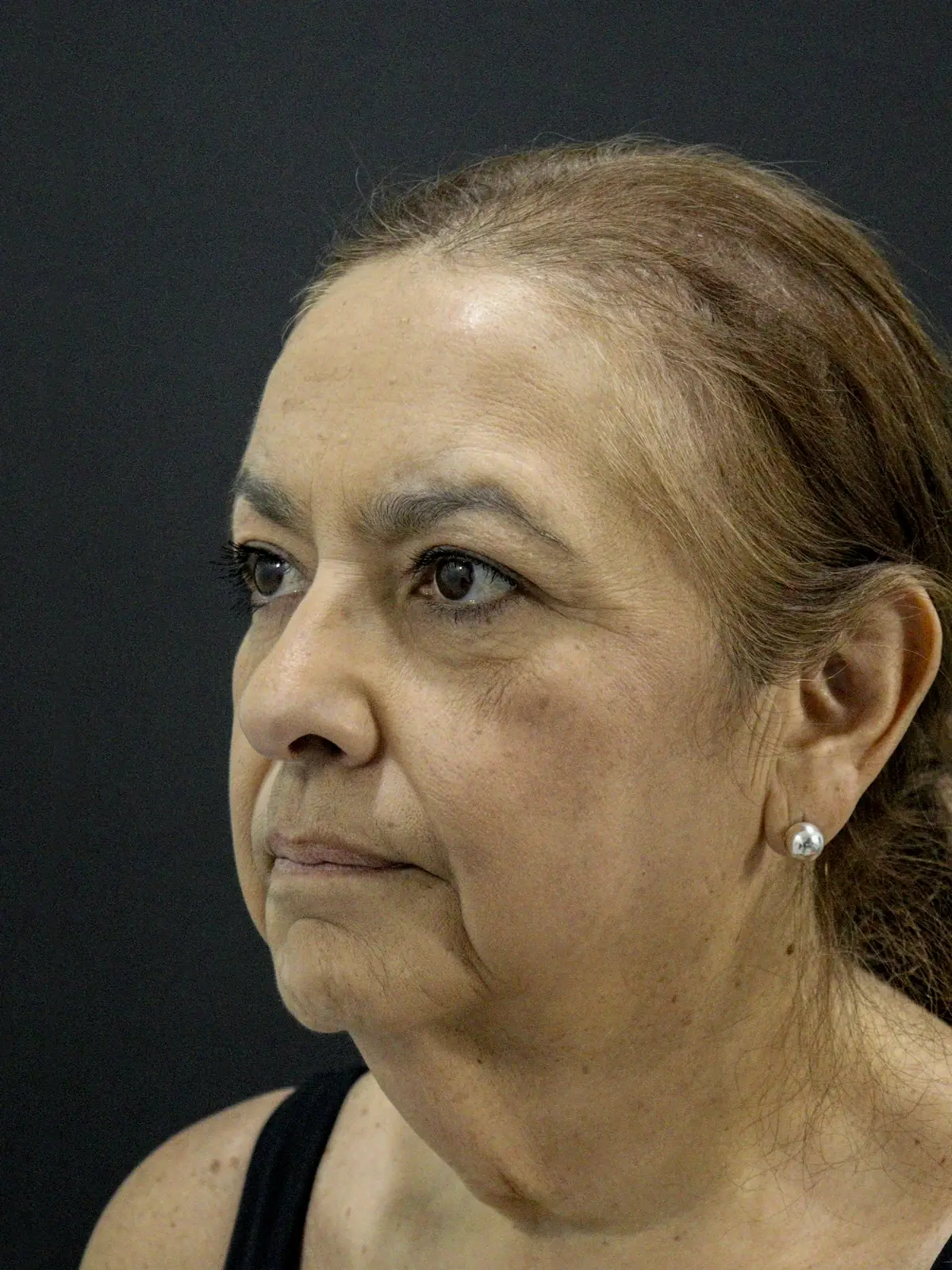
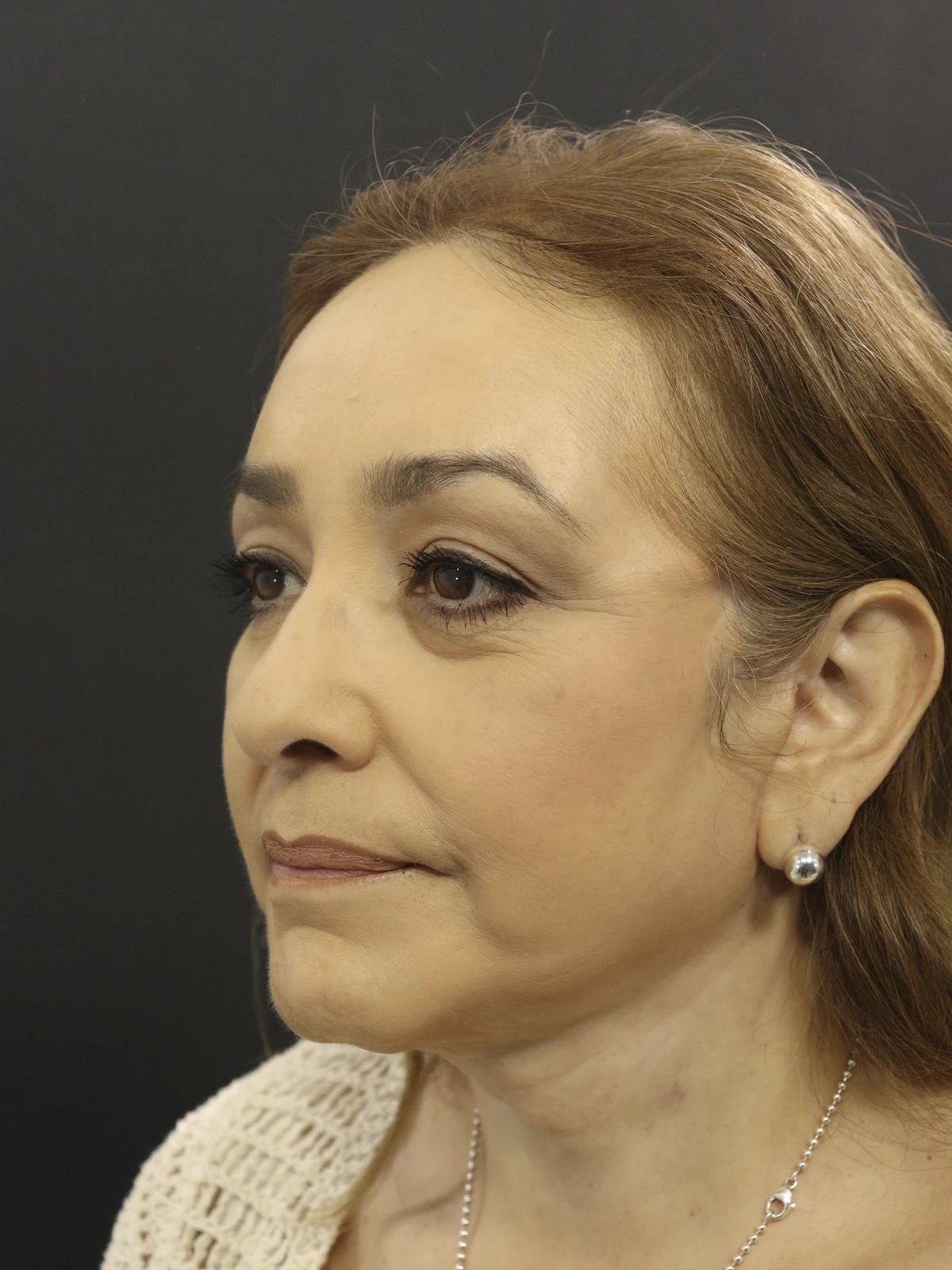 BeforeAfter
Drag to compare. This is the reset a deep plane lift creates: it does not stop aging, it moves your starting point back years. A real result, photographed with consent. Individual results vary.
What can you actually control after surgery?
Three habits protect a facelift more than anything sold in a jar: sun protection, not smoking, and a stable weight.
Sun comes first because it is the largest lever. The lift repositioned your structure, but your skin is the envelope draped over that structure, and much of the envelope’s aging is driven by ultraviolet light; dermatology reviews attribute the majority of visible skin aging to sun exposure rather than to the passage of years alone. Daily sunscreen is the cheapest, least glamorous, most effective maintenance a facelift will ever receive, and it costs you thirty seconds a morning. If you do only one thing for your result, do that.
Cigarettes work against every part of this. Smoking constricts the small vessels your skin depends on, and skin that is starved of blood supply ages faster and heals worse; the harm to face lift skin flaps specifically is well documented in the surgical literature, which is one reason I am uncompromising about it around surgery. If you smoke, the single best thing you can do for a facelift, before it and long after it, is stop and stay stopped.
Weight matters because I tailor a lift to the face in front of me, to its volume on the day of surgery. Significant gain stretches the envelope; significant loss deflates it and can bring back laxity that has nothing to do with the lift relaxing. A stable weight protects the tailoring. If a major weight change is in your plans, the right order is to reach a stable weight first and then lift the stable face, which is exactly the situation I wrote about in facelift after major weight loss.
Beyond those three, sleep, general health, and consistent skin care all help the surface, and resurfacing treatments can keep the envelope in better condition than neglect would. Just be honest with yourself about the boundary. Nothing applied to the surface holds up structure. No cream lifts a face, and no device does either; they maintain skin quality, not position.
Can you get Botox or filler after a deep plane facelift?
Yes. A facelift and injectables work on different layers of the face, so one does not interfere with the other. A lift owns position: it returns descended deep structure to where it sat. Botox owns expression: the forehead lines and frown lines made by muscle movement, which no facelift treats. Filler owns volume, which a lift does not restore. I have drawn that map in full in what a facelift does not fix, and the short version is that the three tools answer three different questions, which is why they can coexist on the same face without argument.
Two cautions, because I have seen both go wrong. The first is timing. Let the face settle before anyone injects anything near the work; swelling takes months to resolve fully, and settled anatomy is a better canvas than a moving target. Raise it at a follow-up and I will help you time it. The second caution matters more. Filler is not a maintenance plan for a facelift. The repositioned structure does not need topping up, and when descent eventually resumes, volume layered on top of descending structure does not lift it, it widens it. Year after year of chasing a jawline with syringes is how faces end up heavier and stranger than aging alone would ever have made them. When the structure has genuinely moved again, the honest conversation is a surgical one, and I would rather have it plainly than watch an overfilled version of you postpone it.
How is normal relaxation different from a lift that failed early?
Normal relaxation is slow, soft, symmetric, and arrives years after surgery; a lift that gives way within the first year or two, or that looks pulled at any point, is not aging, it is a problem with the operation. Normal looks like this: several quiet years, then a gradual softening at the jaw or the neck that you notice in photographs before anyone notices it in person, with no distortion and no signature of surgery on the face. Early failure looks different. The jawline or the neck returns not long after the swelling settles, or the face carries the marks of tension: a swept hairline, a widened scar, an over-tightened cheek, a corner of the mouth that reads as a stretch. Time does not do those things. Technique does.
The distinction matters because the answers are different. Normal relaxation needs nothing, or eventually, if it bothers you enough, a refresh years down the road. A lift that relaxed too soon or pulled deserves an honest assessment of what can and cannot be corrected, which is its own subject, and I wrote what a revision facelift can and cannot do for exactly that reader. If you are not sure which one you are looking at in your own mirror, do not diagnose yourself. Photographs and an honest read settle it quickly, and I would much rather tell someone their lift is behaving normally than let them worry for a year.
What the longevity data can and cannot tell you
I want to be straight about the numbers I quote. The ten to twelve year figure for a deep plane result rests on a fairly small body of long-term follow-up, and much of that work measures when patients chose to come back for a revision, not the day a result stopped working. Those are two different things, and the people who return are not a perfect stand-in for everyone who had the operation. Long-term studies that put deep plane and surface techniques side by side over decades are still thin, so I treat every longevity range as a well supported estimate rather than a settled fact. I would rather tell you that plainly than hand you a number and call it a promise.

What should you do when you notice change, years from now?
Send photographs and ask, because an honest read costs you nothing, and I would rather look than leave you wondering. Follow-up with my patients does not end when the sutures come out; it continues remotely once you are home, and the coordination team in San Diego stays reachable for the years after, not just the weeks. Most patients who write to me years later do not need anything. They need to hear that what they are seeing is ordinary time on a face that had a real reset, and that the reset is still working underneath it. A few eventually want to talk about doing it again, and that conversation starts the same way the first one did: with photographs, and with me telling you plainly what I see.
If you are earlier in this journey and still deciding, the consultation is where every honest read begins. Call or text +1 (619) 738-2144, or write by email; phone, SMS, iMessage, and email are the channels we answer. A facelift resets where you are aging from. It never promised to stop time, and it does not need to. Individual results vary.