The fear that sits down before the patient does
A woman from Newport Beach sat across from me last spring with a folder of photographs. Not inspiration photos. Warnings. Celebrities with tight, shiny lower faces and earlobes that seemed welded to their jaws. She slid the folder across my desk and said, “Whatever you do, I cannot look like this. I would rather look old.”
I have been in practice for 37 years, and I have performed more than 3,000 facelifts. In all that time, I can count on one hand the patients who were afraid of the operation itself. The anesthesia, the incisions, the recovery, those questions come later, and they come calmly. What walks into the room first, every single time, is a different fear. The fear is not the surgery. It is looking like you had one.
I want to take that fear seriously, because it is not irrational. The faces in that folder are real. You have seen them too. But here is what I told her, and what I will spend this article proving to you: the “done” look is not what a facelift looks like. It is what a specific list of technical mistakes looks like. Those mistakes have names. They have published causes. Surgeons have understood them for decades. And every one of them is avoidable.
”Done” is not a style. It is a set of mechanical errors.
A facelift looks fake for physical, nameable reasons: skin pulled sideways under tension, a distorted earlobe and hairline, tissue removed instead of repositioned, and filler stacked on top of loose anatomy. None of these is an inherent property of facelift surgery. Each one is a choice, or the downstream consequence of a choice, made in the operating room or in the years before it.
This is not my private theory. In 1998, Sam Hamra published a paper in Plastic and Reconstructive Surgery with a title that says everything: “Frequent face lift sequelae: hollow eyes and the lateral sweep.” He documented, case by case, how conventional lifting techniques that advance tissue laterally, toward the ears, produce a recognizable sweep across the lower face as the cheek continues to descend above the tightened lower portion (PMID 9774028). Two years later he published a follow-up specifically on preventing and correcting what he called the “face-lifted” appearance (PMID 11802570).
Read those dates again. The profession has had a published diagnosis of the operated look since before some of my patients graduated from college. So why do you still see it at dinner parties and on television? Because the techniques that cause it are faster to perform, easier to learn, and easier to schedule in volume. The windblown face is not a mystery of medicine. It is, most of the time, an economics problem wearing a surgical mask.
Let me dissect the failure modes one at a time, because once you understand the mechanics, you will never look at a “bad facelift” the same way. You will see exactly which lever was pulled wrong.
Why do facelifts look windblown? Start with the sideways pull
Think about what skin actually is. It is an envelope. It is elastic, it stretches, it drapes, and it was never designed to carry structural load. The structure of the face lives a layer deeper, in the SMAS, the sheet of muscle and fibrous tissue that your expressions run through. I have written a full explanation of what the SMAS actually is if you want the anatomy in detail, but for now hold onto the simple version: skin is the tablecloth, the SMAS is the table.
A skin-only facelift, and to a lesser degree a facelift that tightens the SMAS superficially while relying on the skin to do much of the work, lifts by pulling that tablecloth tight and sewing it near the ears. The pull is mostly horizontal, backward and sideways, because that is where the incisions are.
the diagonal fold of tissue that develops across the lower cheek after a facelift with a sideways pull, as the heavier upper cheek keeps descending over the tightened lower face. Named and documented by Hamra in 1998. is what that pull produces over time, and it is the single most recognizable signature of an operated face. The cheek flattens where it should be full. Diagonal lines appear running from the corner of the mouth up toward the ear, like drapery folds on a curtain pulled from one side. The lower face looks tight, almost varnished, while the midface above it continues to sag, because the sideways pull never actually reached it.
Here is the part almost nobody tells patients: the swept look is usually not visible at the three-month photo. Early on, swelling softens everything and the tension has not yet declared itself. Hamra’s observation was that the malar tissues, the heavy pad of the upper cheek, descend faster than the tightened lower portion, so the mismatch grows. The face that looked acceptable at three months can look unmistakably operated at two years, and it worsens from there. When you see a celebrity who “suddenly” looks pulled, you are usually watching an old lateral vector mature.
There is a second problem with loading the skin, and it is why these lifts also fade quickly. Skin under constant tension does what any elastic material does under load: it creeps. It stretches back toward where it was. So the sideways lift gives you the worst of both worlds, an unnatural direction of pull and a short lifespan for whatever improvement it bought. If you have ever pulled your own cheek toward your ear in the mirror, gently, with two fingers, you have performed a perfect simulation of this operation. Now push the same tissue straight up instead and watch what happens to your jawline and your eye. That difference is the entire argument of this article.
The ear keeps the receipts
I can often tell where a facelift went wrong from about two centimeters of anatomy.
The earlobe is the only part of the ear with no cartilage inside it. It is soft, it hangs, and it has no ability to resist pull. When a surgeon closes the skin around the ear under tension, because the skin is being asked to hold the lift, the earlobe is dragged down and forward over the following months until it blends into the cheek like melted wax. Surgeons call this the pixie ear deformity, and the published literature is blunt about its causes: over-resection of skin, imbalanced lifting vectors, and traction from tension in the closure (PMID 29635413). In other words, the earlobe is a tension gauge. If it has been pulled into the jawline, the skin around it was carrying load it should never have carried.
The tells cluster in this small area because this is where the incision lives. A tragus, the small flap of cartilage in front of the ear canal, that has been pulled flat and skinned tight. A visible pale line running in front of the ear instead of hiding along its natural creases. And above it, the hairline: a sideburn hoisted up above the top of the ear, or gone entirely, because lifting the skin sideways carried the hair-bearing skin with it. Behind the ear, a stair-step in the hairline where the two edges no longer meet.
We are wired to read ears and hairlines. They frame the face, and when they are wrong, an observer senses “something was done” even if they cannot say what. This is why a person can look operated from across a restaurant, before you can see a single scar.
In my operating room the rule is simple and it is absolute: the skin never carries the lift. The deep layer is repositioned and fixed, and it holds everything. The skin is then laid back down, without pull, and only the truly redundant edge is trimmed away. The earlobe is inset with a small cushion of slack so it hangs free. The incision follows the inside edge of the tragus and the natural curves of the ear, and the sideburn stays exactly where your genetics put it. None of this is heroic. It is simply what becomes possible when the lifting work happens in the correct layer.
Subtraction is not rejuvenation
There is an older idea of facial rejuvenation that treats aging as an excess problem. Too much skin, cut it out. Too much fat, remove it. The result of that philosophy, applied aggressively, is a face that is tight and empty at the same time. Skeletonized. You have seen this one too: the hollow lower eyelids, the concave cheeks, the tendons in the neck standing out like cords under thin, tight skin.
Hamra flagged this in the same 1998 paper, pairing “hollow eyes” with the lateral sweep as the two most frequent stigmata of conventional surgery, and pointing at routine removal of lower eyelid fat as a cause (PMID 9774028). The insight behind that pairing matters more than either finding: aging is mostly descent, with some deflation. Tissue falls. It does not primarily accumulate. So an operation built around removing tissue is answering a question the face never asked.
When I lift the deep layer of the midface back up to where it lived in your thirties, the “excess” largely disappears on its own, because it was never excess. It was displaced fullness. The cheek that seemed heavy at the jawline is the same cheek that seemed deflated under the eye; move it home and both problems resolve with the same maneuver. What I remove, in skin or fat, is modest, measured at the end, and never load-bearing. A face rejuvenated by repositioning keeps its volume where light expects to find it. A face rejuvenated by subtraction photographs older in five years than it did before surgery.
The surprised brow, briefly
One more subtraction cousin deserves a paragraph, because it often gets blamed on the facelift even when the facelift is innocent: the permanently startled upper face. Eyebrows hoisted too high, a forehead stretched smooth as a drum, eyes that look alarmed at rest. This is over-elevation at the brow, and it changes something even more fundamental than contour. It changes expression. Your resting face carries your temperament, and when the brow is parked in a position your emotions never chose, people read a mood that is not yours. Serenity becomes surprise. Attention becomes alarm.
The principle is the same one that governs everything else in this article: the goal of rejuvenation is to return tissue to its own former position, not to a new one the surgeon finds impressive. A brow belongs where your brow lived at rest in your thirties, which for many patients, especially men, is lower than the textbooks once taught. Whenever I plan anything near the upper face, I study old photographs the patient brings me, because the target is not an ideal. The target is you, at an earlier date.
The overfilled escape hatch
Some of the most operated-looking faces in your social circle have never had an operation.
For a decade or more, a patient afraid of the “done” look, exactly the fear we opened with, defers surgery and manages the descent with syringes instead. A little filler in the cheek at first. Then more, because the laxity kept progressing and the first round is compressing and spreading. Then filler along the jawline to camouflage the jowl, then the marionette lines, then the temples. Each individual decision was reasonable. The sum is a midface that is round, heavy, and strangely static, light bouncing off it in a way that no young face ever produced, expressions arriving with a slight delay, like weather moving through a thick cloud.
I want to be fair here, because filler is a legitimate tool and I do not disparage it. Used for a genuine, specific volume deficit, in modest amounts, it is elegant. The failure mode is not filler. The failure mode is using volume to chase laxity, treating a structural, positional problem with a substance that only adds weight to the very tissue that is falling. A jowl is not a hole that needs filling. It is a neighbor who moved and needs to be walked home.
When a patient comes to me with years of accumulated product, we sometimes dissolve it before surgery, not as a punishment but as a diagnostic necessity: I need to see the real face, the actual position and volume of your tissue, before I can plan a vector for it. Several of my most natural-looking results, the ones where friends insist the patient simply “started sleeping,” began with subtraction of old filler followed by repositioning of what was always theirs. Individual results vary, but the direction of that trade is almost always right: structure moved home beats weight stacked on top.
The neck that got skipped, or strangled
A beautifully lifted face sitting on an untouched, heavy neck reads as wrong instantly, the way a freshly painted door on a weathered house does. The observer may not name the neck as the problem. They just register that the parts do not agree, and disagreement between the parts is one more thing that whispers “surgery.”
The opposite error is just as common: a neck treated with the same sideways skin tension we have already dismissed for the face. The skin shines, pleats form under the ears, and within a year or two the platysmal bands, the vertical cords that tension the neck, are back on stage, because the muscle that creates them was never addressed.
And then there is a third scenario, the one that separates a complete evaluation from a template. In some patients, the fullness under the chin is not fat under the skin and not loose muscle at all. It sits beneath the platysma: deep compartment fat, a prominent submandibular gland, sometimes a thick digastric muscle. No amount of skin work, muscle tightening, or liposuction will flatten what lives under the muscle. This is deep-neck territory, and most surgeons, honestly, do not go there. I do, when the anatomy calls for it. That can include reducing the deep fat, conservatively reducing a prominent submandibular gland, and managing the digastric muscles. A systematic review of 602 patients undergoing 1,200 partial submandibular gland resections for aesthetic indications reported no mortality, no permanent motor nerve damage, and no dry mouth, with transient weakness of the marginal mandibular nerve in under 5 percent of cases, findings that support the procedure’s safety in experienced hands (PMID 31970454).
I want to frame that carefully, because it would be easy to oversell. Not every full neck needs deep work, and I do not do it routinely. It is a judgment made from examining you and studying your photographs, and the honest answer for most patients is that more conservative maneuvers are enough. But when the deep structures are the problem, they are the whole problem, and a surgeon unwilling to address them will deliver a neck that never looks finished no matter how tight the skin gets. An unfinished neck and an overworked face is one more recipe for “done.”
The vertical vector, and why it reads as rested
Now the alternative, and the reason I have organized my surgical life around it.
lifting the deep tissue of the face predominantly upward, retracing the path it descended with age, rather than pulling it backward toward the ears. Gravity pulled down; the repair should push up. is the shortest way to describe what a deep plane facelift does differently. Hamra introduced the deep plane technique in 1990: instead of separating the skin from the SMAS and pulling each independently, the surgeon dissects beneath the SMAS, releases the retaining ligaments that anchor the descended tissue, and moves skin and SMAS together as a single composite unit into a higher position (PMID 2359803).
Every failure mode we have covered is answered by some part of that sentence.
The lateral sweep cannot form, because the lift is not lateral and the skin is not the thing being lifted. The pixie ear and the tight, shiny closure cannot form, because the deep layer is fixed to strong structures and carries the entire load, leaving the skin to be draped and trimmed without tension. The hollowed, subtracted look does not happen, because the operation is built on returning volume to its original position rather than removing it. And because skin and SMAS travel as one piece, in the direction the tissue actually fell from, the relationships between your features, the distance between your mouth and your ear, the shape of your smile, the way light sits on your cheekbone, are preserved rather than redrawn.
That last point is the identity thesis, and it deserves a plain statement. You look like yourself after a deep plane facelift because nothing about you was relocated sideways. The composite tissue went home, vertically, and your face’s proportions came along intact. What changes is the position of the deep structures; what does not change is you. This is why the compliment my patients report most often is not “great facelift.” It is “you look so rested,” from people who have no idea an operation occurred.
If you want the technical comparison in full, I have written a detailed page on how a deep plane facelift differs from a SMAS lift, including where each technique places tension and why that placement decides the outcome. The short version is the one that matters: ask any surgeon you consult one question. What layer carries the tension in your lift, and in what direction? If the answer involves skin, or “back toward the ear,” you now know exactly which future you are buying.
Individual results vary, and I will not pretend that technique alone decides everything. Skin quality, bone structure, healing biology, and honest patient selection all play their parts. But direction and layer are the difference between a face that ages forward gracefully from a better starting point and a face that slowly reveals its surgery.
Tight at week two is not the same as done
A quick reassurance, because patients in early recovery sometimes panic at their own reflection. In the first weeks after any well-performed facelift, including mine, the face feels and can look tight. There is swelling, the tissues are newly seated, and the jawline can seem sharper than the final result will be. This is not the “done” look arriving early. It is the ordinary chemistry of healing, and it softens steadily as the swelling resolves and the tissues settle over the following months. Individual results vary in pace, but the direction is always toward softness.
The distinction is simple and worth memorizing: healing tightness fades, structural tightness matures. A face that looks slightly overtight at three weeks and natural at three months healed normally. A face that looked fine at three months and swept at two years is wearing a lateral vector, and no amount of additional healing will undo a direction. So judge no facelift, yours or anyone’s, before the settling is done, and judge every facelift by where it is heading years out, not weeks. The failure modes in this article are all of the second kind. Time exposes them; it does not excuse them.
How can you tell a natural facelift from a pulled one?
Before you trust anyone with your face, including me, spend an evening with their published results. Not the two showcase cases on the homepage. The deep catalog. My own gallery of facelift results is organized so you can do exactly this, and I encourage you to hold it to the standard below.
Here is what I look for when I evaluate another surgeon’s work, and what you should look for too:
- the earlobe hangs free, with a sliver of daylight where it meets the jaw
- the sideburn is still in front of the ear, at its original height
- the tragus keeps its soft, rounded shape
- light on the cheek moved upward compared to the before photo, not outward
- the mouth is the same width and shape it was before
- the jawline and neck agree with each other, clean but not shiny
- the person is unmistakably themselves, just less tired
- diagonal folds sweeping across the cheek toward the ear
- an earlobe pulled into or fused with the jawline
- a raised, thinned, or missing sideburn, or a stepped hairline behind the ear
- tight, reflective skin over the jaw while the upper cheek still sags
- a mouth pulled wide, with flattened corners
- an overstuffed midface that does not move with expression
- every patient in the gallery converging on the same face
That last red flag deserves a sentence of its own. A surgeon with one operation sells that operation to every face that walks in. When a gallery has a house look, the surgery is being done to patients rather than for them, and a house look is by definition a look, which is the very thing you came here to avoid.
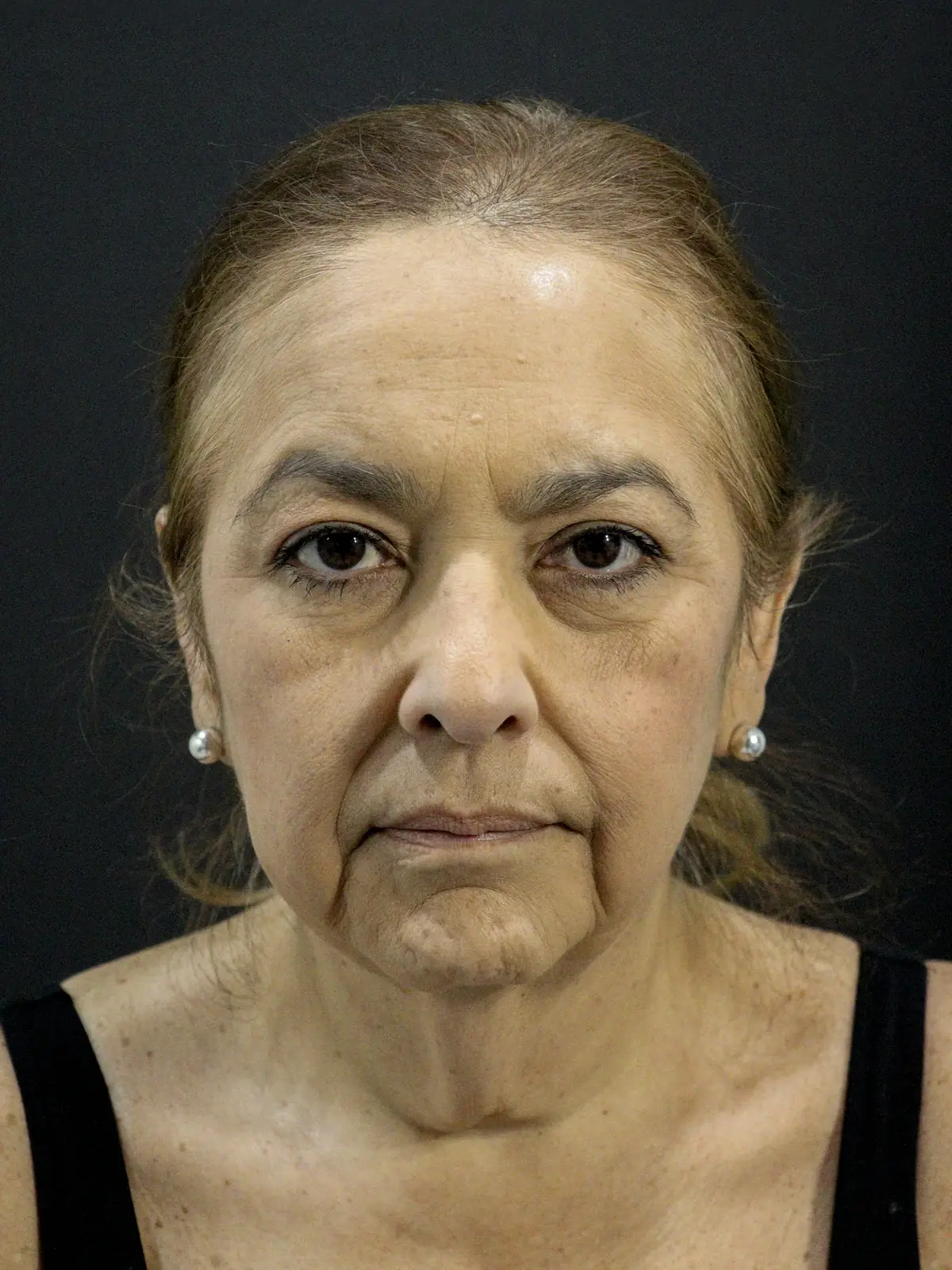
 BeforeAfter
Drag that slider slowly and pay attention to what refuses to move: the shape of her mouth, the position of her sideburn, the character of her smile. The jawline resolves and the midface rises, and yet nothing about her identity travels with the handle. That is the whole test. A natural result survives the slider. An operated one confesses in the first centimeter.
When I tell someone not to have a facelift
I said at the start that I would take the fear seriously, so let me be honest about the cases where the right answer is no, or not yet, or not me.
If you are in your early forties with early jowling, good skin elasticity, and a well-defined neck, a facelift will work, but you may not need it yet, and I will often say so. Operating early buys refinement, not transformation, and some patients are better served waiting a few years so that one excellent operation covers more ground. There is no virtue in surgery performed before its time.
If what you want is a different face, I am the wrong surgeon, and truthfully surgery is the wrong tool. A facelift repositions your own anatomy. It will make you look like yourself a decade or so ago; it will not make you look like the person in the photograph you brought. Patients who arrive wanting a new identity rather than a restored one need a longer conversation, and sometimes the most valuable thing I can offer is a referral to talk that through before anyone talks about incisions.
If your motivation arrived last month with a divorce, a layoff, or a loss, I would rather you wait. Surgery performed as a response to a crisis carries emotional risk that has nothing to do with technique, and no result, however good, resolves grief.
And if you are shopping for the cheapest date on a calendar rather than for a surgeon, someone will take the booking, but I hope it is not anyone. The failure modes in this article are not distributed randomly. They cluster where facelifts are performed fast, in volume, by the least experienced hands available, because tension on skin is quick and work in the deep plane is not. I say this as a surgeon in Tijuana who has spent a career watching Americans assume that crossing a border means accepting that trade. It does not. Geography does not determine technique; the individual surgeon does, and you should interrogate a surgeon in Beverly Hills and a surgeon in Mexico with exactly the same questions about layers, vectors, earlobes, and revision policies. The answers, not the address, tell you what your face will look like in five years.
The question I ask before every operation
At the end of every planning session, with the photographs on the screen and the vectors drawn, I ask myself one question: when this woman walks into her sister’s kitchen at Thanksgiving, what does her sister see?
If the honest answer is “a facelift,” something in the plan is wrong, and the plan changes. If the answer is “she looks wonderful, did she change her hair, has she been on vacation,” the plan is right. That standard, applied for 37 years, is the entire secret, and you will notice it has nothing to do with ambition and everything to do with restraint exercised in the correct anatomical layer.
The woman with the folder of warning photos had her surgery late last year. At her follow-up she told me her book club spent an entire evening trying to figure out what she had done, and the winning theory was a new skincare regimen. She never corrected them. That is not a promise of what your outcome will be, individual results vary and every face presents its own anatomy, but it is a faithful picture of what this operation is designed to do when it is designed around you.
The fear is not the surgery. It is looking like you had one. And the answer to that fear was never to avoid the operating room. It was to avoid the specific, well-documented mechanics that read as surgery: the sideways pull, the loaded skin, the branded earlobe, the subtracted volume, the stacked filler, the forgotten neck. Every one of them has a name, and every one of them stays out of your future when the person holding the scalpel plans in the deep layer and lifts along the path your face actually fell.
If you want to know what that plan would look like on your anatomy specifically, the place to start is a consultation where I study your photographs and tell you, honestly, which of these mechanics matter for your face, and whether now is even the right time. Bring your folder of warnings. I take them seriously.