
Let me decode this one quickly, because I owe you a straight answer before anything else: there is no operation called the ponytail facelift. The American Academy of Facial Plastic and Reconstructive Surgery says it on their own patient page, in plain language, that there is no single standardized surgical definition for a ponytail lift. It is a marketing term rather than a medical term, and the technique varies widely depending on the surgeon selling it. When a patient in California emails me asking whether the ponytail facelift is worth it, my first job is not to answer yes or no. My first job is to find out what she was actually offered, because two very different things are wearing that name right now, and they have almost nothing in common.
One of them is a real, published, technically demanding operation with a 22 year track record in a single surgeon’s hands. The other is a loose family of short scar mini lifts, suture suspensions, and sometimes thread lifts that borrowed the name because it photographs well on social media. Whether the ponytail facelift is worth it depends entirely on which of the two you are being sold, and whether your face is the face it was designed for. For most of the patients who ask me, and I will show you why, the honest answer is no. Not because the concept is a scam, but because they are standing in front of the wrong tool.
I have spent 37 years and more than 3,000 facelifts learning that the name of an operation tells you what the marketing department did. Only the plane of dissection tells you what the surgeon did. So let us go through the planes.
The name has a real history, and it is more interesting than the ads
A marketing name, not a standardized operation. Originally it described one surgeon’s endoscopic deep plane technique with incisions hidden in the hairline and a strongly vertical pull, like hair gathered into a high ponytail. Today most clinics use the name for short scar mini lifts that share the branding but not the anatomy. The term traces back to Dr. Chia Chi Kao in Los Angeles, and I want to be fair to him, because the original version is serious surgery. In 2024 he published his experience in the Aesthetic Surgery Journal: 22 years, 600 consecutive patients, an endoscopic technique that enters through small incisions concealed in the hairline, dissects underneath the SMAS in the deep plane, and repositions the face along a vertical vector. The visual signature, cheeks and brows lifted the way they rise when you pull your hair up tight, is where the name comes from.
Read that carefully, because it contains the joke the market never tells you. The original ponytail lift is a deep plane operation. It works in the same anatomical layer I work in. It releases and repositions the deep structures of the face. It is long, meticulous, endoscopic surgery with a steep learning curve, performed by a surgeon who spent two decades refining it. Whatever you think of the branding, the published version is not a lunchtime procedure.
And that is precisely why the version most patients are quoted has so little to do with it. A technique that difficult does not scale across thousands of clinics. The name scaled instead. It detached from the operation, floated across the internet, and landed on whatever each practice already offered. The AAFPRS lists the aliases the term now travels with: mini facelift, short scar facelift, limited incision facelift, weekend facelift. Different names, one shared trait, a much smaller scope than a standard facelift.
What most clinics mean when they sell you one
When a patient forwards me a quote for a ponytail lift, the operation described underneath the branding is usually one of three things.
Most often it is a short scar lift in the family of the MACS lift, the minimal access cranial suspension technique that Tonnard and Verpaele published in Plastic and Reconstructive Surgery in 2002. It is a legitimate, well documented operation: a shortened incision in front of the ear, a limited skin flap, and long purse string sutures that gather the SMAS and suspend it upward to the sturdy fascia above. Notice the verb. The SMAS is gathered and hung, not entered and repositioned. The retaining ligaments that anchor a descending face stay exactly where they were.
The second version is a suture suspension or S-lift variant, an even lighter cousin. A small incision, a stitch or two placed to cinch the superficial tissues, minimal undermining. The third, and I see this more than I would like, is a thread lift wearing surgical vocabulary, barbed sutures passed under the skin through punctures, no incision at all. Some clinics market that as a scarless facelift. I would rather you hear it from me plainly: there is no scarless operation that repositions the deep structures of the face. What has no scar has no access, and what has no access moves nothing that is anchored.
None of this makes those procedures illegitimate. Tonnard’s papers are honest about what the MACS lift does and does not do, and a well selected patient can do nicely with one. My quarrel is never with the surgeons who perform short scar lifts on the right faces. My quarrel is with a label that lets a thread lift, a purse string suspension, and a 600 case endoscopic deep plane series all answer to the same two words, so that the patient cannot tell which one she is buying.
Does a ponytail facelift touch the SMAS?
Usually barely, and the distinction between touching the SMAS and working beneath it is the entire argument. So let me slow down here.
The SMAS is the fibromuscular sheet that sits under the skin of your face like the canvas under a painting. Every facelift worth the word does something to it, because pulling skin alone stretches and fails. The question that separates operations is not whether the SMAS is involved but how. A plication folds the sheet on itself with sutures, from above. A suspension gathers it with a purse string and hangs it from a fixed point, which is the MACS approach. A deep plane operation goes underneath the sheet, releases the retaining ligaments that tether it to the bone, and moves the whole composite of skin, fat, and muscle as one piece, so it settles into a new position without tension on the skin. That is the operation Sam Hamra described in Plastic and Reconstructive Surgery back in 1990, and it is the lineage of the deep plane facelift I perform today.
Here is the mechanical consequence, and it is not a matter of opinion. A face that has genuinely descended is held down by its ligaments the way a tent is held by its stakes. Folding or cinching the canvas while the stakes remain planted gives you a tighter canvas and the same stakes. Under load, over months, sutures placed in tension gradually let the tissue drift back. Release the stakes, move the tent, and let it heal where you set it, and the result rests on healed anatomy instead of on stitches. If you want the full taxonomy, I have written a longer comparison of deep plane, preservation, and SMAS techniques, but for today’s question one sentence carries it: most operations sold as ponytail lifts work on top of the SMAS or hang it from a thread, and almost none of them release what is actually holding your face down.
So when a consultation coordinator tells you the ponytail lift “lifts the deep tissues,” ask the only question that matters: at what plane do you dissect, and what do you release? A surgeon doing real sub SMAS work answers in seconds, with anatomy. A pause, a pivot back to the brand name, or the phrase “proprietary technique” is itself a finding.
What each version can honestly claim
I promised you a fair comparison rather than a sales chart, so here is the honest ledger. These are the claims a deep plane facelift can make on the evidence, and the claims most marketed ponytail style lifts cannot.
- A deep plane releases the retaining ligaments and repositions cheek, jowl, and midface as one composite, so the skin carries no tension
- It reaches the neck: when combined with platysma work it addresses bands, blunted jawlines, and true neck laxity
- Published series characterize its longevity at roughly a decade or more before patients seek a secondary lift
- It restores structure rather than tightening the surface, which is why it can look natural in motion, not only in photographs
- No standardized definition: two clinics selling a ponytail lift may be describing operations as different as a thread lift and endoscopic surgery
- Most versions fold or suspend the SMAS rather than releasing it, so heavy jowls and descended midfaces are beyond their reach
- Short scar access largely bypasses the neck, so platysmal bands and loose neck skin remain untreated
- Results in the mini lift family are commonly quoted at 5 to 10 years, with the lighter suture versions at the short end of that range
Notice what the list does not say. It does not say a short scar lift is a con, and it does not say a deep plane is right for everyone. It says the two operations answer different problems, and the label ponytail hides which problem yours is.
How long the results actually hold
The most useful number I can give you comes from a study published this year in Facial Plastic Surgery and Aesthetic Medicine. Levin and Frankel reviewed 30 years of deep plane facelifts and measured how long patients went before returning for a secondary lift. The mean interval was 10.9 years. Patients who had their first operation at age 53 or younger averaged 12.4 years. That is not a promotional estimate; it is the observed behavior of real patients over three decades, and it matches what I see in my own practice, where I now operate on patients whose first facelift with me was more than a decade ago.
Against that, the AAFPRS patient guidance for the mini and short scar family says many patients enjoy their improvement for 5 to 10 years, and in my experience the versions that rely on suspension sutures alone sit at the bottom of that range, sometimes well below it when the patient’s laxity was more than the operation could carry. The pattern is mechanical, not mysterious. A result that hangs from stitches placed under tension relaxes as the stitches relax. A result built on released and healed anatomy relaxes only as fast as you age.
Two honest qualifiers, because I refuse to oversell my own operation. First, longevity numbers describe populations, not individuals; skin quality, weight changes, sun, smoking, and genetics move every patient up or down the curve, and individual results vary. Second, a deep plane does not stop time. At 10 years you will not look the way you looked the week the swelling settled. You will look like yourself, aging forward from a better position, which is the only promise aging surgery can honestly make.
Two patients, one name, opposite answers
Let me make this concrete with two women who wrote to me in the same week, both asking about the same branded lift.
The first was 34, from Orange County. Early softening along the jawline, excellent skin that snapped back when she pinched it, a strong chin, no real neck laxity. She had been quoted a ponytail lift and wanted to know if she was being fooled. My answer surprised her: she was one of the few people for whom a light, short scar procedure is a reasonable conversation, and frankly, so was the option of doing nothing for a few more years. Her tissues still held themselves. A deep plane at her age, for her anatomy, would have been more operation than her face was asking for, and I told her so. I do not operate on faces that do not need me yet.
The second was 58, from San Diego, after significant weight loss. Heavy jowls that sat below the jawline, deep folds beside the mouth, visible platysmal bands, loose skin under the chin she could gather between two fingers. She had been quoted the same ponytail lift, by name, at another clinic. For her anatomy that recommendation was not a smaller version of the right answer. It was the wrong answer. No purse string in the cheek reaches a descended neck. No thread carries a jowl that gravity has been working on for two decades. The AAFPRS page says this in its own careful way, that mini lifts cannot address severe neck laxity or significant sagging. I will say it less carefully: selling a short scar lift to a heavy neck is how you create a patient who says facelifts do not work.
She had a deep plane facelift with platysma repair. Her jawline at one year is the kind of result the branded lift she was first offered could not have approached, because the operation she needed had to release and reposition what the other one would only have cinched. Individual results vary, and I show every patient cases that match their anatomy rather than my favorites.
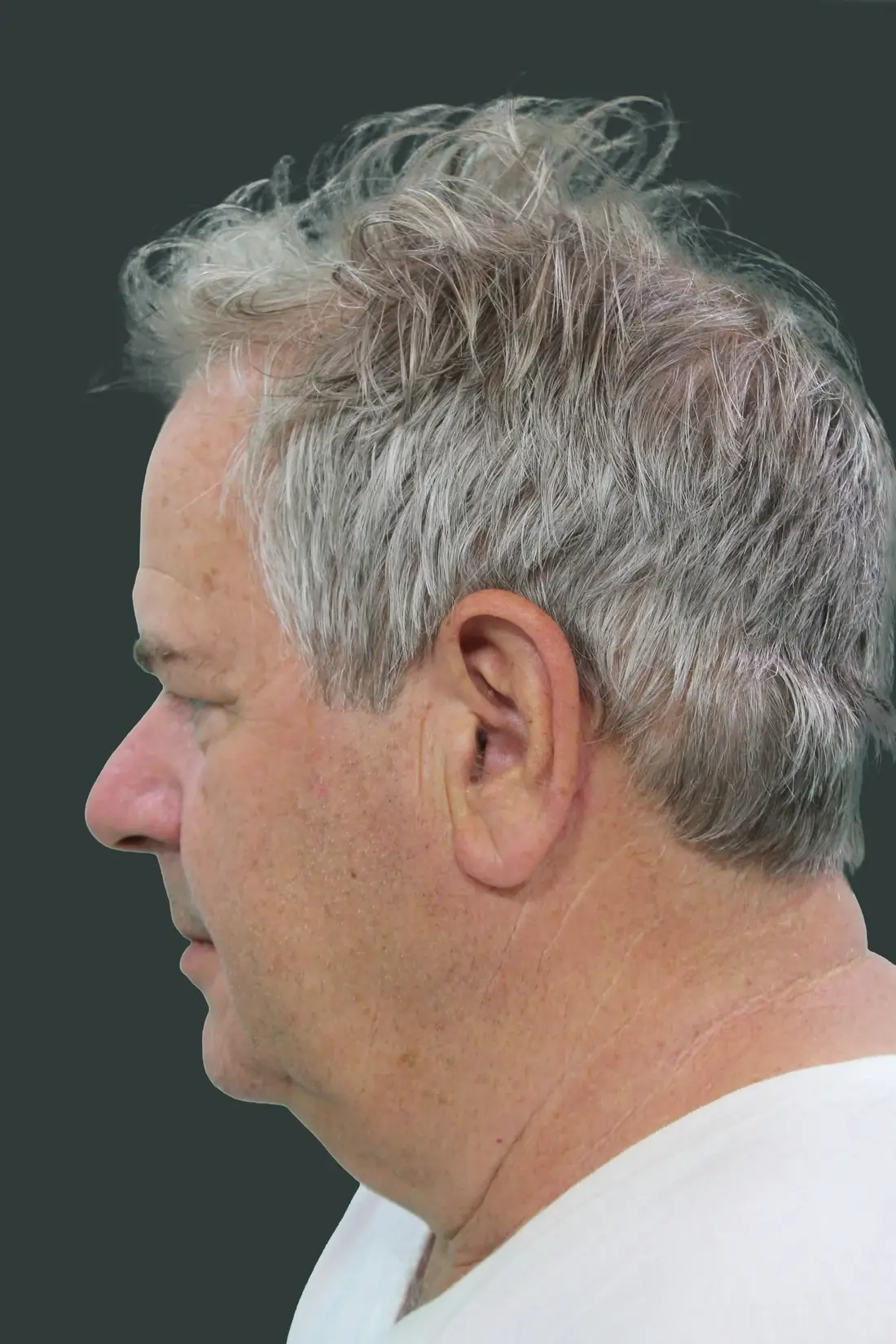
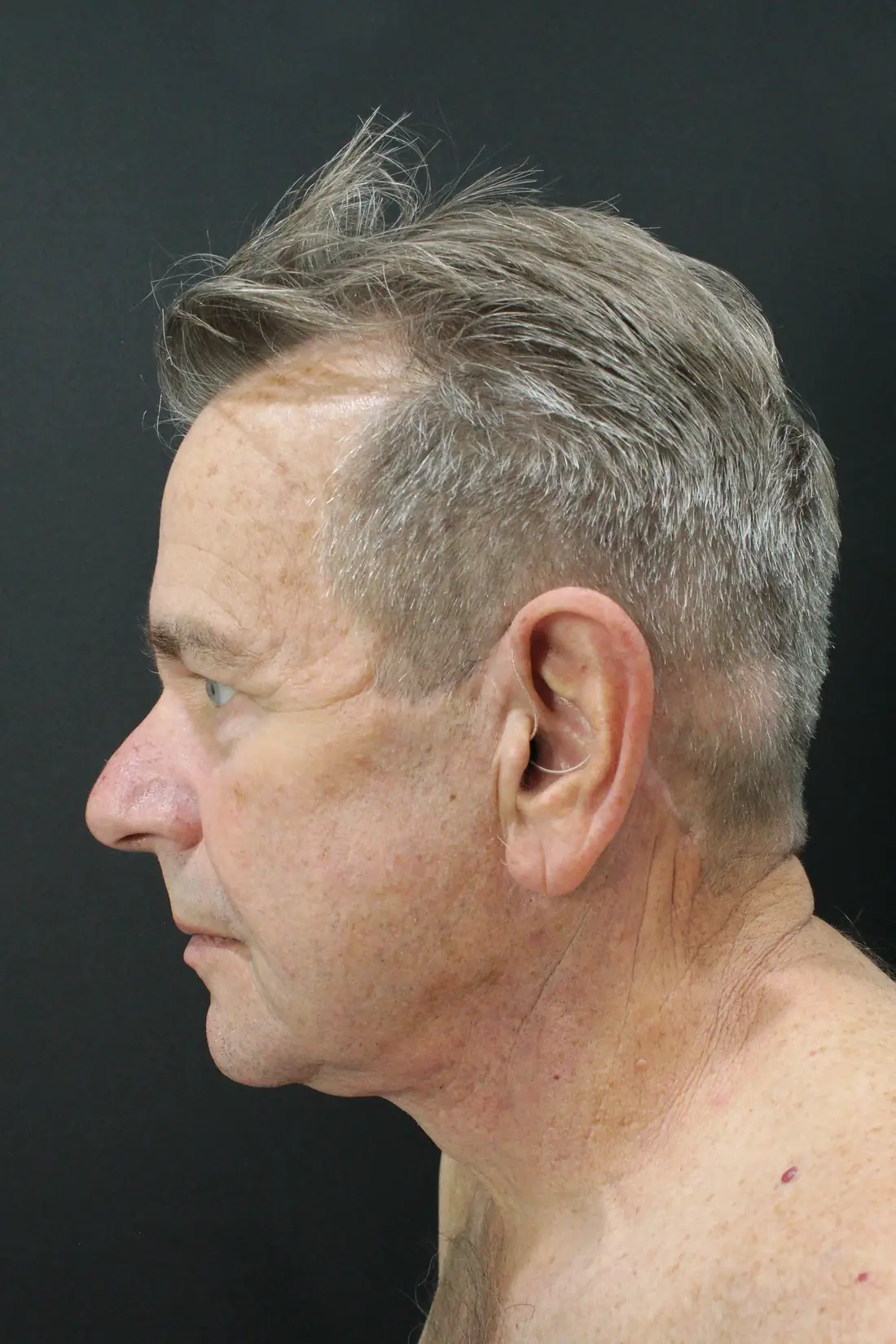 BeforeAfter
The dividing line between those two women is not age on a driver’s license. It is laxity, skin recoil, and above all the neck. The AAFPRS puts typical short scar candidates between the late 30s and early 50s with good elasticity and early to moderate change, and I would tighten that further: the moment the neck is truly involved, every version of the ponytail lift is off the table, whatever the clinic’s photographs suggest.
Learn to read the photographs
Since the ponytail lift lives on before and after photographs, you should know how those photographs are staged, because the staging is half the operation.
Look at the hair first. In a remarkable number of ponytail lift results, the after photo shows the hair pulled up high and tight, which is itself a mechanical lift of the temple and lateral brow. Ask to see the same patient with her hair down. Look at the chin next. A chin raised even a few degrees tightens the neck and sharpens the jawline in any human being, operated or not, so insist that before and after were shot at the same angle, same lighting, same lens distance. Then look at the date. Photographs taken at six weeks flatter every lift, because swelling is still doing some of the lifting; the honest comparison is one year, when the sutures have long since surrendered whatever they were going to surrender. And finally, look at the necks. If a gallery selling a short scar lift shows you only faces from the front, cropped above the jaw, that crop is a confession.
None of this requires expertise. It requires only the willingness to look at photographs the way the clinic hopes you will not. I hold my own galleries to the standard I just described, matched angles, hair down, one year out, necks included, because a gallery that cannot survive those rules is not evidence of anything.
Small incisions are not small surgery
There is a quiet assumption inside the marketing, that a smaller scar means a safer, more trivial procedure. The published record says otherwise, and the most instructive numbers come from the ponytail lift’s own inventor.
In Kao’s 600 case series, transient facial nerve weakness occurred in 4.88 percent of patients. Every one of those recovered, permanent injuries were zero, and skin necrosis was zero, numbers that reflect real skill and honest reporting, and I cite them with respect. But sit with that first figure. Roughly one patient in 20 woke with a temporarily weak branch of the facial nerve, in the hands of the surgeon who spent 22 years inventing and refining the operation. That is what it costs to work near the facial nerve through small access ports, even at the top of the field. Now imagine the same anatomy approached by a clinic that adopted the brand name last spring.
This is the paradox patients rarely hear: limited access can raise difficulty rather than lower it. A short incision means the surgeon sees less, controls bleeding through a smaller window, and works at a greater distance from the nerve branches that animate your smile. I am not telling you this to frighten you away from small operations. I am telling you because the decision deserves the same seriousness either way, and because it changes what you should ask about the environment around the surgery, not just the surgery.
In my practice every deep plane facelift is done under general anesthesia with a board certified anesthesiologist, Dra. Nadiezhda Garcia Bonilla, physically present from the first minute to the last, in a Quad A accredited surgical facility. Some excellent surgeons now perform deep plane work awake under local anesthesia, and I will not disparage them; it is a legitimate trend with thoughtful people behind it. I have simply concluded, over thousands of cases, that a fully monitored, fully asleep patient gives me the stillest field and the widest safety margin for an operation this close to the facial nerve, and gives the patient a morning she does not have to be brave through. That is a choice about comfort and control, and I own it.
So, is the ponytail facelift worth it?
For a narrow slice of patients, younger faces with early laxity, good skin recoil, and no real neck involvement, a well performed short scar lift can be worth having. That is the honest yes, and it carries one condition: the operation must be sold as what it is, a lighter procedure with a shorter reach and a shorter life. If that describes you, my main advice is to make the surgeon define the operation in anatomical terms before you agree to anything with a cute name on it.
For most of the people typing this question into a search bar, and the search data tells me they are largely women in their 50s with jowls and necks that bother them, it is not worth it, and the reason is arithmetic you can do without a single price attached. Surgery in the United States is expensive, and even in my practice, where American patients pay a much smaller fraction for the identical standard of operation, a facelift is a real investment. So think in cost per year of result, and think in operations per decade. An operation that cannot reach your jowls or your neck does not become a bargain because the invoice is smaller; you have paid real money to keep your problem, and the correction still lies ahead of you, now with scar tissue in the field. A lift that relaxes in a handful of years, next to one that holds for around a decade, means you may buy the operating room twice to cover the same span once. And revision surgery after a tension based lift is frequently harder than a primary would have been, because the planes are scarred and the skin has already been drawn.
I have re operated on many patients whose first procedure was a lighter lift that could not carry their anatomy. They are not foolish people. They were offered something that sounded proportionate, gentler, easier to say yes to, and nobody drew them the picture of what it could not do. That picture is the entire purpose of this article.
There is one more piece of worth it that has nothing to do with money, and that is recovery. The weekend facelift branding implies you will be at brunch by Sunday, and for the lightest suture versions the visible downtime truly can be short. But a MACS style short scar lift is still surgery: expect real bruising and swelling for a week or more, and a face you are happy to be photographed with somewhere in the second to third week. A deep plane asks for more, drains for the first days, sutures out around day 7, most patients socially comfortable at 2 to 3 weeks, with quiet settling continuing for months. Individual results vary. So the recovery difference between the two is genuine, but it is a matter of one week against two or three, not of a weekend against a season. If a smaller operation undertreats you, you have spent most of the same recovery, the same anesthesia or sedation, the same explaining of your absence, on a result that may quietly bother you within a few years. Patients rarely price that in. I do it for them.
When I would tell you not to have a deep plane
I would be doing to you exactly what I have criticized if I ended this piece implying the bigger operation is always the answer, so here is the other side, plainly.
If you are in your 30s or early 40s with early midface softening and a clean neck, I will usually tell you that you are early, and that early is a good problem. Skin care, sun discipline, perhaps modest volume work, and time. When you are ready, being younger at your first lift is an advantage the longevity data actually rewards. If your concern is skin texture rather than descent, sun damage, fine wrinkling, etching around the mouth, no lift of any name fixes that; resurfacing does, and I offer Morpheus8 and laser based options for exactly those patients, honestly framed as texture tools rather than lifting tools. If your health does not permit elective surgery under general anesthesia, or your expectations and the mirror cannot be reconciled, the right operation is none, and I have written separately about who should not get a facelift at all.
And there are patients who should not choose me specifically, whatever their anatomy. My practice is built for fly in patients, most of them American, with a local stay of about 6 days, sutures out on day 7, and structured remote follow up afterward, coordinated from San Diego, where I have held California license A 42463 since 1986. That model works beautifully for people who can travel and who value a surgeon they can actually reach across the border afterward. It is the wrong model for someone who wants weekly in person visits 15 minutes from home, or whose health needs day to day physical supervision. I would rather send that patient to a good local colleague than fit her into a system that does not serve her. Saying so costs me nothing and has saved more than one patient from the wrong decision.
One question beats every brand name
A last story, because it compresses everything above. A patient in her early 50s came to a video consultation with three quotes, from three cities, for three operations named after hairstyles and weekends. She had stopped trying to compare them and I do not blame her; the names are designed to resist comparison. We set the brochures aside and I asked her to ask each surgeon two questions instead. At what plane do you dissect, and what do you release? Then one request: show me before and after photographs of necks like mine, at one year, not at six weeks.
The quotes sorted themselves within a day. One surgeon answered in clean anatomical sentences. One sent a brochure back. One never replied. She did not need me to referee after that, and the operation she eventually chose, with the surgeon who answered, was defined by its plane and not by its name. That is every bit of consumer protection I can give you in one paragraph, and it works on me too. Ask me the same questions and I will draw you the layers myself.
So, is the ponytail facelift real? The name is real, the original operation behind it is real and demanding, and the version most people are quoted is a short scar lift wearing a borrowed costume. Is it worth it? If you are young, elastic, and your neck is untouched by time, perhaps, from a surgeon who will define it anatomically. If you found this article because your jowls or your neck brought you here, the honest answer is that you are shopping in the wrong aisle, and the operation you are actually asking about is a deep plane. If you want to know which patient you are, send me your photographs and book a consultation; I review every case myself, and telling you what you do not need is the part of this job I have come to enjoy most.