
The patient I keep thinking about had lost 58 pounds on semaglutide over a year and a half, and she was rightly proud of it. Her labs were better, her knees were better, her sisters wanted her prescription. But in my consultation room she opened her phone, held up a photo of herself from three years earlier, heavier, and asked the question that had carried her from Orange County to Tijuana: why did I look younger then?
Then came the second half of her story, which I now hear almost every week. She had taken that same photo to an injector first. One syringe of hyaluronic acid filler in each cheek. She thought she saw an improvement for a few weeks, then the same tired face came back. Two more syringes a few months later. Then filler in the folds beside her mouth. Then a line of it along the jaw. Fourteen months and many appointments in, her face did not look younger. It looked fuller and older at the same time, wider through the middle, heavier along the jawline, and somehow still hollow at the temples. Her exact words were, the filler stopped working.
The filler had not stopped working. It was doing exactly what filler does, which is occupy space and add weight. The problem was the diagnosis, not the product. Her face had not simply lost volume after the weight came off. It had also descended, and volume injected into a descended face rides the loose tissue downward. You cannot inflate your way out of a structural problem. After 37 years in practice and more than 3,000 facelifts, I can tell you that trying to is one of the most common ways a patient with the best intentions makes a good face worse.
This article is for the person who is several syringes into that experiment and beginning to suspect what she suspected. I want to hand you the distinction that explains it, deflation versus descent, and an honest way to work out which one you are living with before you spend anything else on the wrong answer.
What rapid weight loss actually takes from a face
Begin with what the medication did, because it explains the mirror. GLP-1 medications produce weight loss on a scale prescriptions simply did not deliver before. In the pivotal trial of semaglutide for obesity, adults lost on average about 15 percent of their body weight over 68 weeks, against about 2 percent with placebo. And this is no longer a niche experience. A KFF national poll found that roughly 1 in 8 American adults reported having taken a GLP-1 drug, with about half of those taking one at the time they were asked. Millions of faces are attached to those bodies, and the face does not get a vote when the weight leaves.
Here is the part most patients have never been told. Facial fat is not a single sheet under the skin. It is partitioned into separate compartments, superficial and deep, each with its own boundaries and its own behavior, something Rohrich and Pessa mapped in cadaver studies in 2007. The deep compartments matter most for how young a face reads, because they sit against the bone and push the cheek forward like the framing inside a wall. When rapid weight loss drains those deep compartments, the overlying tissue loses its shelf. The cheek does not just look thinner. It loses the support that was holding everything above the jawline where it belonged.
Meanwhile the envelope does not shrink to match. Skin that spent years stretched over a fuller face has been remodeled by that time, and past our forties, when collagen production is already declining, it has limited ability to snap back. So the injury is double: less stuffing, same envelope. Add the speed, because a face that empties over eighteen months gives the skin far less time to adapt than the same loss spread over a decade, and you get the look the internet named Ozempic face.
I want to be fair to the medication. Semaglutide does not attack the face. Bariatric surgery patients have lived with exactly this deflation for decades, and I have operated on many of them. The drug simply made dramatic, rapid weight loss common enough that the facial consequences became a household topic. If your health is better for the weight loss, the trade was worth it. The face is a solvable problem. But it has to be solved with the right tool, and that requires naming what actually happened.
Deflation and descent are two different injuries
Deflation is missing volume. The compartments emptied, the shelf dropped away, and the face reads gaunt: hollow temples, a skeletal under-eye, a flat mid cheek, sometimes a crepey texture because the skin is draping over less. A purely deflated face looks tired and thin, but its architecture is still in place. The jawline is still a clean line. The jowl has not arrived.
Descent is different. Descent means the supporting structures, the SMAS layer and the retaining ligaments that pin the soft tissue of the face to fixed points, have let go, and tissue has migrated downhill. The tell is that the volume did not vanish. It moved. The fullness that used to live high on your cheek now sits beside your mouth and along your jaw. The folds beside your nose deepened not because something grew there but because the cheek above them fell onto them. The jowl is not new fat. It is your own cheek, arrived at the wrong address.
Look at your own photographs with that lens and the confusion starts to clear. If the young photo shows fullness up high that the current mirror shows down low, you are not only deflated. You are descended. And here is the trap that catches the GLP-1 patient specifically: rapid major weight loss almost always produces both at once. The deep compartments empty, which is deflation, and the loss of that support plus the suddenly oversized skin envelope lets the remaining tissue slide, which is descent. Two injuries, one mirror, and only one of them can be treated with a syringe.
The further left your face sits, the more restored volume, filler or your own fat, can genuinely help. The further right, the more added volume becomes added weight, and the answer is repositioning what fell. Most faces after major GLP-1 loss land in the middle, which is why single-tool plans disappoint. Individual results vary.
Why filler makes a descended face heavier, not younger
Filler at its best restores volume precisely where anatomy lost it. That is a real and legitimate job. But watch what happens when the same product meets descent.
An injector looking at a deep fold beside the mouth has two classic moves. The first is to fill the fold itself. But that fold is not a valley that needs leveling. It is a shoreline, the line where the fallen cheek piles up against tethered skin. Filling it builds a soft berm on top of the pileup, and the lower face reads wider and heavier, exactly what my patient saw after her third round.
The second move sounds more sophisticated: fill the cheek above, and let the projection lift the fold from a distance. There is a grain of truth in it, and in a young face with early hollowing it can look lovely. In a face with real descent it fails for a blunt mechanical reason. Milliliters produce millimeters. A syringe holds about one milliliter, roughly a fifth of a teaspoon, and no plausible number of them can re-suspend tissue whose ligaments have released. What each syringe reliably does add is weight, a gram or so at a time, loaded onto a scaffolding that is already failing. Weight obeys gravity. Six months later the new volume has settled into the same downhill drift as everything else, the face is rounder through the middle, and the patient concludes she needs another syringe. The product gets blamed. The diagnosis was wrong from the first appointment.
There is also the matter of what the extra volume does to identity. A deflated and descended face that gets progressively filled does not travel back toward its own younger self. It travels toward a different face, rounder, blurrier, more uniform, the overfilled look you can now recognize across a restaurant. Patients tell me they looked “done” without ever looking lifted. That is the signature of volume answering a question that structure was asking.
Does Ozempic cause facial sagging?
Not directly, and the distinction matters for how you fix it. Semaglutide and the other GLP-1 medications do not act on skin, ligaments, or the SMAS. What they do is remove, quickly, the fat that was quietly splinting a face whose support was already loosening with age. At 32, a face can give up that fat and the skin recoils. At 54, with two decades of collagen decline and sun already banked, the same loss uncovers laxity that the fullness had been hiding all along. The drug did not sag your face. It took away the packing material and let you see the sag that time had already built.
This is why the same medication produces such different faces in different patients, and why the question “does Ozempic ruin your face” has no single answer. The variables that matter are your age, your skin quality, how much you lost, and how fast. For many of the women I see, there is a further variable stacked on top: the weight came off in the same years menopause arrived, when skin is already thinning and losing its elastic recoil. I cannot tell those two forces apart in the mirror and neither can you, but the practical point is the same. The less rebound your skin has left, the more a rapid deflation will read as sagging rather than slimming. It is also why the phenomenon is drug-agnostic. I see the identical pattern after tirzepatide, after bariatric surgery, after a determined year of diet and exercise. The face keeps a ledger of volume, and any large, fast withdrawal shows up on it. Individual results vary, and I mean that literally: I have consulted on patients who lost 70 pounds and needed almost nothing, and patients who lost 35 and needed a full plan.
One more honest note, because patients ask me whether they should regain a little weight to refill their face. I understand the impulse, and a small, deliberate stabilization at a comfortable weight is a conversation for you and your prescribing physician, not for a surgeon. What I can tell you from the operating room is that weight cycling is worse for the face than either endpoint, because every cycle stretches the envelope again. Pick the weight you can hold, hold it, and then let us solve the face you actually have.
The syringe arithmetic nobody does out loud
When a patient asks me how much filler an Ozempic face needs, she expects an amount. I answer with a different unit entirely, because the arithmetic is the argument.
A face that has lost a large fraction of its fat can be down dozens of milliliters across its compartments. A syringe is about one milliliter. Nobody sane injects dozens of syringes, so every filler plan for major deflation is by definition a partial answer, a highlight here and a patch there, repeated at intervals, forever. That is manageable in a lightly deflated face. In a substantially deflated and descended one, it becomes a treadmill: each round buys a briefer improvement, each briefer improvement invites another round, and the total volume in the face quietly climbs.
Quietly is the key word, because filler outlives its own marketing. We used to tell patients hyaluronic acid lasts six months to a year. Then radiologists started looking. An MRI study published in Plastic and Reconstructive Surgery tracked hyaluronic acid filler persisting in the face for more than two years after injection, without migrating on its schedule, and a later review of MRI findings in patients years out from their last injection found residual filler in every single face examined, in some cases many years later. Your injector is not lying to you about duration; the visible effect does fade. But the material itself, and the water it holds, can remain long after the “wear off” date, which means each annual refresh may be stacking onto a foundation of old product you both assume is gone.
Now run the treadmill for four or five years and look at the totals. A meaningful accumulation of gel in a face that needed repositioning, a slow drift toward the heavy midface, and a spend that, added up honestly over the years, stops being small, all of it purchased in installments so reasonable that no single appointment ever felt like the wrong call. I am not against injectors. I am against a chronic treatment plan for a structural diagnosis. If you have noticed that every round pleases you a little less than the one before, that is not your imagination and it is not a bad batch. It is the arithmetic announcing itself.
When filler is exactly the right tool
If your face is deflated but not descended, filler can be a genuinely good answer, and I say so in consultation more often than you might expect. I have no injectable to sell you across the border and no reason to talk you out of one that is working.
The face that does well with filler looks like this: usually in its late thirties or forties, moderate weight loss, good skin recoil, hollowing at the temples or under the eyes or the front of the cheek, and, decisively, a clean jawline with no jowl. That face has an emptiness problem, not a position problem, and modest amounts of well-placed volume from a skilled injector can carry it beautifully for years. Filler is also a legitimate bridge: if your weight is still moving on a GLP-1 medication, nobody should be operating on you yet, and a conservative syringe can keep you comfortable in the mirror while your body finds its new set point. And some patients simply do not want surgery at any price of looking older, which is a coherent position I respect. My job is to make sure you choose it with accurate information, not to march everyone to an operating room.
While I am being honest about tools: the energy devices have the same boundary. I use Morpheus8 and CO2 laser resurfacing in my own practice because they genuinely improve skin texture and crepiness, which matters in a deflated face. What they do not do, any more than filler does, is reposition descended tissue. A device that tightens the surface of a fallen cheek gives you a smoother fallen cheek. Every tool in this field is good at exactly one thing, and the entire game is matching the tool to the diagnosis.
How to tell which face you have before you spend anything else
Try this before your next appointment of any kind. Lie flat on your back, hold a mirror directly above your face, and look. If you like what you see noticeably better, if the folds soften, the jowl disappears, and the cheek seems to return home, gravity is a main character in your story, which means descent. A purely deflated face looks nearly the same lying down as standing up, just thin from every angle. It is not a scientific instrument, but it separates the two injuries more honestly than any brochure.
Then interrogate your photographs. Find one from five or more years ago at your heavier weight and put it beside the mirror. Ask where the fullness used to live and where it lives now. Fullness that used to sit high on the cheekbone and now pools beside the mouth and along the jaw did not evaporate, it relocated, and relocation is descent. Ask about your jawline specifically: a jowl that interrupts what used to be a straight line from ear to chin is displaced tissue, and no injectable removes displacement.
Watch your face in motion, too, not just at rest. Smile hard at the mirror and hold it. In a descended face, a big smile briefly does the lift’s job, bunching the fallen tissue back up onto the cheekbone, and for a second you glimpse the face you are missing. If animation flatters you dramatically more than repose does, that gap is structural, and it is telling you what kind of correction would close it. A deflated face, by contrast, often looks worse in a full smile, because the motion presses what little volume remains and the hollows deepen.
Finally, audit your own filler history, because it is diagnostic. Write down, roughly, how many syringes you have had and when, and whether each round satisfied you as much as the previous one. A flat or falling satisfaction curve with a rising syringe count is the classic signature of volume being asked to do a lift’s job. Bring that history to whoever you consult next, me or anyone else, because it changes the plan. A face carrying several years of layered product needs to be evaluated for what is actually still in there, and sometimes cleared, before anyone can see the real baseline.
What surgery does that filler cannot, and where your own fat belongs
Here is the part that reframes everything for the frustrated filler patient: a proper facelift is, among other things, a volume operation. Not because it adds anything, but because it returns your own displaced volume to its original address.
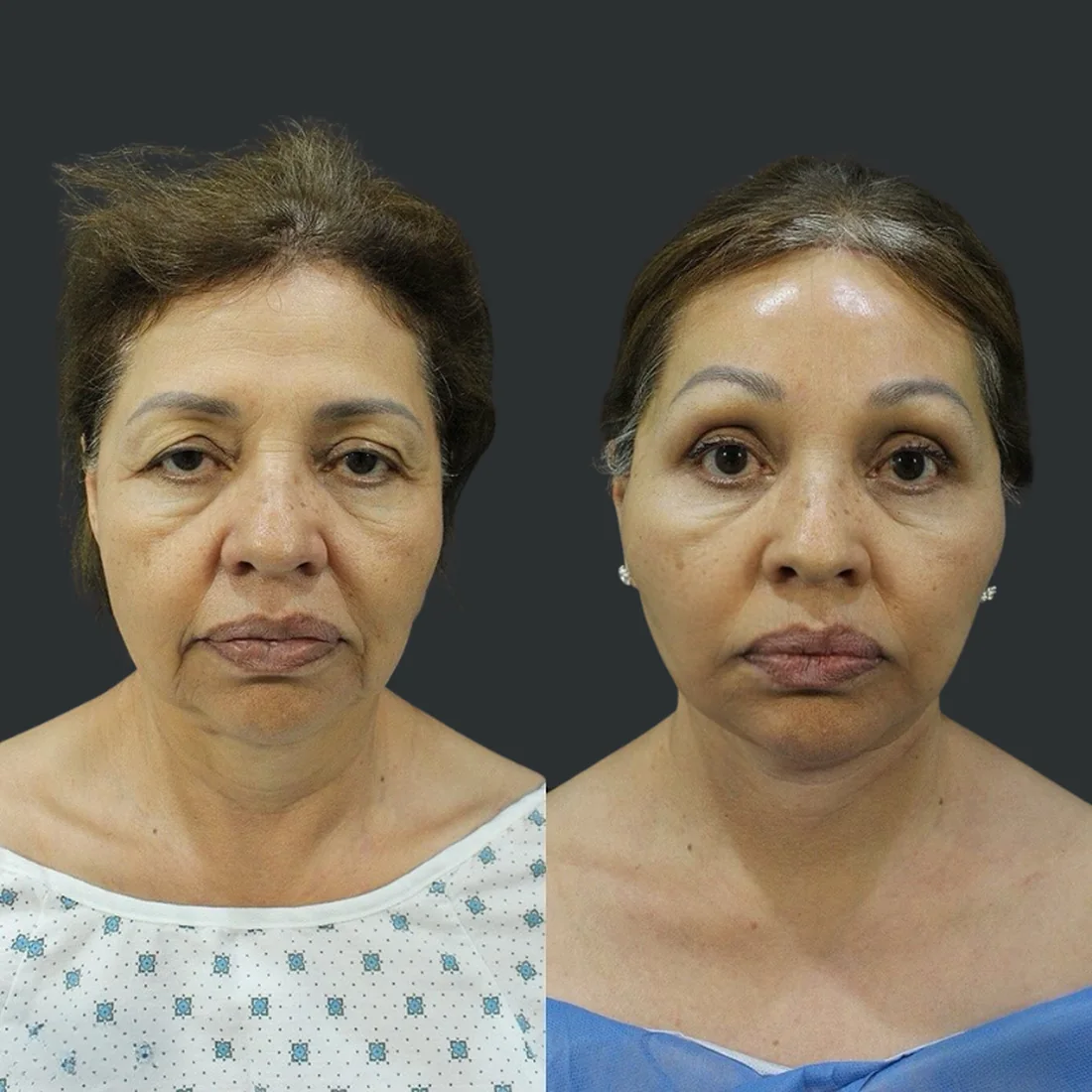
The operation I perform for these faces is the deep plane facelift, a technique whose lineage runs back to Hamra’s description of the deep plane rhytidectomy in 1990. Instead of pulling skin, or folding the SMAS layer from outside, I release the retaining ligaments that have tethered the fallen tissue and move the entire composite, muscle layer and fat and skin traveling together, back up as one unit. When the cheek fat that slid down over the years is repositioned onto the cheekbone where it started, the midface refills without a drop of anything injected. Patients see it and say the strangest, best thing: that looks like me. Of course it does. It is you, put back.
This is also why I tell patients that a high, thorough repositioning sometimes makes added volume unnecessary. If your “hollowing” was really your own fat sitting in the wrong place, the lift solves both problems at once. But repositioning cannot create matter, and after major GLP-1 loss the deep compartments are often genuinely empty, not just displaced. That is where fat grafting earns its place: your own living fat, harvested by gentle liposuction, refined, and placed in small careful amounts into the true hollows, on top of a freshly lifted, well-vascularized foundation. I decide between lift alone and lift with fat by examination, never by menu, and I warn my thinnest patients honestly that scarce donor fat means conservative grafting and variable retention. Individual results vary.
I am far from alone in this shift. The American Academy of Facial Plastic and Reconstructive Surgery’s most recent member survey reported a roughly 50 percent rise in fat grafting procedures in a single year, with nearly half of surveyed surgeons seeing more patients trying to address the facial effects of weight loss medications. The field is converging on the same conclusion this article has been circling: the Ozempic face is being over-served by product and under-served by diagnosis.
One adjacent finding from the exam, because weight loss unmasks it constantly: some patients discover that under the fullness they always had an under-projected chin. A weak chin shortens the jawline and makes the neck look fuller than it is, and in the right candidate a chin implant placed during the lift completes a line that no amount of soft tissue work could finish. I mention it only when the skeleton asks for it. It is an indication, not an add-on, and plenty of my weight loss patients need nothing of the sort. The broader map of when to operate after major loss, timing, staging, and what changes when the whole body has changed, lives on my page about a facelift after weight loss.
If your face is already carrying filler
Most of my GLP-1 patients arrive with product on board, sometimes years of it, and it has to be dealt with before surgery, not discovered during it. Old hyaluronic acid distorts the very landmarks I plan a lift around. It can mimic fullness in a compartment that is actually empty, hide the true depth of a fold, and blur the tissue planes I will be working in. Since the MRI evidence tells us filler routinely persists long past the date everyone assumed it dissolved, “I had that done years ago, it is long gone” is a sentence I no longer take at face value.
The answer is unglamorous and simple: hyaluronidase, an enzyme that dissolves hyaluronic acid filler, administered in one or occasionally two sessions, several weeks before surgery, so the swelling settles and I can examine and photograph your real face. Some patients find that step emotionally harder than the operation itself, because for a few weeks they meet the deflated, descended face the filler was papering over. I tell them what I will tell you: that face is the honest starting line, and every good result I have ever produced started from an honest starting line. I have written a full walkthrough of the process, the timing, and what those in-between weeks are like in my piece on dissolving filler before a facelift.
When I would tell you not to book a facelift
If your weight has not been stable for at least six months, I will not operate on you yet, whatever your face looks like today. A recent systematic review of the plastic surgery literature on GLP-1 facial changes lands on the same threshold, and the logic is not caution for its own sake. A face still shrinking is a moving target; if I lift and graft this month and you lose another 20 pounds by winter, the volume no longer matches the frame and the envelope has new slack I never had the chance to address. Stabilize first. The surgery will still be here.
There are others I turn away, or redirect. The purely deflated younger face I described earlier does not need me yet, and I say so; a good injector, or a conservative standalone fat transfer, serves her better than an operation she is a decade early for. The patient who wants her heavier face back is asking for something surgery cannot deliver, because a lift restores your framework, not your former fullness, and if we do not resolve that expectation in consultation we should not proceed. The patient with an event in four weeks needs a calendar, not a surgeon: you will be presentable sooner, but I want you to own your face again before you have to present it, and rushing the timeline serves nobody. And the patient whose GLP-1 medication, health history, or anesthesia risk needs work-up gets that work-up first, every time, coordinated with my anesthesiologist, because no jawline is worth a preventable complication. Individual results vary, and the honest corollary is that individual candidacy varies too.
None of this is reluctance. It is the same diagnostic discipline this whole article has argued for, pointed at myself. A surgeon who believes filler should not be prescribed reflexively has no business prescribing surgery reflexively.
Bring me the question, not the plan
My patient from the opening did, in the end, get her face back. We dissolved fourteen months of accumulated product, waited, photographed, and found underneath it a classic mixed picture: real deflation at the temples and deep cheek, real descent at the jowl and neck. A deep plane lift repositioned what had fallen, fat grafting refilled what was truly gone, and the syringe treadmill ended. She sent me a photo from her daughter’s graduation a year later. She looked like the woman in the old photo on her phone, minus the weight she had fought so hard to lose. That is the whole ambition, stated plainly.
If you have read this far, you probably do not need another product recommendation. You need the answer to one question: is my face deflated, descended, or both? Do the mirror test lying down. Pull the old photographs. Add up your syringes and your satisfaction. Then put the question to someone qualified to answer it with their hands on your face, whether that is me or a surgeon nearer to you. A consultation with me starts exactly there, unhurried and diagnostic, and for my California patients it is a shorter trip than most expect, just across the border from San Diego. Come with your history and your old photos. The face in them is not gone. Most of it is simply in the wrong place, waiting to be put back where you left it.