
A woman sat across from me last month, mid fifties, and before I could ask my first question she said, almost apologetically, “I have had a lot of filler.” Every six months or so for the better part of a decade. Cheeks, tear troughs, a little in the jawline, lips more than once. She had come to talk about a facelift because she felt the injections had stopped working, and she wanted to know one thing above all others. “When you lift my face, does all of that come out? Do I need to get rid of it first?”
It is one of the most common questions I hear now, and the honest answer is not the tidy yes or no that people want. So let me walk through it the way I would in the room, because the reasoning matters more than the verdict.
What actually happens to old filler when I lift your face
Here is the first thing to understand, because it reframes the whole question: a facelift and a syringe of filler do not work in the same layer of your face. They are not even neighbors.
When I perform a deep plane facelift, I am releasing and repositioning the deep tissue, the layer surgeons call the SMAS, and I am lifting the The triangular pad of fat that sits over your cheekbone and gives a youthful face its high, forward fullness. With age it slides down and inward, which flattens the cheek and deepens the fold beside the nose. A deep plane lift repositions this pad rather than just tightening skin over it. back to where it belonged a couple of decades ago. Most hyaluronic acid filler, on the other hand, was placed above that deep layer, in the fat compartments and the soft tissue closer to the skin. An MRI based case report that actually mapped where filler lives, and how long it stays, found that these products sit in defined superficial pockets and can persist far longer than patients are usually told, sometimes years beyond the point they assumed it was gone (Master, 2021).
So when someone asks whether a facelift “removes” their filler, the accurate answer is that it mostly does not. I am not tunneling through the exact plane where your cheek filler sits. I may pass near some of it, and some may shift as I move the tissue, but an operation designed to reposition deep structures is not a reliable way to evacuate a superficial gel injected in a different neighborhood. That single fact is why the filler question cannot be waved away. If the lift did erase it all, none of this would matter.
I will add what this looks like from my side of the drape, because patients are always curious. When I raise the facial flap in a patient with a heavy filler history, I sometimes see the product directly, small translucent pockets of gel in the superficial fat, occasionally a firmer nodule where old material was walled off by the body. Most of it I never touch, because it lives above my plane of dissection. What concerns me is not that it is dangerous sitting there. It is that I cannot predict how those pockets will settle once the tissue around them has been repositioned. A deposit that read as harmless fullness before the operation can read as an odd, isolated bump after everything around it has been lifted and refined. Unpredictability is the enemy of a precise result, and old filler is, above all else, unpredictable.
Does filler need to be removed before a facelift?
Not automatically, and anyone who gives you a blanket rule in either direction is not really examining your face. Plenty of my patients arrive with a sensible amount of well placed, relatively recent filler, and I leave it entirely alone. It is doing no harm, it is not distorting my landmarks, and dissolving it would only add swelling and an extra appointment for no benefit.
The times I do want it gone fall into a few honest categories: when the history is so long and layered I cannot tell what is you and what is product, when it has migrated from where it was placed, and when it is masking the true position of your tissues so completely that I would be planning surgery on an inflated face instead of your real one. Those situations are worth taking one at a time.
Where your filler is sitting, and why it matters to a lift
Picture two layers. Underneath is the architecture I operate on, the deep fat, the SMAS, the ligaments that hold your face up. On top, closer to the surface, are the compartments where filler was injected over the years. A lift raises the bottom layer. The filler rides on the top one.

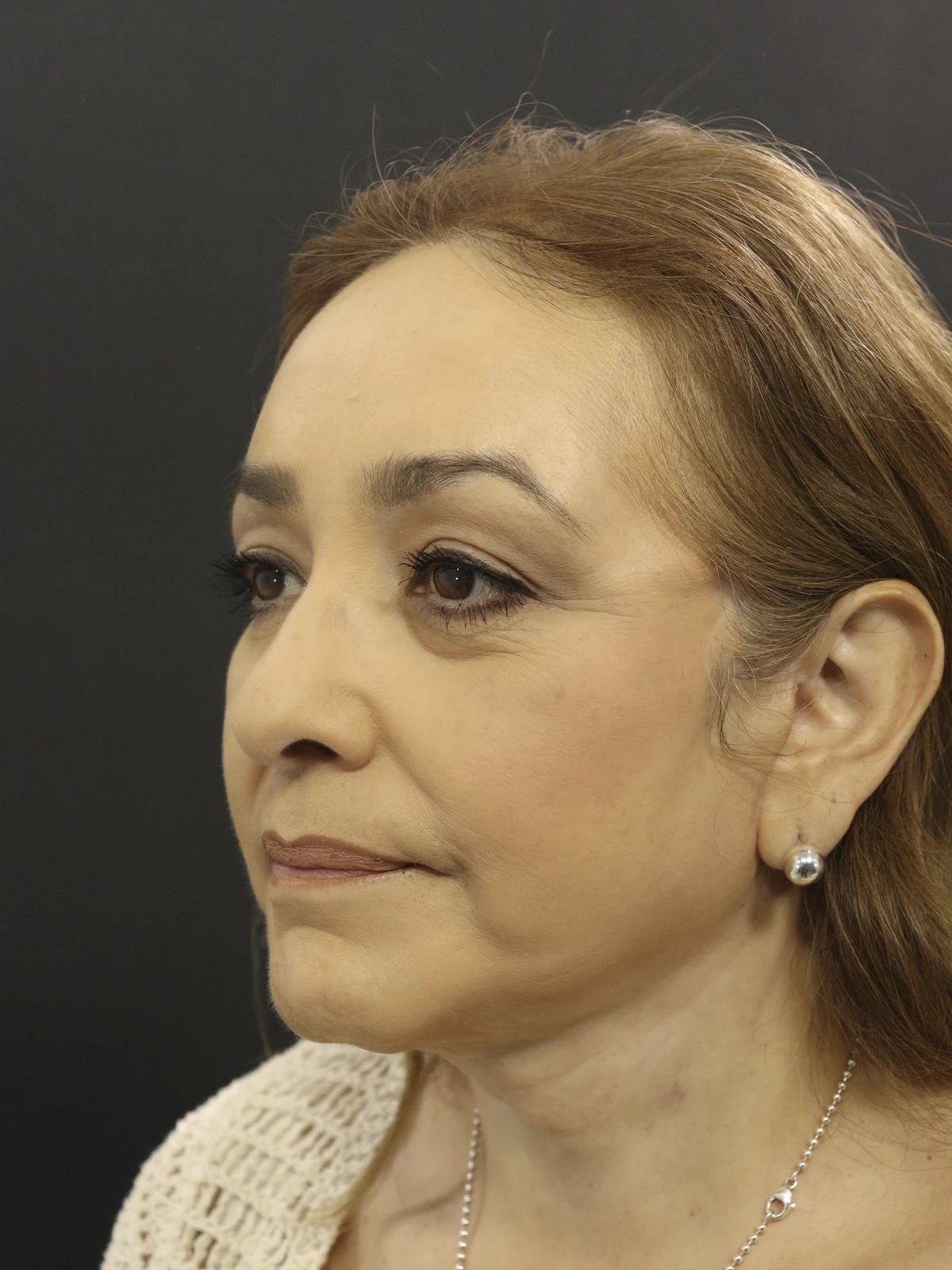 BeforeAfter
When the two layers are in agreement, the filler is subtle and the deep tissue is what needs lifting, I can often work around the product cleanly. When they are in conflict, when there is a lot of surface volume sitting on top of tissue that has quietly dropped, the filler actively works against the result I am trying to create. I lift the deep layer, and the superficial fullness still reads as weight or as blur, and the face does not look as lifted as the surgery underneath it actually is. This is the crux of the whole discussion, it is why I care so much about seeing the real contour before I plan anything, and it is closely related to how I think about what a facelift can and cannot fix.
The problem with reading a face full of filler
Let me tell you what I am actually doing when you sit in front of me and I go quiet and study your face. I am reading descent. Where your cheek fullness has migrated, how deep the fold beside your nose has become, where your jawline has softened, how much of your neck has changed. Every one of those observations feeds the surgical plan. I am, in a sense, measuring the gap between where your tissues are and where they used to be.
Now put years of volume on top of that. A face that has been kept full with regular injections does not show me its descent. The hollow that would have told me the cheek pad slid down has been filled back in. The fold that would have shown me how far things dropped has been softened by product. The face looks pleasant and full, and it lies to me about what is underneath.
This is the quiet trap of a long filler history, and it is not a moral failing on the patient’s part. Injectors filled the hollows as they appeared, appointment by appointment, and it worked for a while. But the descent never stopped beneath the volume. And when a patient finally says the filler stopped working, what they usually mean, though they do not know it yet, is that no amount of volume can lift a face that has structurally fallen. Volume was solving the wrong problem, a theme I keep returning to when I compare what filler and jawline surgery each do over the long run.
Not every filler can be dissolved, and this changes everything
Everything I have said so far quietly assumed your filler is hyaluronic acid, and most of it probably is. But “filler” is a family of very different materials that behave very differently once a facelift enters the picture, and almost nobody brings this up until I do.
Hyaluronidase, the dissolving enzyme, works on hyaluronic acid and on nothing else (StatPearls). If your history includes calcium hydroxylapatite, the product most people know as Radiesse, no enzyme removes it on demand. The same is true of poly L lactic acid, marketed as Sculptra, which works by provoking your own tissue to build collagen around it. That collagen response is the product, and you cannot dissolve a response. Then there is the harder category, the permanent fillers, liquid silicone and polymethyl methacrylate among them, which stay in the face indefinitely and which I have seen produce firm, inflamed areas many years after injection.
None of this means a facelift is off the table. It means my planning changes. With a biostimulator history I examine the tissue quality carefully, because the texture I feel under my fingers is partly your anatomy and partly a collagen scaffold a product built, and the two age differently. With permanent product I plan my dissection with more caution around any firm or previously inflamed areas, and I am more conservative in my promises about the final surface, because material I cannot remove will still be there when the swelling resolves. Occasionally, if a discrete nodule of old permanent filler sits directly in my surgical field, I can excise it during the operation, but that is an opportunistic bonus, never something I can commit to in advance.
So one of the first questions I ask about your injectable history is not how much, but what. A face with years of hyaluronic acid has an undo option we can exercise before surgery. A face with years of biostimulators or permanent product does not, and the honest plan has to be built around that fact rather than pretending it away.
How long before surgery should filler come out?
When I decide filler should go, the next question is timing, and I am fairly particular about it.
I dissolve hyaluronic acid filler with an enzyme called An enzyme that breaks down hyaluronic acid. Injected into an area of HA filler, it depolymerizes the gel so the body can clear it, which is how injectors and surgeons reverse or reduce filler. It works within days but can cause temporary swelling, and how completely it dissolves a given product depends on that product’s crosslinking and concentration.. It is the same tool injectors use to correct a bad filler result, and it works by cutting the gel apart so your body can clear it (Jung, 2020; StatPearls). Two things about it shape my timing. It causes swelling of its own, so the face right after dissolving is not a face I can plan surgery on. And how thoroughly it dissolves a given product depends on its crosslinking, its concentration, and how deep and dense the deposit is, so one session does not always take everything.
For those reasons, when I choose to dissolve, I want it done well ahead of the operation, commonly around four to six weeks before, sometimes with a second look in between to confirm the area has settled and cleared. That interval lets the hyaluronidase swelling resolve so I can examine your real baseline, and it gives me a chance to catch product that needed a second pass. Rushing this, dissolving a heavy filler history a week before surgery, is how you end up operating on a swollen, half cleared face. Individual timing varies, and for someone with only a small amount of recent filler the runway can be shorter.
There is a second reason I like that interval, and it has nothing to do with chemistry. It gives you time to meet your own face again. Patients who dissolve a long filler history often need a few weeks to absorb what they see and to decide, calmly, what they actually want surgery to accomplish. A consultation held on a face that has been visible for a month is a better consultation, and the goals stated at it are more honest than the ones stated while the product was still doing its slow disguising work.
Migrated cheek filler is a different conversation
Some filler does not stay where it was put. Over time, and especially with repeated injections into the same region, hyaluronic acid can drift from its original placement. A recent case series on the management of delayed filler complications describes product that shifted from where it was placed, presenting from weeks to more than a year after injection (Saad, 2025), and MRI evidence separately shows the product can persist in the tissue far longer than patients expect (Master, 2021). The undereye and upper cheek are notorious for this. Product placed in the tear trough migrates, pools, and creates a puffiness patients mistake for their own aging, when it is really old filler that wandered.
The undereye deserves a moment of its own, because it is where migrated filler causes the most confusion. The tissue there is thin and unforgiving, and filler that drifts superficially under it can sit close enough to the surface to cast a bluish tone through the skin, a phenomenon called the A bluish discoloration that appears when hyaluronic acid gel sits too close to the skin surface, most often under the eyes. The gel scatters light in a way that reads as a blue gray tint. It is a sign the product is superficial or has migrated, and it typically resolves when the filler is dissolved.. Patients arrive convinced they have developed dark circles and bags with age, and sometimes they have. But often what I am looking at is a soft fullness sitting in the wrong place for a natural fat pocket, moving the wrong way when they smile, fed for years by well meaning top up appointments.
Migrated filler is almost always worth dissolving before surgery, for a specific reason. It is fullness in a location your anatomy never chose. If I plan a lift around a deposit that drifted, I am building my contour on top of a mistake the gel made, not on your true structure. When I dissolve migrated product and let the area settle, I finally see the real cheek, the real lower lid, the real transition to the jaw. A patient who has been chasing undereye puffiness with more and more filler is often astonished, once it is dissolved, at how much of that “aging” simply disappears with the product and how much cleaner the surgical plan becomes.
Does years of filler stretch your skin?
This one comes up constantly, usually phrased as a worry: “Have I ruined my skin? Did all that filler stretch it out permanently?”
I want to be careful here, because it is easy to frighten people with confident claims the evidence does not support. There is no strong proof that ordinary cosmetic filler permanently stretches skin the way a large, sustained mass would. Skin has real elastic capacity. What I actually see in my practice is different from stretching, and in some ways more important to understand.
What years of filler more often does is mask. It keeps the face inflated while descent continues underneath, so that when the product is finally gone, the underlying laxity that was there all along is suddenly visible. Patients interpret that reveal as damage the filler caused. In most cases it is not damage. It is the face they would have had anyway, now uncovered. That is a genuinely different thing from filler having stretched the skin, and the distinction changes how you feel about it. You did not wreck your face. You padded over a process that never paused.
Where I am more cautious is with very large volumes placed repeatedly over many years. Sustained heavy volume can contribute to tissue changes, and a face kept aggressively full for a long time can look deflated and lax once emptied. But even there, the more useful framing is that the volume was postponing a structural problem, not creating one out of nothing.
Will unremoved filler make a facelift look unlifted?
It can, and this is the outcome I work hardest to avoid, because it is quietly disappointing in a way that is hard to fix after the fact.
Imagine I do everything right in the deep plane. I release the ligaments, I reposition the malar pad, I redrape without tension, the neck is clean, the deep structure is exactly where it should be. And sitting on top of all that good work is a layer of old superficial fullness that has nothing to do with the lift. The eye reads it as heaviness. The jawline that should look crisp is blurred by product that migrated toward it. The cheek that should catch the light with a defined highlight instead looks broad and flat, still carrying volume it does not need. The lift is real, the structure is better, and yet the face does not photograph as lifted as it is.
That gap between the surgery I performed and the result the patient sees is the strongest argument for addressing filler beforehand. A clean facelift result depends on the light hitting restored contour, not on a surface that is still padded. When I remove the padding first and let the deep lift show through, the difference is not subtle. I would rather add an appointment on the front end than deliver a beautiful operation that a syringe of old gel is muffling. Individual results vary, but the principle does not.
What dissolving actually involves
Once we open this subject, the practical worries come quickly, and they deserve plain answers. The first is usually whether I can simply take the filler out while the face is already open during surgery. Mostly I cannot, and I know that feels counterintuitive. Hyaluronic acid filler is a soft gel dispersed through tissue in small pockets, not a discrete object I can lift out. Chasing it surgically would mean dissecting through superficial planes I otherwise have no reason to disturb, trading real added risk for incomplete removal. The enzyme does the job better and without a scalpel, which is exactly why it belongs before the operation rather than during it.
The next worry is whether dissolving hurts and what the recovery is like. It is an injection appointment, not a procedure. There is a sting, the area swells for a few days, sometimes there is a bruise, and occasionally a spot needs a second pass a couple of weeks later. Set against the surgery you are already planning, it is a minor stop along the way, and the emotional side is usually bigger than the physical one.
That emotional side is really the fear underneath the others, whether you will look older after dissolving. For a while you may feel that you do, and I would rather tell you that now than let the mirror ambush you. Remember what the filler was doing, masking descent. Take the mask away and the descent shows. But you will not look older than you are. You will look like you actually are, which is precisely the starting point a surgeon needs and precisely the thing we are about to correct. The patients who struggle most in that window are the ones nobody warned.
The last question is quieter and more technical, whether hyaluronidase destroys your own natural hyaluronic acid. The enzyme does not distinguish between injected gel and the hyaluronic acid your skin makes on its own, so there is a temporary local effect on native tissue. The reassuring part is that your body produces and turns over its own hyaluronic acid continuously, so that effect is short lived, while the crosslinked filler, once broken apart, is cleared for good (Jung, 2020). I have not found this to be a meaningful clinical problem when dissolving is done with reasonable dosing by someone who knows the anatomy.
What I actually do in practice, which is not a blanket rule
I want to be clear that none of this is a policy I apply to every chart. It is a judgment I make face by face, and it depends heavily on what you can tell me about your history and what I can see and feel when I examine you.
- You can tell me roughly what was injected, where, and when, even approximately.
- Your filler is a modest, recent amount placed by someone who documented it.
- You are open to dissolving product if I find it is masking your true anatomy.
- You understand that dissolving may reveal descent you did not know was there.
- "I have no idea how much I have had or what it was, I just went whenever I looked tired."
- Panfacial injections every few months for years with no records at all.
- Obvious migrated or lumpy product you insist must stay because it "cost too much to waste."
- An expectation that the surgery alone will erase a decade of accumulated filler.
The green items make my planning safer and more precise. The red items do not mean I will refuse to help you. They mean we have more work to do before I can plan a lift I would be proud of, usually starting with dissolving and a fresh look at your real face. I will not design an operation around a face I cannot actually read, and a good consultation is where that reading happens.
The filler fatigue that is bringing people to my door
There is a real shift happening, and I would be pretending not to notice it if I did not name it. Over the last couple of years a lot of people have grown tired of the injectable cycle. Tired of the maintenance, tired of the slow creep toward a fuller, rounder, subtly unfamiliar version of their own face, tired of spending steadily and feeling like they are running to stay in place. The online conversation calls it filler fatigue, and it is bringing a particular kind of patient into my consultations: someone who has done everything short of surgery, done it faithfully, and finally suspects the whole approach was aimed at the wrong layer.
I have a lot of sympathy for these patients, and I try not to let them leave the room feeling foolish. The injections were not stupid. For early volume loss, well placed filler genuinely helps, and I say so plainly. But there is a point on the aging curve where volume stops answering the question, because the problem is no longer emptiness, it is descent. Adding volume to a descended face makes it fuller, not younger, and past a certain threshold it makes it heavier. The patients who feel their filler “stopped working” are usually standing exactly at that threshold. Nothing failed. The tool reached the edge of what it was ever able to do.
Where devices and lasers genuinely fit, and where they do not
I want to head off a misunderstanding. I am not one of those surgeons who tells you everything short of a scalpel is a waste of money. That is not what I believe, and it is not true.
I offer skin resurfacing and radiofrequency microneedling in my own practice, and I use them deliberately. A facelift repositions tissue, but it does nothing for the quality of the skin draped over that tissue, the fine texture, the sun damage, the tone. So I frequently combine a lift with radiofrequency microneedling or a laser in the same chapter of care, and I use those same tools as maintenance afterward, because protecting and refining the skin is how you extend a surgical result over the years. That is a legitimate use, and I would never wave a patient away from it.
Here is the distinction that matters. A device can improve the skin. It cannot lift true descent or erase a real jowl, because those are structural problems living in a layer no energy device reaches durably. The mistake is never using a device. The mistake is using a device instead of the operation the face structurally needs, year after year, while the descent continues underneath.
I am more openly skeptical about one specific category, and I want to be precise so this does not read as a surgeon reflexively trashing everything he does not sell. I do not offer ultrasound based tightening, the Ultherapy and Sofwave family, and my hesitation is grounded in how little durable lift that modality delivers for an advanced jowl or real laxity. For genuine descent, I have not seen ultrasound produce lasting structural change that justifies its cost for that particular patient. That is a narrow reservation about ultrasound for advanced laxity, a completely different statement from the radiofrequency and laser tools I use for skin quality, which have a real and honest place. Blurring those two together is how patients get sold the wrong thing.
When I leave filler alone entirely
Having spent this whole piece explaining when filler should come out, I want to be equally clear about when it should stay, so this does not read as a campaign against injectables.
If you have a small, sensible amount of well placed, recent filler that is not distorting my landmarks, I usually leave it exactly where it is. Dissolving it would add swelling, add an appointment, and gain nothing. If your filler is deep, stable, and genuinely additive to a contour I want to keep, there is no reason to disturb it. And there are patients for whom a little retained volume in the right spot actually complements the lift, filling a hollow that surgery alone would not address. The goal is never a philosophy about filler. It is a plan built on your real anatomy, and sometimes your real anatomy is best served by leaving good product alone.
I also tell patients, honestly, that some of them do not need me yet at all. If your volume loss is early and your tissues have not truly descended, filler is a reasonable answer for now, and a facelift would be premature. Knowing when not to operate is part of my job, and it connects to how I think about the right age and readiness for a lift.
Does filler ever come back after the lift?
Sometimes, and this surprises people who expect me to declare the era of injections over. A facelift restores structure. It does not restore every kind of volume, and it does not treat every region of the face. A patient a year out from a beautiful deep plane lift may still have genuinely deflated temples, or lips that lost their border long before anything descended. In those places, a small, precise amount of filler is a fine tool again, doing the job it was always good at, replacing focal volume, instead of the job it was never built for, holding up a falling face.
What changes after surgery is the dose and the philosophy. Post lift filler in my patients is measured in fractions of what they used before, placed in specific deficits rather than sprayed across the whole face on a schedule. The structure is doing the structural work now, and the syringe returns to being a detail brush instead of a load bearing wall. Patients who spent a decade on the maintenance treadmill usually find that a relief.
What to bring to your consultation
If you take one practical thing from all of this, let it be this: come ready to talk about your filler honestly, even if the honest answer is “I lost track.” I am not there to judge the number. I am there to plan around it, and I can only plan around what I know.
Bring what you can remember, or better, whatever records your injector kept. What product, roughly when, which areas, and whether anything was ever dissolved before. Tell me about any lumps, any migration you noticed, any area that stayed puffy longer than it should, any result you are afraid of losing. All of it feeds the plan. And if I recommend dissolving before surgery, understand that I am not undoing your investment for the sake of it. I am clearing the surface so I can lift the real face underneath, and so the operation shows the way it should.
The woman from the start of this piece did dissolve most of her filler, several weeks before I lifted her. At the pre operative visit she stared at herself for a long moment and said, “So that is what I actually look like.” There was a flicker of alarm in it, the descent she had been padding over for a decade was finally visible. But it was the right starting point, the true one, and the face I could then lift was hers, not a version inflated to hide the very thing surgery exists to correct. Individual results vary, and every plan is built on the specific face in front of me. But I have never once regretted insisting on seeing the real one first.