
She was 58, a school administrator from Orange County, and she said it within the first five minutes, the way so many patients do. She leaned forward slightly, as if confessing something, and told me, “I want to look 20 years younger.”
I have heard some version of that sentence for most of my 37 years in practice, across more than 3,000 facelifts. I never laugh at it, and I never scold it. It is an honest sentence. It usually comes from someone who has spent months looking at a face in the mirror that no longer matches the person living behind it. But I also know, from long experience, that the sentence contains a trap, and that my most important job in that first hour is not to measure her jawline or examine her neck. It is to gently take the number away from her and replace it with a better target.
So I asked her the question I ask everyone who says it. “Tell me what you looked like 20 years ago. Not younger in general. You, specifically, at 38.”
She paused. She could not really remember. Almost nobody can. What she could describe, with great precision, was what bothered her now: the heaviness along the jaw, the fold beside her mouth, the way her neck had softened, the colleague who kept asking if she was tired. And that is the whole point. Patients who ask for 20 years are almost never asking for a specific past. They are asking for relief from a specific present.
This article is about that difference. Not the mechanics of surgery, which I have written about elsewhere, but the goal itself. What should a facelift actually be trying to achieve? Should it make you look younger, or make you look like yourself again? And why does the answer determine, more than any technical detail, whether you will love your result or quietly regret it?
The number is the wrong target
Aging is not a dial that a surgeon turns backward. I wish it were that simple, because my consultations would be shorter. A face does not age uniformly, one year at a time, in a way that can be uniformly reversed. Some things descend: the cheek, the jowl, the deep tissues of the neck. Some things deflate: fat compartments thin and shift. Some things change surface: the skin itself collects sun, loses elasticity, develops the fine texture of a life lived outdoors in Southern California. And some things never change at all: your bone structure, the set of your eyes, the way your mouth moves when you are about to laugh.
A facelift, even the most complete one, addresses only part of that list. It repositions what has descended. Done properly, it restores the architecture of the jawline and neck and the position of the deep cheek. It does not resurface skin, it does not restore every lost volume, and it does not touch the parts of your face that were never young or old to begin with, only yours.
So when a patient fixes on a number, two bad things tend to happen.
First, the number becomes a measuring stick that no honest operation can satisfy. If the target is 20 years and the mirror delivers a beautiful, rested, structurally younger face that reads perhaps six or eight years back, the patient can feel shortchanged by a result that any surgeon would be proud of.
Second, and more dangerous, the number invites escalation. More tension on the skin. A more aggressive pull. Filler stacked on top of surgery to chase what surgery was never going to give. This is precisely the road that ends at the face everyone fears, the tight, windblown, slightly alien look that makes strangers whisper that someone has had work done. The pursuit of maximum youth is not the opposite of the operated look. It is the cause of it.
I tell my patients a version of this in plain words: the moment we stop trying to make you look like yourself and start trying to make you look young at any cost, we have already lost.
How many years younger does a facelift actually make you look?
Blinded studies, where independent observers guess patients’ ages from photographs, put the average somewhere between three and nine years, depending on the study and on how much surgery was done. Not 20. Not 15. Single digits, with wide variation from person to person.
The details are worth knowing, because they are more encouraging than that summary sounds. In a study from the University of Toronto published in Archives of Facial Plastic Surgery, raters estimated the ages of 60 patients from photographs taken before and after facial rejuvenation surgery. Before surgery, patients were judged to be about 1.7 years younger than their true age. After surgery, they were judged to be about 8.9 years younger than their true age, and the effect grew as procedures were combined: a face and neck lift alone gave a smaller change than a face and neck lift with eyelid or forehead surgery added.
A second study from the same group, published in JAMA Facial Plastic Surgery, was stricter. Fifty blinded raters evaluated 49 patients and the mean perceived age reduction came to 3.1 years, with an enormous range: some patients were judged more than nine years younger, and a few were actually judged slightly older than in their before photographs. The same study found something quietly profound. Attractiveness scores barely moved. Observers thought the patients looked younger, but not measurably more attractive, because surgery had not made them different people. It had made them the same people, with less descent.
I want you to sit with those two findings together, because they define realistic expectations better than any brochure. A good facelift reliably moves perceived age backward by a meaningful but single digit number of years on average. And it does not transform who you are, which, once you think about it, is exactly what you should want.
There is a third piece of evidence I find even more useful in consultation. Researchers at Johns Hopkins showed photographs of 13 facelift patients to 526 casual observers who did not know what they were looking at. After surgery, the same faces were rated not only as younger but as healthier and more successful. Nobody in that study said “this person looks like she had surgery.” They said, in effect, “this person looks well.”
That is the honest promise. Not decades erased. Wellness restored, and read instantly by strangers. Individual results vary, and I will never tell you otherwise, but the direction of the change is remarkably consistent when the operation respects your identity.
One more caution about the numbers, because I want to be fair to them in both directions. Averages compress very different faces into one figure. A patient with heavy jowls, a lax neck, and good bone structure can see a change that photographs dramatically and reads well beyond the averages above. A patient with mild laxity and significant sun damage may see a smaller change in perceived age, because a lift cannot repair what lives in the skin itself. This is why I refuse to quote a number of years in consultation. I would rather show you, on your own photographs, exactly which changes surgery can produce, and let you judge the worth of those changes yourself.
The spectrum every facelift lives on. The right result sits between rested and refreshed: unmistakably better, never explainable as surgery. Push past that band chasing years and the face begins to announce the operation.
What patients are actually asking for
Over the years I have learned to listen past the opening request, because the words patients use in the first five minutes and the truth underneath them are rarely the same thing.
The woman who says “20 years younger” almost always follows it, if I stay quiet long enough, with something much more specific and much more human. People keep asking if I am tired. I look angry in photographs and I am not an angry person. My daughter got married and I could not enjoy the pictures. I caught my reflection in a store window and did not recognize the person for a second. I look sad when I feel happy.
Notice that none of those sentences is about a number. Every one of them is about a mismatch. The face has drifted away from the person, and the person wants it back. Psychologists have a word for this that I find more useful than “vanity”: congruence. My patients do not want to be 38. They want the outside to agree with the inside again.
The research on this is reassuring but has an edge to it. A review of psychosocial outcomes in Plastic and Reconstructive Surgery, covering 37 studies of cosmetic surgery patients, found that most people do well psychologically after their procedures. But the same review identified the patients who tend to do poorly, and the list should be posted in every consultation room: patients with unrealistic expectations, patients troubled by a deformity so minimal that others cannot see it, patients motivated by a relationship crisis, and patients with body dysmorphic disorder.
Read that list again and you will see that almost every item is a version of the same error. The unhappy patients were not failed by their surgeons’ hands. They walked in with the wrong target, and no scalpel can correct a target.
This is why the first part of my consultation is a conversation, not an examination. If a patient in her 40s with lovely early changes tells me she needs to look dramatically different to save her marriage, I am not going to operate on her that season, and I will tell her why with as much kindness as I can manage. If a patient describes flaws I genuinely cannot see, I say so plainly, because agreeing with a distortion is not compassion. Surgery amplifies whatever expectation it is built on. Build it on a mismatch between how you feel and how you look, and it produces some of the most grateful patients in medicine. Build it on a fantasy, and it produces disappointment with excellent scars.
Rested is a stronger result than younger
Here is a small thought experiment I offer patients who are still attached to the number.
Imagine two women, both 60, walking into the same dinner party. The first has been pulled tight in pursuit of maximum youth. Her skin is smooth, her jawline is sharp, and every person in the room clocks within seconds that something has been done, even if they cannot name what. The second looks, at a glance, like a 60 year old who sleeps beautifully, exercises, and just came back from two weeks somewhere sunny. Her jaw is clean, her neck sits well, her face moves naturally when she laughs.
Now ask: which of them do people describe as looking younger?
It is the second woman, every time, and the reason is worth understanding. Human beings do not estimate age the way a document does. We read health, energy, and coherence. A face where every feature agrees with every other feature reads as vital. A face where a taut lower half argues with the eyes and the hands reads as altered, and altered does not register as young. It registers as strange, and strangeness gets read, unfairly but reliably, as age plus effort.
The Johns Hopkins observer data I mentioned earlier captures this exactly. The rejuvenated faces were not rated as different people or as remarkable beauties. They were rated as healthier and more successful. That is what “younger” actually looks like to the human eye: not fewer birthdays, but more life.
So when patients ask me how many years I can give them, I have started answering with a different unit. I cannot promise you a number of years. I can very often give you back the version of your face that people respond to instead of the version they worry about. In my experience that change is worth more than any number, because you live inside other people’s reactions to you every single day. Individual results vary, and the size of the change depends heavily on what has descended and what your skin will allow.
Where the operated look actually comes from
The done look has a specific anatomy, and it is worth demystifying, because most people who fear it have never had it explained.
It almost never comes from doing a facelift. It comes from doing the wrong facelift, and from three technical sins in particular.
The first is the lateral vector. The oldest and simplest lifting techniques tighten skin, or skin plus a superficial layer, by pulling it sideways toward the ears. But gravity did not pull your face sideways. It pulled it down. Correct a vertical problem with a horizontal answer and you produce the swept, windblown midface that photographs so badly. The mouth widens subtly. The cheek flattens. The face looks tight rather than young, because tightness was never a feature of youth.
The second is tension on the skin. Skin is a covering, not a support. Ask it to hold the lift and two things happen: the scars stretch and announce themselves, and the earlobe gets tugged downward into the pulled shape surgeons call a pixie ear. A distorted earlobe or a hairline that has migrated is often the first thing a sharp eyed observer notices, long before they can articulate what else is different.
The third sin belongs to the syringe rather than the scalpel. When lifting is avoided or underdone, and volume is stacked into the cheeks and jawline year after year to compensate, the face acquires a rounded, inflated geometry that never existed at any age. Many of the celebrity faces people bring to me as cautionary examples are not surgical failures at all. They are the cumulative result of filler chasing a structural problem it could not solve.
The technique I have committed my practice to exists specifically to avoid all three. A deep plane facelift releases the retaining ligaments beneath the deep tissue layer and moves that layer and the overlying skin together, as one composite unit, on a predominantly vertical vector. Because the deep structures carry the lift, the skin is closed without tension, the earlobe and hairline stay where nature put them, and the surface of the face keeps its texture and its expressions. The comparison with older techniques is not subtle once you know what to look for, and I have laid out the full comparison of deep plane and SMAS approaches elsewhere on this site. The short version is this: the deeper and more vertical the repositioning, the less the skin is asked to lie about, and the more the result reads as you, earlier, rather than you, tightened.
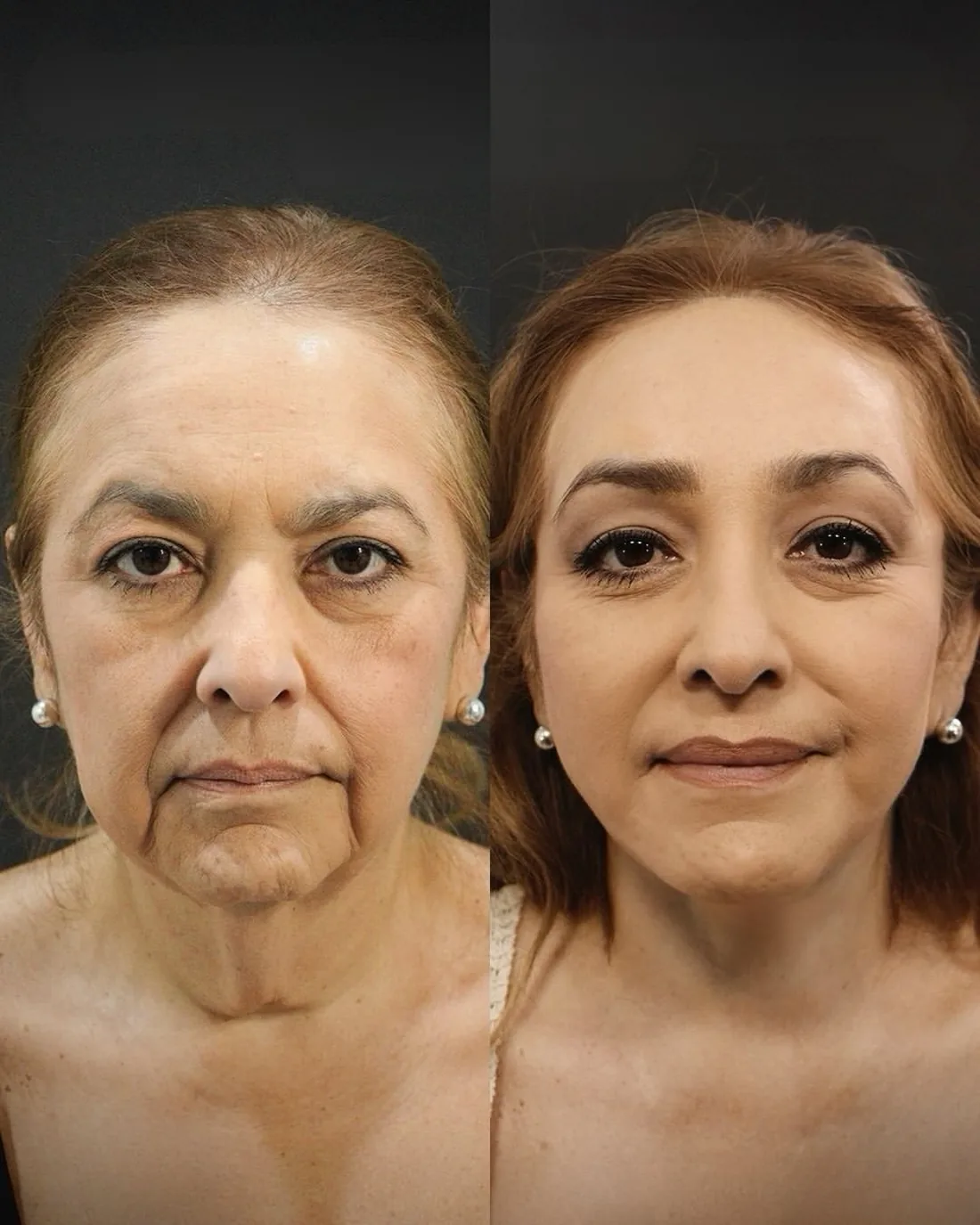
What a realistic result looks like, feature by feature
Let me be concrete, because “natural” and “rested” are words every clinic in the world uses, and they mean nothing without specifics.
When I study a candidate’s photographs, I am looking at a short list of structures that descend in predictable ways, and a realistic facelift result is simply those structures, repositioned. The jowl that has settled over the jawline lifts back into the cheek where it started, and the border of the jaw becomes a clean line again. The marionette shadow beside the mouth softens because the tissue that was casting it has been carried back up. The neck angle deepens from an open, soft slope back toward the crisp angle under the chin. The midcheek regains the fullness of position, which is different from the fullness of filler, because the tissue returns to where it once lived rather than being added on top.
In some necks, and only some, the story continues below the surface. When the fullness under the chin comes from deep structures rather than skin and platysma alone, I address those structures directly, reducing a prominent submandibular gland or managing the digastric muscles when the anatomy calls for it. Most surgeons stay out of the deep plane of the neck entirely, and I want to be careful not to oversell this: the majority of my patients do not need it, and the decision is made from an examination and photographs, never from a menu. But when a heavy deep neck is the real culprit, no amount of skin work will create the angle the patient is hoping for, and it is better to know that before surgery than to discover it after.
Just as important is the list of things a realistic result does not include, and I ask every patient to hear it before we schedule anything. A facelift will not change your skin’s surface: the etched vertical lines around the mouth, the sun damage, the crepe texture of the eyelids belong to different treatments entirely. It will not lift a heavy brow or open tired eyes; those are their own procedures with their own decisions. It will not restore the volume of your 30s, and it should not try. And it will not stop time; it resets the clock and the clock keeps running. I keep an honest inventory of these limits in my piece on what a facelift does not fix, and I would rather you read it before a consultation than after an operation.
There is one exercise I recommend to anyone weighing all this. Find photographs of yourself from roughly 10 to 15 years ago. Ordinary ones, not the flattering outliers. Study where your jawline was, where the fullness of your cheek sat, what your neck did when you turned your head. That is the vocabulary of a realistic result: your own features, in their earlier positions. If what you want when you look at those photographs is that face, the operation and your expectations are pointed at the same target. If what you want is a face those photographs never show, no operation will get you there, and I will tell you so.
How I set the target in consultation
By the time a patient sits across from me, usually after a video call and a set of photographs sent from California, I already know a good deal about her anatomy. The consultation itself is mostly about something else: finding out whether her target and mine are the same, and adjusting one of them until they are.
I listen first for the language. “I want to look like I did before everything sagged” is a green light; that patient is asking for herself back, and I know exactly how to pursue that. “I want a jawline like this actress” from a patient whose bone structure could never produce it is a conversation, not a plan. “My husband left and I need to look 30 again” is a reason to slow everything down, because the research and my own long memory agree on how that story ends when a surgeon rushes it.
Then we work on her photographs together, and I show rather than promise. I point to the jowl and show where that tissue used to live. I trace the neck angle that her anatomy will actually allow, which depends on her bone, her deep structures, and her skin, not on her wishes or mine. I am specific about asymmetries she has had since childhood, because they will still be there afterward and she should hear that from me now rather than notice it with resentment later. Faces are not symmetrical, and a facelift that manufactures symmetry manufactures strangeness.
And I say a sentence out loud, in these words or close to them, in nearly every consultation: my goal is that a year from now, people who do not know your history cannot tell you had surgery. They should think you look wonderful and be unable to say why. If that goal disappoints you, if what you want is a transformation that announces itself, then I am truly not the right surgeon for you, and I would rather we both know that today.
Some patients leave that conversation and choose a surgeon who promises more. I have made my peace with that. The patients who stay are the ones whose results I can stand behind for the rest of my career, because we agreed on what we were making before we made it.
The patients I ask to wait, and the ones I decline
Honesty about goals also means honesty about candidacy, so let me say clearly when a facelift, or at least a facelift with me, is the wrong answer.
I ask patients to wait when the anatomy is not ready. A woman in her early 40s with minimal descent and excellent skin may hate a photograph she saw of herself, but operating on changes that barely exist buys a small improvement at full surgical cost in recovery and risk, and it spends tissue laxity she may want me to work with a decade later. Timing is its own subject, and I have written about it separately, but the summary is that the calendar matters far less than the face.
I decline, or refer for other help first, when the goal is a person rather than a position. The patient who brings a photograph of someone else’s face. The patient who has had three procedures elsewhere and is still chasing something none of them delivered, without being able to tell me what it is. The patient whose distress is wildly out of proportion to anything I can see, which can signal body dysmorphic disorder, a condition surgery is known to leave unimproved or worse. None of these people are bad people. They are people for whom my scalpel is the wrong instrument, and telling them so respectfully is a duty, not a rejection.
And I am cautious with anyone in the middle of an earthquake: a fresh divorce, a death, a lost job. Not because grieving people cannot make good decisions, but because a face cannot fix a season, and the operation deserves to be chosen calmly, for oneself, at least a few months clear of the tremor.
The moment I work for
Somewhere between the third and sixth month after surgery, once the swelling has finished its slow retreat and the tissues have settled into their new positions, there is a moment I have watched thousands of times and have never grown tired of. Individual results vary in size and in timing, but the moment itself is remarkably consistent.
The patient stops evaluating her face and simply recognizes it.
She is not counting years. She is not comparing herself to a photograph or to an actress or to the number she brought into my office at the beginning. She looks in the mirror and sees, without effort, the person she has privately felt like all along. Friends tell her she looks rested, or ask about her vacation, or say she seems happy, and not one of them says the word surgery. That silence, I tell my patients, is the sound of a facelift done correctly. You can see what it looks like in practice throughout my facelift results, and I would encourage you to study those faces the way a stranger would: not hunting for the operation, but asking whether each person simply looks well.
The administrator from Orange County had her surgery, and at her follow-up visit some months later she told me, laughing, that I had failed her. She did not look 20 years younger. She looked, she said, exactly like herself, back when her face still agreed with her. Her sister had accused her of getting a new haircut. Her colleague had stopped asking if she was tired.
She was not disappointed. She was delighted, and she understood by then what I hope you understand now, at the beginning of your own thinking rather than the end. Younger is a number, and numbers are poor material for a face. Yourself, rested, with the descent of the years carried back to where it started, is not a smaller goal than 20 years. It is the only goal that was ever really worth an operation.