
She was 44, a runner from Orange County, and she set her phone on my desk with the photos already open. Liposuction under the chin at 36. Three rounds of Kybella in her early 40s. Fifteen pounds lost on purpose and kept off with a discipline most people never manage. And there in the photos, and there under my exam light, the same soft, full neck she had been trying to fix for 8 years. She asked me the question I hear almost every week, usually from people who are thin everywhere else: why is my neck still full?
The answer is almost never that the liposuction was done badly, or that the Kybella was weak, or that the diet fell short. The answer is that the fullness she was fighting does not live where any of those treatments work. The neck is built in layers, and everything she had tried operates in the top one. Her fullness lived underneath, below a muscle called the platysma, in a compartment that no cannula, no injection, and no amount of weight loss can reach.
This article is the explanation I gave her, at full length. What actually sits deep in the neck. Why the surface treatments could not touch it. Why even a well executed standard neck lift often leaves it alone. And what a deep neck lift is, including the two structures almost nobody names in a consultation: the submandibular glands and the digastric muscles. I will also be direct about the fact that deep neck surgery is not for everyone, because it is not, and a surgeon who offers it to every full neck should concern you as much as one who has never heard of it.
Four layers, one profile
Press your fingers gently into the front of your neck and you are passing through a stack. First the skin. Then the superficial fat, the subcutaneous layer, the fat you can pinch between two fingers. Then the platysma, a broad, thin sheet of muscle that drapes over the front of the neck like an apron, continuous above the jaw with the SMAS layer of the face. And beneath the platysma sits a compartment most patients have never heard named: the subplatysmal space. The surgical anatomist T. Gerald O’Daniel mapped this deep central neck in detail in the plastic surgery literature, precisely because operating there safely demands knowing every structure inside it.
Three of those deep structures decide how full a neck looks.
The first is the subplatysmal fat, a discrete pad of fat that sits in the midline underneath the muscle, roughly between the chin and the voice box. It is completely separate from the fat you can pinch. You cannot feel it directly, and no cannula placed above the muscle will ever meet it.
The second is the pair of a pair of small muscles under the chin whose front bellies run from the inside of the jaw down to a small bone in the neck called the hyoid. When those bellies are naturally bulky, they blunt the angle under the chin from below, like two ropes lying under a tarp.. In some necks the anterior bellies are slender and irrelevant. In others they are thick enough to round out the space under the chin all by themselves.
The third is the pair of the walnut sized salivary glands that sit tucked under the border of the jaw on each side, about halfway between the chin and the ear. When a gland is large or sits low, its lower portion bulges below the jawline and reads as stubborn fullness that no fat treatment changes.. These are working salivary glands, not fat. In some people they are generous in size, or they sit lower than average, or both, and they show as a persistent rounded bulge on each side of the neck just below the jaw border.
A youthful neck depends on all four layers behaving. Ellenbogen and Karlin described the visual criteria in a classic paper: a clean angle between chin and neck, a distinct jaw border, a visible edge of muscle, a subtle contour at the voice box. When the deep layer is the problem, the top three layers can be flawless and the neck still reads as full. That single sentence explains years of frustration for a lot of my patients.
Liposuction, Kybella, and weight loss all work in the first zone, above the platysma. Everything to the right of the band sits beneath the muscle, where only deep surgical work reaches.
Why liposuction left you where it found you
There is a persistent belief that liposuction failed if the neck still looks full afterward. Usually the operation did exactly what it was designed to do. It was simply pointed at the wrong layer.
A liposuction cannula in the neck travels in the superficial fat, above the platysma, on purpose. That plane is where the procedure is safe: the marginal mandibular nerve, which moves the corner of your lower lip, runs close to the jaw border, and the structures below the muscle are surrounded by vessels that a blind cannula has no business near. So a careful surgeon stays superficial, and if your fullness was superficial fat, the result is excellent. Individual results vary, but in the right neck, liposuction remains a good operation.
The trouble begins when the fullness was never superficial. Then the cannula removes the thin cushion that was softening the picture, and the deep structures underneath can actually become more visible. I have examined patients whose necks looked lumpier after aggressive liposuction than before it: the glands now casting a shadow on each side, the edges of the platysma starting to show, a firm rounded floor under the chin where the fat used to hide the digastrics. Some of my most frustrated consultations are people whose liposuction was technically well done. Nobody diagnosed the layer first.
That is also my answer when someone asks whether a second round of liposuction will finish the job. If the first round was reasonable and the neck is still full, more suction almost never helps and often harms. The remaining volume is not fat you can reach from above the muscle.
Kybella did what Kybella does
Kybella is deoxycholic acid, a molecule that destroys the membranes of fat cells where it is injected, and the honest data on it is respectable. In the randomized, placebo controlled REFINE-1 trial, published in Dermatologic Surgery, patients treated in the fat under the chin showed measurably greater reduction of that fat than patients receiving placebo. For the right person, it works: a younger patient, a small and discrete pocket of pinchable fat under the chin, elastic skin that will shrink back once the pocket deflates, and no muscle bands or deep fullness in the picture. I do not disparage it, and I do not offer it; I simply frame it by candidacy, the same way I frame my own operations.
But read the description of where it goes: into the fat under the chin, above the muscle. The injector keeps it superficial for the same reason the liposuction surgeon keeps the cannula superficial, to protect the nerve and everything below the platysma. Deoxycholic acid does not shrink a salivary gland. It does not slim a digastric muscle. It does not tighten skin, and it cannot cross into the subplatysmal space at the doses and depths used clinically.
So three rounds of Kybella that changed nothing are not a failure of the product or the injector. They are a diagnostic result. If a fat dissolving injection placed correctly in the superficial fat made no visible difference in your profile, the volume you are looking at is very unlikely to be superficial fat. You paid for that information in swelling and patience, so use it.
There is a spiral I want to name here, because I watch patients fall into it for years before they reach me. A treatment aimed at the wrong layer produces a partial or invisible result. The natural conclusion is that you need more of it: another round, another syringe, another device. Each repetition costs money, downtime, and hope, and none of it moves the needle, because repetition does not change which layer a treatment can reach. The most expensive path through a full neck is usually not surgery. It is a decade of surface treatments stacked on a deep problem. Before you buy the next round of anything, ask the person selling it one question: which anatomical layer is my fullness in, and does this treatment reach that layer? If they cannot answer both parts, get the diagnosis first.
You cannot diet a gland away
This section is short because the fact is short. Weight loss shrinks fat cells. It does not shrink salivary glands, and it does not slim muscle bellies; if anything, a leaner neck exposes them. That is why the question that brings people to me is so often phrased with genuine bewilderment: why does my neck look full when I am thin everywhere else? Because what remains is not fat. Gland size and digastric bulk are largely inherited, and so is the position of the hyoid bone, which sets how deep the angle between your chin and neck can ever be. When a marathon runner has a full neck, the scale was never the problem.
I see this more now than at any point in my career, because of how many patients arrive after major weight loss on GLP-1 medications. They have done something genuinely hard, the face and body have deflated, and the neck has kept a fullness that feels like a betrayal. In those necks the superficial fat is often nearly gone, which is exactly why the deep structures have stepped forward. The weight loss did not fail. It finished its part of the work and revealed what was underneath all along.
What a standard neck lift does not fix
Last year I examined a woman who had a neck lift in the U.S. about 18 months earlier. The skin work was good. The scars around her ears were discreet, the jawline skin was smooth, and she was still unhappy, because the central fullness she had the surgery for was still there, sitting quietly under the muscle where the operation never went.
A standard neck lift does two things well. It tightens and redrapes the skin through incisions around and behind the ears, and it tightens the platysma, either along its edges or through the midline corset technique Feldman described. Both maneuvers work on or above the muscle. When your problem is loose skin and separated muscle edges, that operation is the honest answer, and it is a large part of what a full neck lift accomplishes.
But if the driver of your fullness is subplatysmal, tightening the platysma over it is like lacing a corset over a full closet. The surface becomes smoother and the contents remain. In some necks the tightened muscle actually presses the glands into sharper relief, so the bulges below the jaw border look more defined after surgery than before. Marten and Elyassnia, two of the surgeons who have written most carefully about neck lift planning, put the principle simply: define the anatomic problems first, then choose the treatment, because an operation that skips a structure on the problem list will disappoint no matter how well it is executed. That is the truthful answer to the painful question of why a neck can still be full after a neck lift. Often nothing failed. The plan just stopped one layer too high.
So what is a deep neck lift?
A deep neck lift is neck surgery that opens the platysma and treats what lies beneath it: the subplatysmal fat, the anterior bellies of the digastric muscles when they are bulky, and the submandibular glands when they are enlarged or low, each one only if your anatomy calls for it. The access is usually the same small incision hidden under the chin that I use for muscle repair, so going deep does not mean a new scar. What changes is the work done through it.
Once the platysma is opened in the midline, the deep compartment is in view, and the sequence is judgment more than technique. The subplatysmal fat is sculpted conservatively; taking too much hollows the center of the neck and produces the sunken contour surgeons call a cobra deformity, which is far harder to fix than the fullness was. If the digastric bellies are part of the problem, I reduce them tangentially, shaving volume while preserving their function; it is a modest maneuver that makes a visible difference in the right neck. If a gland is the culprit, the portion that protrudes below the jaw border can be reduced. Then the platysma is repaired over the corrected floor, the way you would close a well packed suitcase rather than a stuffed one.
Two honest qualifiers belong in the same breath. First, deep neck work is frequently combined with facial work, because a heavy neck rarely travels alone; when the jawline and midface have descended too, I address them together in a deep plane facelift, so the neck and face age as one unit rather than two mismatched halves. Second, individual results vary, and the deep space is exactly where a surgeon’s restraint matters most. The goal is a clean, natural angle, not the deepest possible excavation.
Why do relatively few surgeons work below the platysma? Because the space is unforgiving. The marginal mandibular nerve crosses near the territory. Branches of the facial artery and vein run beside the gland. Bleeding that would be trivial in the superficial fat is serious under the muscle. None of that is a criticism of colleagues who stay superficial; it is a description of why the deep compartment demands specific training, real volume of cases, and the humility to leave it alone when it is not the problem. After 37 years and more than 3,000 facelifts, I still treat every subplatysmal dissection as the most demanding minutes of the operation.
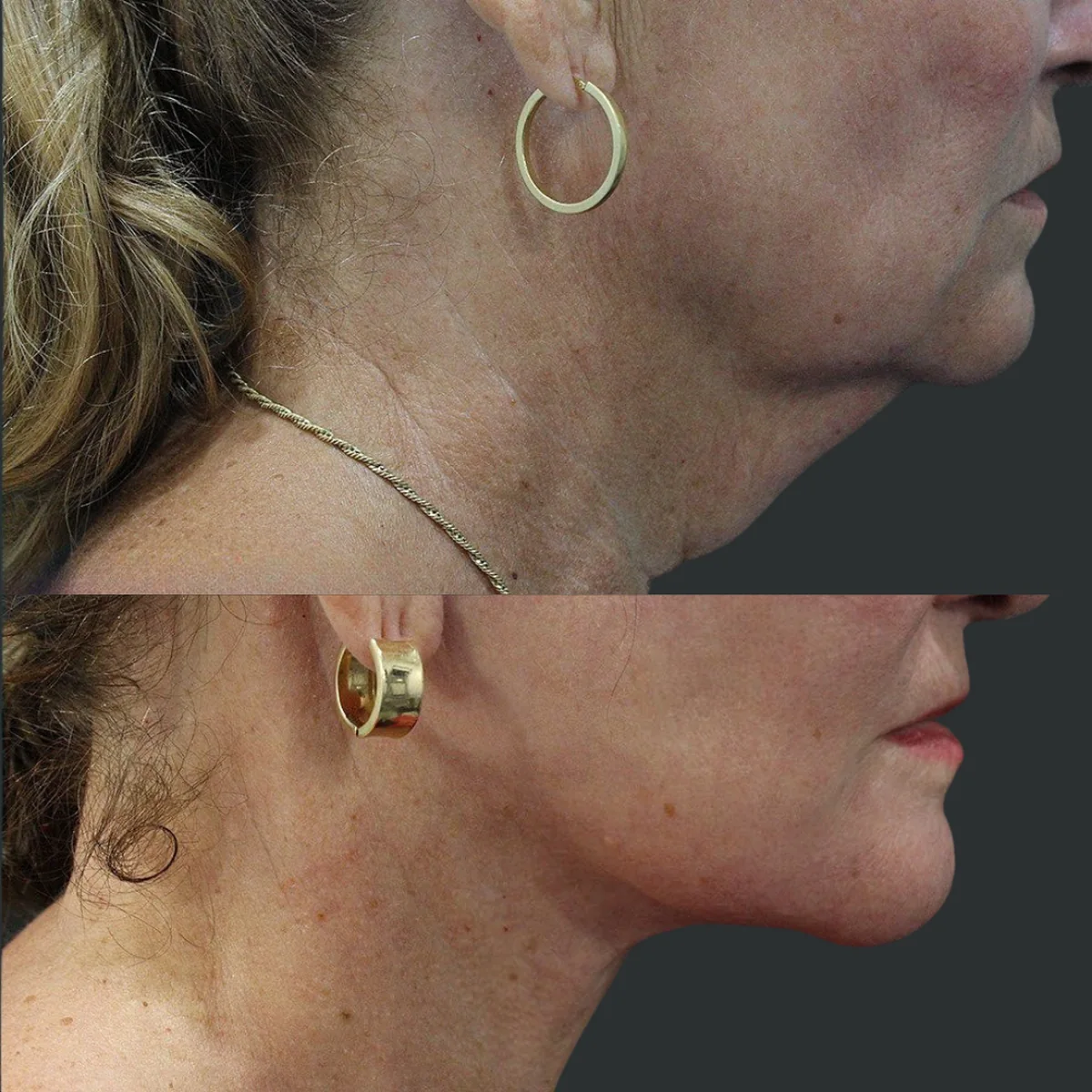
The gland question
Almost every patient with deep fullness has already felt the two bulges below the jaw border, pressed on them in the mirror, and been told some version of “that is just how your neck is.” It is worth slowing down here, because the submandibular gland is where honest surgeons are the most careful with their words.
A detail that surprises people: the gland bulge often seems to appear after a treatment, not before. Patients tell me their liposuction “caused” the lumps, or that the glands showed up once the weight came off. What actually happened is unmasking. The gland was always that size; it was upholstered in fat, and once the upholstery thinned, the furniture showed. That distinction matters, because it means the fix is not undoing the previous treatment. It is finally addressing the structure the previous treatment revealed.
These are functioning salivary glands. They matter, and nobody should remove them casually for a contour. What aesthetic surgery does, when it is indicated, is a partial reduction: only the portion of the gland that hangs below the jaw border is reduced, the rest of the gland stays and keeps working. This is established surgery with a real literature behind it, not an experiment. A systematic review in Aesthetic Plastic Surgery pooled 602 patients and roughly 1,200 partial gland reductions performed for aesthetic reasons and found that the procedure can be done with an acceptable safety profile, while noting honestly that the published evidence is still limited. André and Luiz Auersvald, the Brazilian surgeons who helped modernize this work, have published detailed guidance on managing the gland within a neck lift, including when not to touch it.
The risks deserve plain language. The complications reported most often are temporary weakness of the marginal mandibular nerve branch, which can make one side of the lower lip lazy for a while, and collections of saliva called sialomas, which usually resolve with drainage and pressure but can slow a recovery. Bleeding in the deep compartment is uncommon and taken seriously. I walk every gland reduction candidate through those risks specifically, separate from the general risks of a neck lift, because consenting to deep work should feel different from consenting to superficial work. It is different.
And here is the part I insist on: I reduce a gland only when the gland itself is clearly the contour problem. That means I can feel it as a firm, discrete, rounded structure in exactly the place the patient points to, it stays put when the muscle tightens, and the rest of the exam does not explain the bulge. In my practice that describes a minority of full necks. When a colleague or a website proposes gland reduction to nearly everyone, that is not a more advanced philosophy. It is a missing exam.
The digastric conversation is quieter but follows the same rule. Bulky anterior bellies are reduced when they blunt the angle, left alone when they do not. There is no prize for touching structures that were behaving.
When I will not do the deep work
I decline deep neck surgery regularly, and the reasons are worth listing because they are the same reasons you should hear from any surgeon you consult.
If your fullness is genuinely superficial, pinchable fat in a young neck with elastic skin, you do not need me to open your platysma. Liposuction alone, or a smaller operation through the chin incision, is the honest answer, and the reasoning behind how a submentoplasty compares with a full neck lift applies directly. If your gland shows only when you grimace or strain, it does not need reducing. If your hyoid bone sits low and forward, I will show you in your own photos what surgery can and cannot deepen, because operating toward an impossible angle is how necks end up overdone; the bone sets the stage and I do not move the bone. If you cannot accept drains and a few weeks of central firmness, the deep compartment is the wrong place for you. And if what you really want is the tightest, sharpest neck achievable regardless of whether it looks like you, we are not the right match, because my entire practice is built on the opposite premise.
There are also patients who should not cross a border for surgery at all until their health is optimized: unstable medical conditions, blood thinners that cannot be paused safely, smoking that will not stop. Deep neck surgery is elective. It deserves a body that is ready for it.
For those who are candidates and are weighing surgeons, the signals are consistent:
- The surgeon examines your neck with their hands, has you tense the muscle and swallow, and names the specific structure causing your fullness
- Deep work is presented as selective: the gland or digastric plan is justified from your anatomy, not offered as a package
- The risks of the deep compartment, nerve weakness and saliva collections included, are explained before you ask
- The surgeon can tell you when they would refuse to do the deep work, and their answer sounds like this article
- Gland reduction is recommended to essentially every patient, sight unseen or from photos alone with no exam planned
- You are promised a pencil thin neck regardless of your bone structure
- Nobody can explain which layer your fullness lives in, only that "everything will be tightened"
- The deep neck is treated as routine, with no separate discussion of its specific risks
How I read your neck before I ever suggest surgery
The diagnosis of layers happens in minutes, with hands and light, and it is the part of the consultation I refuse to rush.
I start with the pinch. Superficial fat comes up between my fingers along with the skin; if the pinch is thin but the neck is full, the volume is deep. Then I ask you to tense your platysma, the grimace that pops the muscle. Fullness that softens or hides behind the tightened muscle is deep to it; fat that still pinches above the contracting sheet is superficial. Then I palpate below the jaw border on each side for the glands, firm, rounded, discrete, in a location so consistent that patients usually say “yes, there, that is the thing” when I find it. I look at the neck with your chin neutral, with your chin down, and in three quarter view, because deep fullness barely changes with posture while loose skin changes dramatically. I ask about your weight history, because a neck that stayed full through a fifteen pound loss has already told us what it is made of.
This is also why I ask for specific photographs before we ever talk, and why the photo instructions you receive before a consultation matter more than they seem: a true profile in flat light and a three quarter view will show me the gland shadow, the blunted angle, and the state of your skin before you say a word. By the time we speak, I usually know which layers are involved. The conversation is about confirming it and deciding what is worth doing about it, which is a different question.
One more honest wrinkle: sometimes the answer is more than one layer. Loose skin over separated muscle over a low pad of subplatysmal fat over generous glands is a real combination, especially after major weight loss, and it is why the operation has to be assembled per patient rather than picked from a menu. The layers get diagnosed one by one and treated one by one, in the same operation.
What recovery adds when we go deep
Deep neck work changes recovery less than patients fear, but it does change it, and I would rather you hear the specifics from me than discover them.
The early days feel like a standard neck lift with more central firmness. There is a sense of tightness under the chin, and some patients notice an odd awareness when swallowing for the first several days, which fades. Drains matter more after subplatysmal work than after superficial work, because the deep compartment must not collect fluid or saliva; mine typically come out at 48 to 72 hours. The chin incision is small and settles the way it does for any submental procedure. The central swelling is the honest tax of deep work: the area under the chin stays firm and slightly full for weeks while the deep tissues heal, which means the very patients who came to me about fullness must live with temporary fullness before they see the result. I warn everyone about that irony, and everyone still asks about it at the first follow up. Individual recovery varies, and individual results vary; a neck built on reduced glands and repaired muscle keeps improving for months as the swelling leaves in stages.
My patients from California and across the U.S. spend those first days at our Recovery Boutique with nursing around the clock, so the drains, the compression, and the early checks happen a hallway away from me rather than across a border. When you fly home, follow up continues remotely, coordinated from San Diego, with an in person visit added if your healing calls for one. None of that is specific to deep neck work, but deep neck work is exactly when you want it in place.
The point was never a smaller neck
Here is what I have learned watching thousands of patients look at their own necks in a mirror. The fear is not the surgery. It is looking like you had one. A neck that has been suctioned thin over untreated glands, or corseted tight over a full deep compartment, or pulled sideways along with the face, is a neck that announces itself. A neck where the actual cause was found and treated, where the deep floor was corrected and the muscle repaired over it and the skin allowed to settle without tension, just looks like a neck. Your neck, earlier.
The runner from the beginning of this article is a good place to end. Her exam found modest subplatysmal fat, thick digastric bellies, and glands that sat low on both sides, under skin that was still excellent. Three structures, none of them reachable by anything she had tried, all of them diagnosable in about four minutes with two hands and good light. What she needed was not a fourth treatment aimed at the wrong layer. It was one operation aimed at the right one.
If your neck has stayed full through liposuction, injections, or real weight loss, you are probably not doing anything wrong, and you are probably not imagining it. Send me honest photographs and I will tell you which layer I see, including if the answer is that you do not need deep work, or do not need me at all. That answer costs you nothing but the photos, and it is the answer every treatment you have already tried was missing.