
Both of these operations treat the neck, and the difference between them is scope. A submentoplasty is the smaller procedure: one small incision hidden under the chin, through which I address the fat beneath the chin and tighten the platysma muscle. A full neck lift does that same work when it is needed and adds the one thing the smaller operation cannot do, which is treat loose skin, through incisions placed around and behind the ear. So the real question is not which procedure is better. It is what your neck is made of, and above all what your skin can still do on its own. Over my 37 years and more than 3,000 facelifts I have learned that patients almost always arrive with a procedure already in mind. My job is to look past the name they arrived with and read the anatomy. This article walks through that reasoning the same way I would at a consultation.
What is a submentoplasty?
A submentoplasty is a smaller neck procedure performed through a single small incision hidden under the chin, where I address the fat beneath the chin and tighten the platysma muscle, and it removes no skin. The platysma is the broad sheet of muscle that covers the front of the neck, continuous below the jaw with the SMAS layer of the face, the layer Mitz and Peyronie mapped in the surgical literature in 1976. With age its medial edges, the ones nearest the midline, can separate and show through as the two vertical bands people notice in the mirror, and as the whole sheet slackens, the clean angle between chin and neck blunts. Suturing those medial edges back together, work called platysmaplasty, is what sharpens the cervicomental angle, the angle you see in profile between the underside of the chin and the front of the neck; the corset platysmaplasty Feldman described in 1990 is the classic version of that repair.
The word to hold onto in that description is the one missing from it: skin. A submentoplasty corrects what lies beneath, then trusts your skin to shrink back and settle over the new contour by itself. That trust is only justified when the skin still has good tone. Which is exactly why this operation is right for some necks and wrong for others, and why the rest of this article is mostly about skin.
- Good skin tone, with fullness and cords as the main problem: a submentoplasty is often enough
- Skin that still snaps back when you pinch it: the smaller operation tends to hold
- Loose skin that folds and hangs: a full neck lift is usually the honest answer
- A choice made on price rather than on your skin: never the right way to decide
What does a full neck lift do that submentoplasty cannot?
It moves skin. Everything else the two operations can share. A full neck lift may include the same work under the chin, the fat and the platysma, and then it goes where the smaller operation cannot: it treats the laxity of the skin itself, through incisions that typically run around and behind the ear. From there the skin of the neck can be redraped and the excess managed, which is simply not possible through one small opening under the chin.
Think of it this way. The submentoplasty rebuilds the frame and asks the upholstery to follow. The full neck lift rebuilds the frame and then fits the upholstery by hand. When the fabric still has its elastic, the first approach works beautifully. When the fabric has stretched, no amount of frame work will make it sit right, and pretending otherwise is how people end up disappointed.
The decision lives in your skin, not on a menu
Stand in front of a mirror, look at your neck in profile, then gently pinch the skin under your jaw and let it go. What you are watching for is the snap, how quickly and completely the skin returns. That small test does not replace an examination, and I make the real call from standardized photographs, but it points at the right question. The clean jawline and crisp profile angle that read as a youthful neck were catalogued by Ellenbogen and Karlin in 1980, and they are the target both of these operations aim at. A full or aging neck is built from three possible ingredients:
- fat that has gathered beneath the chin
- a platysma muscle that has slackened, or whose edges have separated into vertical bands
- skin that has stretched and lost its snap
The first two can be corrected through the small incision under the chin. The third cannot, and that division is exactly how the surgical literature on neck rejuvenation sorts these cases: skin with real redundancy has to be removed, while skin that still has tone can be trusted to redrape on its own. Skin with good tone behaves like fabric with elastic still woven into it: correct the contour beneath and it shrinks back to follow. Skin that has lost its elasticity behaves like fabric stretched for years. It does not follow, it hangs. Sculpt the fat and tighten the muscle beneath skin like that and you can even make the neck look worse, looser and emptier, because you removed the volume that was propping the skin up without giving the skin anywhere to go.
So when I study your photographs, I am really asking two questions. What is your fullness made of? And can your skin follow on its own? The answers decide the operation, not a menu and not a budget.
When is submentoplasty enough?
Submentoplasty is enough when the problem lives under the chin, fat, early muscle laxity, a softening angle, and your skin still has the tone to redrape over the corrected contour on its own. In my experience the neck that fits this description is often a younger one, or a neck where genetics placed fullness under the chin long before the skin aged. The jawline above still holds. There are no deep folds of loose skin, no heavy established bands, just a blunted angle in profile that bothers the patient every time a camera catches them from the side.
For that neck, the smaller operation is not a compromise. It is the correct operation, and I would rather do it than a larger one the anatomy does not ask for. One incision hidden in the crease under the chin, the fat addressed, the muscle edges brought together, and the skin, because it still has its elastic, settles over the new angle by itself. Individual results vary, and the honest reading of whether your skin qualifies comes from photographs, not from age alone.
When do you need the full neck lift instead?
A patient sends me photographs. The angle under her chin has been gone for years. Two vertical bands run from under the jaw toward the base of the neck, and in the profile shot taken with her chin slightly down, the skin folds instead of tightening. She has read about the smaller procedure and hopes she is a candidate, because it sounds easier. I understand the hope. But I would do her no favor by agreeing.
When the skin itself has real laxity, when the bands are established and the skin over them is loose, when the neckline has blunted and a pinch of skin under the jaw stays slack instead of springing back, the full neck lift is the honest operation. Choosing the smaller procedure for that neck does not produce a smaller version of the same result. It produces a different result, and usually a disappointing one, because the ingredient left untreated, the skin, is precisely the one everybody sees. Individual results vary, but this principle does not: the operation has to match what the neck is actually made of.
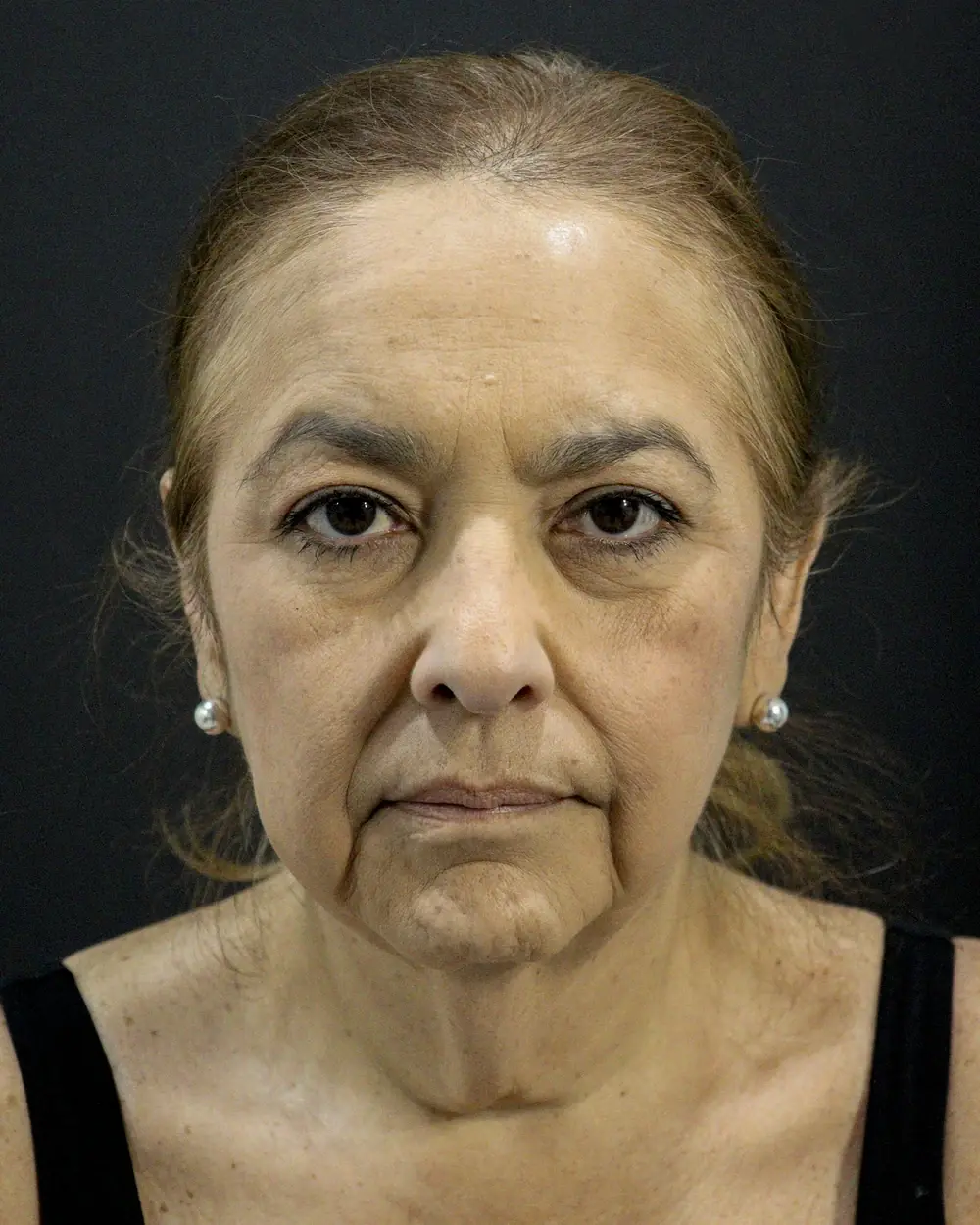
 BeforeAfter
Drag to compare. Whether a small under-chin procedure is enough or a full neck lift is needed comes down to your skin, not your wishes. A real result, photographed with consent. Individual results vary.
Neither one fixes the jowl
Neither operation touches the jowl, and I want that said plainly. Jowls form above the neck, from descent at the jawline and the midface, so a procedure that works only below the jaw cannot correct them. When jowls are part of what bothers you, the conversation moves up, to a lower face lift or a deep plane facelift, sometimes combined with the neck work in a single operation. I have written separately about whether a neck lift fixes jowls, and if you want to understand how I think about the deeper technique question behind facelifts, that comparison lives on the deep plane versus SMAS page.
Why I will not choose your operation by price
Let me be candid about how most people find this comparison. Many are quietly hoping to qualify for the smaller procedure, and cost is often part of that hope. I understand it. Surgery in the United States is genuinely expensive, and part of why patients travel to my practice in Tijuana is that they pay a lower percentage of what the same care would cost at home. But whatever the numbers are in your situation, they cannot pick your procedure.
Anatomy chooses the operation. Price never does.
A submentoplasty performed on a neck that needed skin work is not a saving. It is a first procedure that leads to a second, plus a stretch of time spent living with a result that disappointed you. And the reverse is just as true: if your neck genuinely needs only the smaller operation, I will tell you so, because I have no interest in performing a larger operation than your anatomy calls for. In 37 years, the recommendations I have never regretted are the ones that matched the tissue in front of me.
How do the recoveries compare?
Recovery after a submentoplasty is generally quicker than after a full neck lift, though I resist promising exact days, because tissue does not read calendars and individual recovery varies. The smaller operation means one small incision, no skin removal, and, in general, an easier early arc. How much easier depends on your tissue and on exactly what was done to the muscle, and I walk through the specifics of healing after muscle repair in how long platysmaplasty recovery takes.
For the full neck lift, my patients plan a minimum local stay of about six days, spent at the in-house Recovery Boutique with nursing around the clock. Drains typically come out at 48 to 72 hours, sutures at about day seven, and most patients are socially presentable near fourteen days. Swelling keeps settling over the months that follow, and the real result is the one you see at several months, not the one in the first mirror. The broader framework of healing lives on the facelift recovery page. Individual recovery varies.
Can either be combined with a facelift?
Yes, and often the combination is the honest plan. A neck lift may be done alone or together with a face lift, and when the jawline and midface have descended along with the neck, one combined operation means one anesthesia, one recovery, and a result that reads as continuous from cheek to collarbone rather than corrected in one zone and aged in the next. Whether a deep plane facelift already includes the neck is its own question, and I answer it in does a deep plane facelift include a neck lift. The reverse case, a neck treated on its own with the face left alone, is covered in neck lift without a facelift.
The room matters as much as the procedure
One thing I do not scale down with the size of the operation is safety. Whether your plan turns out to be the smaller procedure or the full lift, the surgery takes place at VIDA Wellness & Beauty, the first Quad A (AAAASF) accredited facility in Mexico, licensed by COFEPRIS, and my anesthesiologist, Dra. Nadiezhda Garcia Bonilla, is present for every procedure, including the small ones. A short operation is not a casual operation. The full picture of the facility and how anesthesia is handled is on the facility and anesthesia page.

Which one do you need? Send photographs and I will tell you
This article can teach you the reasoning, but it cannot examine your neck. Photographs can come close: a true profile, the chin neutral and then slightly down, good light, no filter. From those I can usually see what your fullness is made of, whether bands have declared themselves, how the skin behaves at the angle, and whether the jawline above is holding or asking for help. I did my fellowship with Bruce F. Connell, a master of the face and neck lift, and the habit I keep from those years, study the anatomy before you name the operation, is still how every plan in my practice begins.
If the wider map helps first, I have laid out the whole decision, fat versus muscle versus skin and which procedure answers each, in neck lift or lower facelift. When you are ready for the direct answer, request a consultation. Our team coordinates everything from San Diego, and you can reach us by phone, SMS, iMessage, or email at +1 (619) 738-2144. I will study your photographs myself and tell you plainly which operation your neck is asking for, including when the answer is the smaller one. Individual results vary.