
The real math, before anything else
Let me start with the numbers, because the numbers are the whole story.
A polydioxanone thread, the material in most absorbable thread lifts, is a surgical suture designed to dissolve. The body breaks it down by hydrolysis over roughly six months. Whatever mechanical pull it exerts on the day it is placed, the material itself is gone from your face within the year.
A deep plane facelift releases the retaining ligaments of the face, repositions the muscle and fascia layer as a single unit, and fixes it in a new position where it heals. In my practice, after 37 years and more than 3,000 facelifts, I expect the structural repositioning of a well executed deep plane to hold for a decade or more before natural aging catches up. Individual results vary, always, but the difference in durability between the two procedures is not a matter of degree. It is a matter of category.
Here is the number that should stop you, though. In 2021, a meta-analysis in Aesthetic Plastic Surgery pooled 26 studies of facial thread lifting. Patient satisfaction immediately after the procedure was 98 percent. Months later it had already fallen to 88 percent, a statistically significant drop, and the authors concluded that patients should be told before the procedure that the rejuvenation effect “may not maintain in the long-term” (PMID 33821308).
A 98 percent approval rating on day one is not a small detail. It explains the entire industry. The procedure photographs beautifully in the first weeks, when swelling and inflammation are doing most of the visual work. The disappointment arrives on a delay, quietly, at home, months after the payment cleared.
I meet the people on the other end of that delay. They sit in my consultation room, usually a year or two after the threads, with the same jowls they started with and a new layer of frustration. This article is the conversation I have with them, written down. Not because threads are a scam, they are not, but because the arithmetic of what they cost, what they fix, and how long they last is almost never laid out honestly before someone buys them.
Why a thread cannot hold a jowl
To understand why thread lifts fade, you have to understand what makes a face fall in the first place.
Your facial soft tissue is organized in layers. Skin on top, then fat, then a sheet of muscle and fascia called the SMAS, the superficial musculoaponeurotic system, a continuous layer that actually descends with age and that a proper facelift repositions. Beneath that sit the retaining ligaments, short, strong anchors that tether the deeper layers to the bone. With age, those ligaments stay put while the tissue between them loosens and descends. The jowl is not loose skin. The jowl is the SMAS and its attached fat sliding down past a ligament that no longer holds it where it belongs.
Now consider what a thread does. A barbed suture is passed through the fat layer, above the SMAS in most techniques, and the tissue is bunched along the barbs like fabric gathered on a drawstring. Nothing is released. The retaining ligaments, the actual anatomical reason the tissue fell, are never touched. The heavy descended structure is not moved back to where it was in your thirties; a few millimeters of soft tissue are pleated upward against constant gravitational load, held by a filament with the tensile strength of, well, a suture.
Sutures are wonderful things. I trust my life’s work to them every week. But in surgery we use sutures to hold tissue together while it heals into a new position, and then the healing does the holding. That is the crucial difference. In a deep plane facelift, I release the ligaments, advance the entire composite layer, and suture it where it belongs. Over the following weeks the body heals that layer into its new position, and from then on the result is maintained by your own anatomy, not by the stitch. If you want the full anatomical explanation, I have written in detail about what a deep plane facelift actually repositions.
A thread has no second act. The pleat it creates is under tension from the first minute, gravity works on it every hour, and the thread itself is dissolving on schedule. There is no moment when the load transfers to healed anatomy, because no anatomy was moved.
How long do PDO thread lifts really last?
Most patients see the visible effect of an absorbable thread lift fade within the first year, and the published literature supports that honest estimate rather than the two to three years often quoted in marketing. Individual results vary, and I have met patients who felt some benefit into a second year, usually those with very mild laxity and good skin. But the material timeline is not negotiable: polydioxanone loses tensile strength within weeks and is substantially resorbed by about six months. Poly-L-lactic acid and caprolactone threads persist somewhat longer as material, yet the mechanical lift decays on a similar curve, because the failure mode is not only the thread dissolving. It is the soft tissue cheese-wiring through the barbs and settling back under load long before the material disappears.
The most sobering study on this question is older than most people realize. In 2009, Abraham and colleagues at Albany Medical College followed 33 patients after thread lift procedures, with a mean follow-up of 21 months. The patients who had threads alone lost their measurable improvement by the end of the study period, while control patients who had other rejuvenation procedures kept theirs. The authors’ blunt conclusion was that the early improvement was largely attributable to swelling and inflammation, and that they could not justify continuing to offer the procedure (PMID 19451452).
Nearly a decade later, in 2018, a systematic review in Plastic and Reconstructive Surgery went looking for evidence that the technology had matured. The authors screened everything published since the optimistic early reviews and found that essentially nothing had been added to support the durability or efficacy claims. All of the included studies except two showed, in their words, at best a very limited durability of the lifting effect. The two favorable studies were sponsored by the companies that manufacture the threads (PMID 29481392).
I want to be fair here. Thread materials and barb designs have iterated since those papers, and there are practitioners who use threads thoughtfully in well selected patients. But when the independent literature has said one thing since 2009 and the sponsored literature says another, a patient deserves to know which is which.
The complication column of the ledger
Durability is only half of the math. The other half is what can go wrong, and thread lifts are routinely presented as if the answer were nothing.
The 2021 meta-analysis I mentioned earlier pooled complication data across 26 studies, and the profile is worth reading slowly. Swelling was nearly universal enough to be expected, at a pooled 35 percent. Skin dimpling, the puckered, gathered look where the barbs grip unevenly, occurred in about 10 percent of patients. Visible or palpable threads, meaning you can see or feel the device under the skin of your face, occurred in about 4 percent. Infection in about 2 percent, and thread extrusion, the thread actually working its way out through the skin, in about 2 percent (PMID 33821308).
Two findings in that paper matter even more for the patients I actually see. First, non-absorbable threads, sometimes pitched as the answer to the longevity problem, carried significantly higher risks: extrusion at 7.6 percent versus 1.6 percent for absorbable threads, and paresthesia, altered sensation, at 11.7 percent versus 3.1 percent. A permanent foreign body under facial skin is not a free upgrade.
Second, and this is the finding I wish every med spa consultation included: patients over 50 had dramatically higher complication rates than younger patients. Dimpling at 16 percent versus 5.6 percent. Infection at 5.9 percent versus 0.7 percent. Think about what that means. The patients with real jowls and real laxity, the ones most aggressively sold a thread lift as the way to avoid surgery, are precisely the patients in whom threads both work least and complicate most. Thinner, looser, sun-damaged tissue shows every barb and pucker, and it holds a pleat poorly.
Most thread complications are managed without lasting harm, and I want to keep that in proportion. Dimples often soften, extruded thread tips can be trimmed or removed. But removal of a fully embedded barbed thread that has caused a problem is not trivial, and I have done tidy-up work on faces where threads left palpable cords and tethered scars that outlived the lift itself by years. It is a strange bargain: the aesthetic effect is temporary, but the complications are not always on the same clock.
What the decay actually looks like, month by month
Patients describe the same arc to me so consistently that I can almost narrate it for them. Here is the typical course of an absorbable thread lift laid against what the same months look like after a deep plane facelift. Individual results vary in both columns.
- Day 1 to week 2The thread lift looks its best. Swelling and inflammation add fullness, the pleated tissue sits high, photographs are taken, reviews are written. A deep plane patient at this stage is bruised and swollen, clearly in recovery, and looks worse than the thread patient.
- Weeks 2 to 8Edema resolves and the first honesty arrives. As thread lift swelling settles, a portion of the early lift goes with it. Dimples and pulling sensations usually soften in this window. The deep plane patient is now presentable, back at work, watching residual swelling fade off a repositioned foundation.
- Months 3 to 6The polydioxanone is dissolving on schedule. Tension on the barbs relaxes, soft tissue settles back under gravity, and many patients start angling the bathroom mirror, unsure whether they still see it. The deep plane patient's tissues have healed into their new position; the result no longer depends on any suture.
- Months 6 to 12This is where pooled satisfaction has already slipped from 98 to 88 percent. For most thread patients the jowl is visibly back, or was never truly gone. Some return for more threads here, and the spending cycle begins. The deep plane patient at one year is at the result I photograph for their records.
- Months 12 to 24The thread lift is functionally over for most patients. In the Albany study, patients followed for a mean of 21 months had lost measurable improvement from threads alone. The deep plane result is simply holding, aging forward slowly from a younger baseline.
- Years 5 to 10 and beyondOnly one of these procedures still exists. A thread patient who kept repeating the cycle has now purchased the equivalent of a serious procedure in installments, without ever getting one. The deep plane patient is often still ahead of where they started, a decade later.
What patients tell me at the one-year mark
A woman from San Diego sat across from me last spring and put it more precisely than any journal article. She had spent, in her words, a very good vacation’s worth of money on two rounds of threads over three years. “For the first month I kept catching my reflection and smiling,” she said. “By the summer I was turning my head in photos again. By the anniversary I honestly could not tell you what I had paid for.”
I hear versions of this constantly, and the emotional arc matters as much as the anatomical one. Thread patients rarely feel deceived at first; they feel confused. The procedure did do something, they saw it, other people commented on it. So when it fades, many assume their face failed the procedure rather than the reverse, and some book the next round out of a kind of loyalty to that first month. Understanding that the first month was mostly swelling, and that the decay was designed into the material, is usually the moment the confusion lifts. It is also, for what it is worth, the moment most of them get angry, not at the injector, but at how the timeline was glossed over when they asked directly.
If you take one practical instruction from this article, let it be this: before agreeing to threads, ask the provider to show you their own patients at one year, not at six weeks. Unretouched, same lighting, same angle. If those photographs exist and still look good, you are in unusually honest hands. In my experience, the one-year album is the one nobody can produce.
Surgery has risks too, and you deserve those numbers with the same honesty
It would be easy for a surgeon to write an article like this, hammer the thread complication data, and stay quiet about his own. That is not how I practice.
A deep plane facelift is real surgery, with anesthesia, incisions, and a recovery measured in weeks. The best aggregate data we have comes from a 2019 meta-analysis in the Aesthetic Surgery Journal covering 183 studies of SMAS-based facelift techniques. For deep plane facelifts, the pooled rate of major hematoma, a collection of blood requiring intervention, was 1.22 percent, statistically higher than simpler plication techniques. Temporary facial nerve weakness across the more extensive techniques ran in the range of roughly 1.5 to 1.9 percent, and, importantly, the risk of permanent nerve injury did not differ significantly between techniques (PMID 30768122). The authors’ conclusion is one I have repeated to patients for years: choose the technique for the quality and durability of its results, because the serious complication profiles are closer than most people assume.
So the honest comparison is not “risky surgery versus risk-free lunchtime lift.” It is a low but real rate of surgical complications, managed within a surgical system built for them, in exchange for a structural result, versus a lower-stakes procedure with its own double-digit nuisance complication rates and a result that dissolves. When a hematoma happens in my operating room, I am there with an anesthesiologist, a sterile field, and decades of experience managing it. When a thread extrudes through a cheek eight months after a lunchtime appointment, the patient is often on their own, searching for whoever will see them.
I go through my own complication numbers, unprompted, in every consultation, because I believe a patient comparing options deserves symmetrical candor. Ask any provider offering you threads for their extrusion and dimpling rates. If the answer is that those basically never happen, you now know the published pooled data well enough to recognize what that answer is worth.
Threads versus a facelift for jowls specifically
The jowl question deserves its own section because jowls are the most common reason patients consider either procedure, and they are also where threads fail fastest.
A jowl is heavy. It is descended SMAS and fat sitting below the mandibular ligament, and it re-forms the moment its support is removed because gravity never takes a day off. A pleat of soft tissue gathered on a barbed filament is simply not a structure that can carry that load for years. Even on day one, a thread lift improves a true jowl only partially; by the time the material softens, the jowl is exactly where it was. The same logic applies to the neck, where the platysma muscle bands and the deep fat under the chin are entirely beyond what any thread can address. No thread lift performs a neck lift, and a heavy neck is often half of what bothers the patient in photographs.
This is the same conversation I have about injectables, by the way. Filler along the jawline and threads through the cheeks share a business model: a modest, temporary softening of a structural problem, sold on a subscription. I wrote a companion piece walking through the long-term math of jawline surgery versus filler, and the conclusion rhymes with this one.
What does the surgical alternative actually look like on a real face? This is where a picture does work my paragraphs cannot.
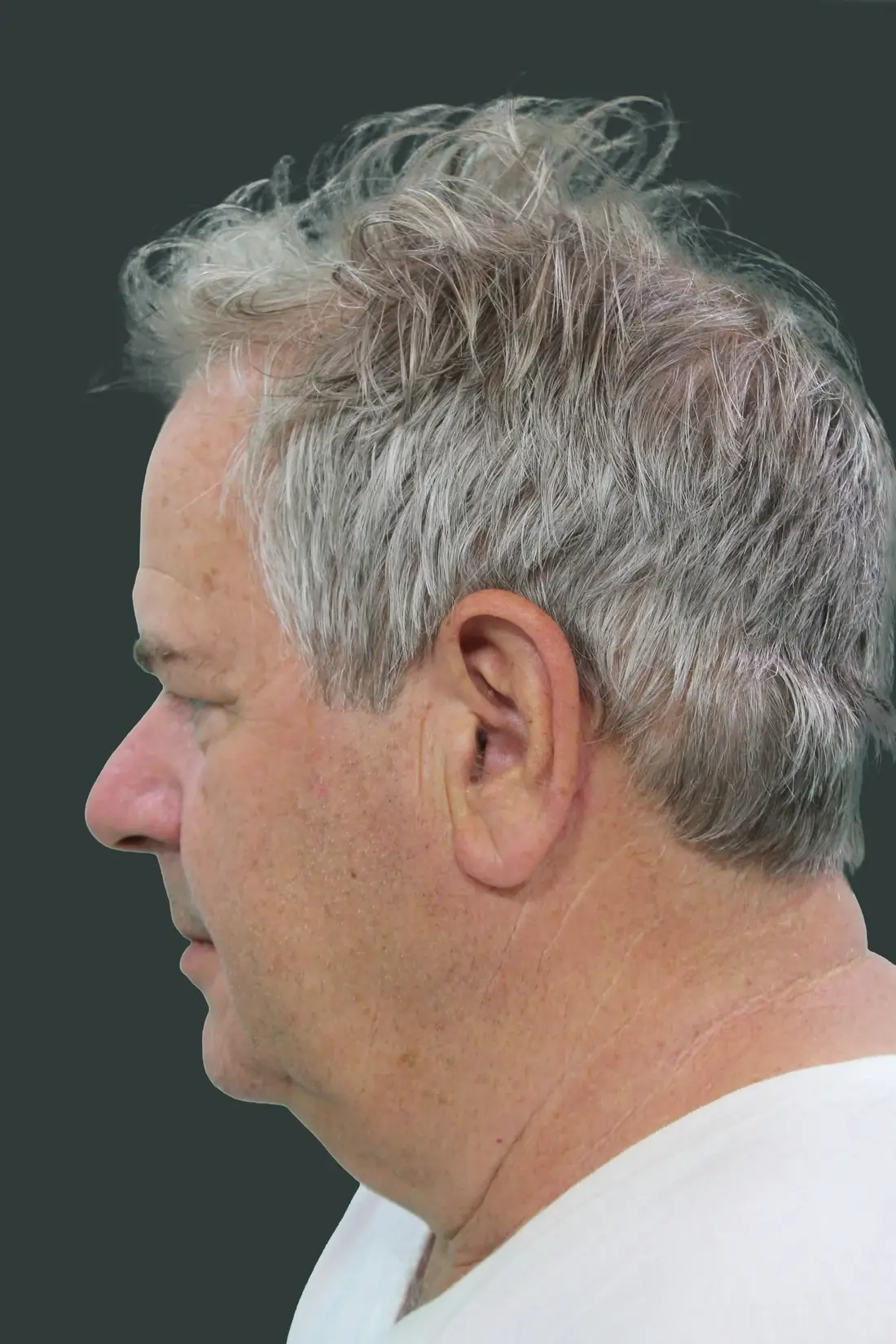
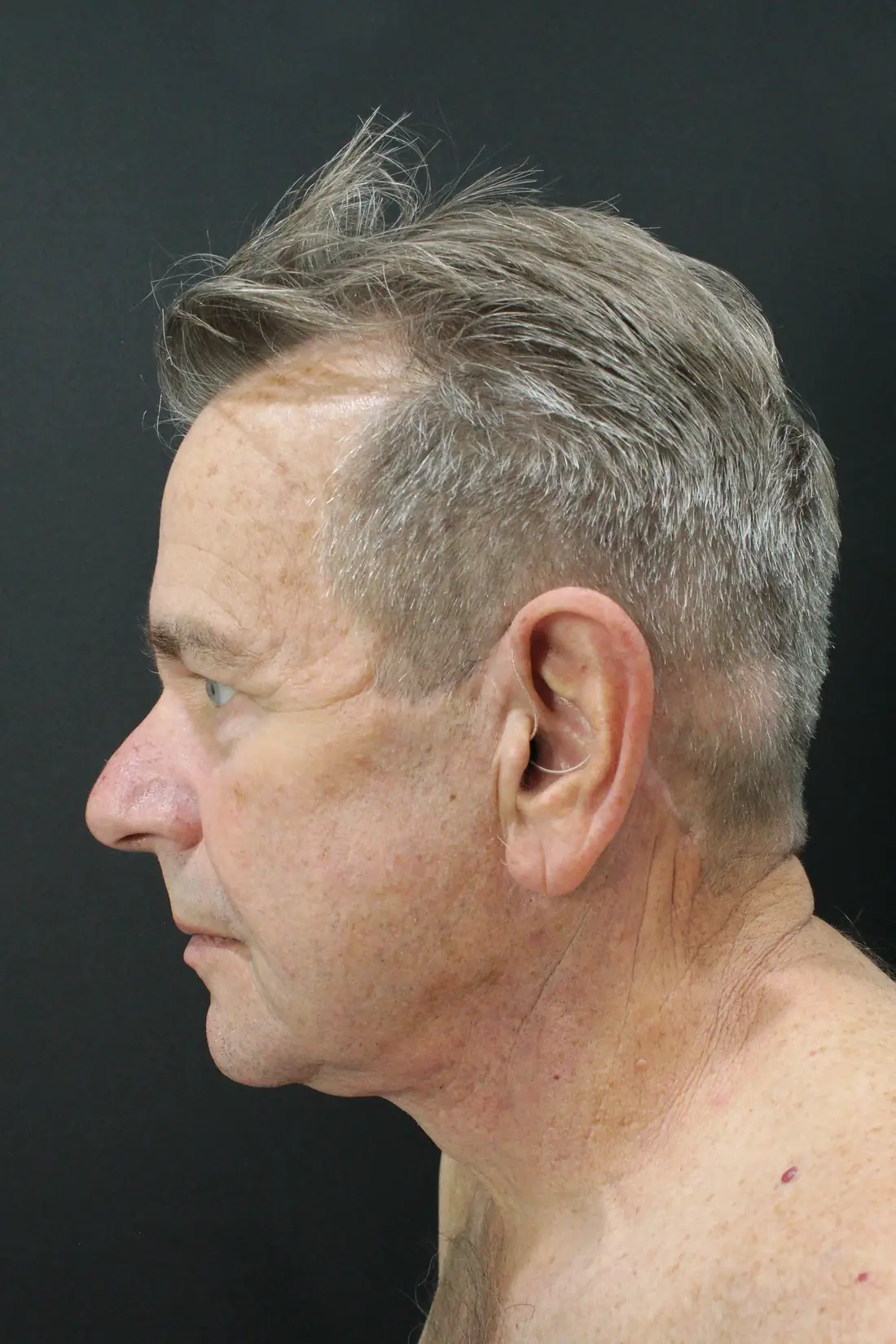 BeforeAfter
Notice, in an after photo like this, that the jawline is not tight. It is repositioned. The tissue that made the jowl is back up in the cheek where it lived decades earlier, the neck angle is reconstructed, and nothing is stretched. That distinction between pulling on tissue and moving tissue is the entire difference between these procedures, and it is also why a deep plane result differs from an older style SMAS pull even among facelifts.
Can you get a facelift after a thread lift?
Yes. A prior thread lift almost never prevents a facelift, and I operate on previously threaded faces regularly. If you have threads in place now and are reading this with regret, you have not ruined anything. Individual anatomy varies, but in more than 3,000 facelifts I have not once had to turn a patient away because of old threads.
What I actually find under the skin is worth describing, because patients imagine either that the threads will have vanished without a trace or that their face is full of wire. The truth is in between. Absorbable threads leave behind fine tracks of fibrosis, thin lines of scar tissue along the path of each thread, occasionally with a barb remnant or a palpable nodule where the tissue reacted. Usually this adds a few careful minutes to my dissection and nothing more. Occasionally, especially after multiple rounds of threads or after non-absorbable threads, the fibrosis is dense enough to distort the normal planes, and the dissection demands more patience to protect the nerve branches passing beneath. It has never changed what I could achieve for the patient; it has sometimes changed how long the operation took.
Practical guidance if this is you. First, tell your surgeon exactly what was placed, when, how many, and ideally the brand, because absorbable and permanent threads behave differently under dissection. Second, if your threads are recent, I generally prefer to wait until the acute inflammation has settled, commonly six months or so, before operating through that tissue. Third, do not let anyone talk you into a round of removal surgery as a prerequisite; embedded absorbable threads that are causing no problem are usually best left to dissolve, and chasing them causes more scarring than ignoring them.
The one genuine caution: repeated thread procedures compound the fibrosis. One round is a footnote. Five rounds over eight years creates a scarred soft tissue envelope that makes any future surgeon’s work harder and can subtly affect how the skin redrapes. If you already suspect you will eventually want the definitive operation, every additional round of threads is buying months of effect at the cost of surgical field quality later.
Where the machines in my own office fit into this
I want to be precise here, because it would be convenient for a surgeon to wave away everything that is not surgery, and it would also be wrong.
In my practice I use Morpheus8, radiofrequency microneedling, and CO2 laser resurfacing alongside other laser and skin treatments, and I use them constantly. Not instead of facelifts. With them, and after them. A deep plane facelift repositions structure, but it does not change the quality of the skin itself: the sun damage, the fine crepe texture, the etched vertical lines around the mouth, the pigment. Those live in the skin, not under it, and energy devices and resurfacing are genuinely the right tools for them. I frequently perform Morpheus8 or CO2 in the same session as a facelift, treating the canvas while surgery repairs the frame, and I use the same tools afterward as maintenance, protecting a surgical result the way good servicing protects anything built to last. My patients who combine the two get results neither approach produces alone, and I say that as someone who sells both. The honest framing is not surgery versus devices. It is that each fixes what the other cannot, and the expensive mistake is buying a device treatment to do a facelift’s job. I have written elsewhere about what a facelift does not fix, and skin texture leads that list.
Threads sit in an awkward middle position in this landscape: invasive enough to have real complications, structural enough in their marketing to be sold against surgery, but mechanically unable to do surgery’s work.
Ultrasound tightening devices deserve one honest paragraph too, since patients often compare them to threads. I do not offer ultrasound-based tightening in my practice, so read this knowing that. My skepticism is specific: for mild early laxity in younger patients, focused ultrasound can produce measurable but modest tightening, and some patients are happy with it. For an established jowl or real neck laxity, the published improvements are subtle, frequently graded by trained observers rather than obvious in a mirror, and in my consultation experience the gap between what was paid and what a patient over 55 can actually see is often disheartening. That is not a condemnation of the physics. It is a statement about matching the tool to the magnitude of the problem, the same principle that runs through this entire article.
The honest accounting
Now put the two columns side by side, because this is the arithmetic nobody runs out loud in a med spa consultation.
I will not quote prices here; costs vary by market, by provider, and by year, and this page would age badly if I pretended otherwise. But the structure of the math does not change. A thread lift costs a meaningful fraction of what surgery costs, and it delivers a partial correction that decays within a year or two. Repeat it on schedule, as the model intends, and within a handful of years the running total crosses what the definitive operation would have cost, while the face has never once been definitively corrected. Every payment bought time, not change. Patients traveling to my practice in Tijuana also discover that the surgical side of this ledger is smaller than the U.S. numbers in their heads, which shifts the crossover point earlier still.
A deep plane facelift is one larger outlay, one recovery, one scar pattern healed once. Amortize it over the decade or more the result typically holds and it becomes, per year of visible correction, one of the least expensive things in aesthetic medicine. Individual results vary; a heavy smoker with major sun damage will not hold a result like a healthy patient with good skin. But even the conservative version of this arithmetic is not close.
There is also a cost no invoice captures. The thread cycle keeps a person permanently in maintenance, permanently reassessing, three to four appointments a year, always with a fading result somewhere on the curve. The patients I operate on describe the opposite experience: they stop thinking about it. That, more than any photograph, is what they thank me for at their annual visits.
Who threads actually suit, honestly
I promised candor at the start, so let me end by arguing briefly for the other side, because thread lifts do have a legitimate patient. It is simply not the patient they are usually sold to.
Threads make defensible sense for a patient in her late thirties or forties with mild, early laxity and good skin thickness, who understands, in writing, that she is buying roughly a year of subtle improvement. They can make sense as a one-time bridge, ahead of an event, ahead of a planned surgery date, for someone who wants a temporary nudge and knows it is temporary. And for the rare patient whose health genuinely rules out anesthesia and surgery, a modest temporary improvement may honestly be the best available option, chosen with open eyes.
What threads do not suit is the patient who fills my consultation days: 55 or older, with a true jowl, loose neck, and descended cheeks, who has been told threads are the sensible way to avoid a facelift. For that patient, the pooled data say the complications roughly triple, the mechanical effect is smallest, the decay is fastest, and the money spent is subtracted from, not credited toward, the operation her anatomy actually calls for.
If you are trying to locate yourself on that spectrum, that is precisely what a consultation is for. I examine the face, I move the tissue with my hands, and I tell people plainly which category they are in, including the ones I advise to wait five years and spend nothing. You can see the kind of outcomes this approach produces across my facelift results, and what the recovery genuinely demands in my writing on recovery.
My thread lift didn’t last. I hear that sentence, or a version of it, nearly every week, and I want to say clearly: it did not last because it could not last. Nothing was wrong with you. Nothing was even necessarily wrong with the injector’s technique. The material dissolved on schedule, the ligaments were never released, and gravity kept its perfect attendance record. The face falls by structure, and it is lifted by structure. Everything else is a rental.