
Filler adds volume and the body absorbs it. Surgery repositions structure, and the result is measured in years. That is the honest core of this comparison, and nearly everything else about the jawline follows from it. I want to be fair here, because filler is not the enemy: on the right jawline it is a reasonable, conservative tool, and I would rather a patient start conservatively than have an operation she does not need. But there is a point where filler stops defining a jawline and starts burying it, and most people are never told where that point sits. This article is about that point, and about what each answer looks like years down the road.
Does jawline filler last?
No. Filler is temporary by design: the body absorbs it over time, and the aging it was covering continues underneath it the whole while. That is not a defect. It is the product doing exactly what it says. The trouble is that two clocks run at once. The filler clock counts down toward absorption while the aging clock counts up, so every touch-up is placed on a slightly older face than the last one. Which means the real question is not whether filler lasts. It is what, exactly, is being maintained. Not a correction. A camouflage. The blur it hides, a jowl gathering at the jawline or a softening under the chin, comes from structure that has moved, and volume does not move structure back. Individual results vary.
What filler is actually doing at the jawline
Filler is volume. That is the entire tool, and there is no shame in it, but you should know precisely what problem you are handing it.
A jawline loses its definition from two directions. From above, the midface and jawline structure descends and gathers at the border of the jaw as a jowl. From below, the platysma, the broad sheet of muscle that wraps the neck, slackens and blunts the angle under the chin, the territory of the neck lift. Filler performs neither repair. Placed along the jaw or in the notch in front of a jowl, it fills the shadow that descent created, straightening the silhouette for a while. On the right face that is a real improvement, honestly earned, and temporary. It treats the outline, never the cause.
Tools have territories, and this cuts both ways. Just as filler cannot lift a jowl, a neck-only operation cannot fix one either, because the jowl originates above the jaw. I walk through that boundary in does a neck lift fix jowls.
When is filler the right choice?
Every so often I study a set of photographs and write back that I would not operate. A woman in her thirties, say, whose skin fits her face perfectly well, but whose chin and jaw have been short of projection since her twenties. Nothing has descended. Nothing has loosened. Her jawline is not aging; it was simply never strongly drawn. For that face, filler is a legitimate answer, and surgery would be the wrong instrument.
Filler earns its place when three things are true:
- The skin still fits the face, with no real laxity to speak of.
- The goal is projection or proportion the jaw never had, not correction of descent.
- The patient understands it is maintenance, not a repair, and accepts the schedule that comes with that.
When those hold, I say so plainly. A conservative tool used on the right problem is good medicine, and recommending an operation to that face would say more about the surgeon than about the patient.
Where filler stops working
There is a line, and most patients sense it before anyone names it for them.
Past a certain degree of laxity, added volume stops sharpening a jawline and starts widening the face around it. A defined jawline is not fullness. It is a clean border of light and shadow, created by structure sitting where it belongs. When that structure has descended, volume laid on top of it rounds the lower face instead of edging it. The face reads heavier, softer, vaguely wider, and its owner often cannot say why, only that the mirror has drifted.
I have seen versions of the same story many times in the photographs patients send me: years of faithful, well-intentioned maintenance, and a lower face that has slowly traded its angles for weight. Nobody did anything wrong. The tool was asked to do a job it does not perform.
Here is a simple way to locate the line. If your jawline looked sharper several sessions ago, and each appointment now seems to restore a little less than the one before, you are not approaching the line. You are past it.
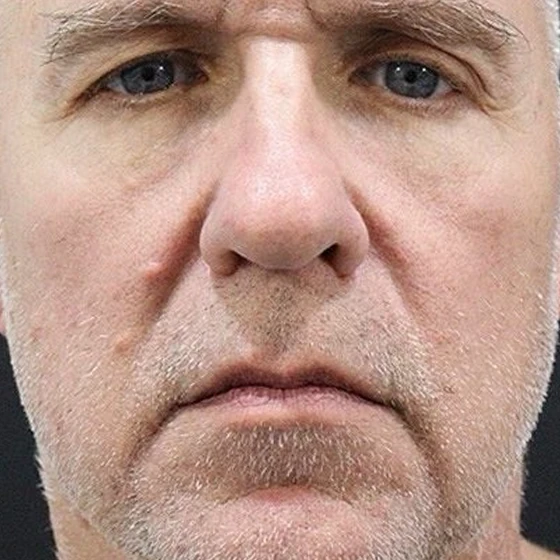
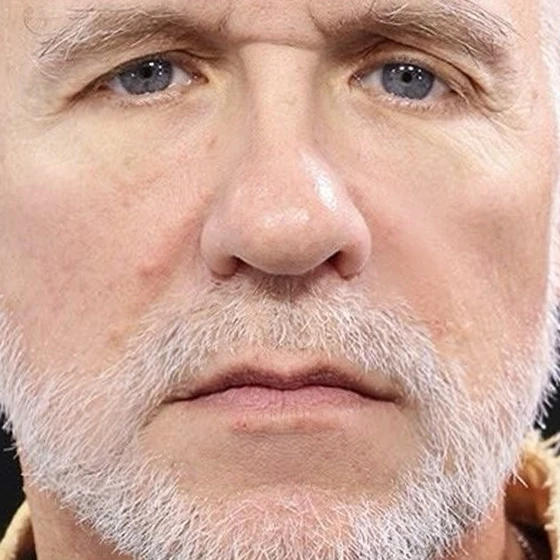 BeforeAfter
Drag to compare. Surgery repositions the jawline itself, which is what filler cannot do once a jawline has descended. A real result, photographed with consent. Individual results vary.
What happens to filler over the years?
Three things, in my experience, and none of them is a scandal. First, filler does not always vanish on schedule. Absorption is the design, but it is not a promise: high-resolution imaging studies have found hyaluronic acid still detectable in the face years after it was placed, well past the months a label tends to suggest. In the faces I examine I sometimes find that same soft fullness persisting where product was put down long before, quietly adding to the very heaviness the patient came to discuss. Second, volume placed years apart does not always stay where it was first placed; the lower face is a moving landscape, and product can end up contributing to the fullness it was meant to disguise. Third, the target itself keeps moving. Descent continues underneath the maintenance, so each session negotiates with a slightly older face, and the scope of the touch-ups tends to grow even when nobody intends it to.
This is why I ask about filler history whenever I study a patient’s photographs. Residual product can imitate descent, or mask it, and I want to know whether I am reading your anatomy or reading your injector’s work. Do yourself a favor regardless of where you have surgery: keep a simple record of what was placed, where, and roughly when. It makes every future consultation more honest.
What about the jawline after major weight loss?
A face that has lost a great deal of weight has a particular kind of jawline: emptied from within, draped by an envelope that no longer fits. That combination, deflation plus laxity, is the one job filler is least equipped to take on, because you would be chasing lost volume across the whole lower face while the loosened envelope hangs unaddressed, and the result tends toward heavy rather than defined. In my judgment that face is served by repositioning the envelope first, and only then asking whether any true volume deficit remains. The full conversation lives on the facelift after weight loss page. Individual results vary.
So which one actually lasts?
Surgery, and it is not close. A lift repositions the structure that descent displaced, which is why its result is measured in years rather than in maintenance appointments.
- A deep plane result is commonly described in published data as lasting about ten to twelve years.
- Surface and SMAS techniques are more often described at about five to ten years.
- Filler lasts as long as the maintenance continues, and not a day longer.
Why the deep plane tends to hold longer than SMAS approaches is a genuine debate among surgeons, and I keep that argument in one place rather than re-litigating it here: the deep plane versus SMAS page walks through it properly. I will not oversell those numbers, though. They come from studies that measure different things over different follow-up periods, and a 2025 systematic review of both techniques concluded that the comparative long-term evidence is still too limited and too heterogeneous to declare a winner outright. What is not in doubt is the direction: repositioned structure holds for years, absorbed volume does not. And a lift is a real operation, with anesthesia, a recovery, and the ordinary risks any surgery carries, where filler is an office visit; that difference belongs in the decision too. Then let me hedge the rest the way honesty requires: no operation stops time. A lift resets the starting point; the face continues to age from a better position. Individual results vary.
Repositioning versus adding: the real difference
In 1990, Hamra described the operation that reframed this entire conversation. The deep plane technique releases the deep structure beneath the SMAS, the superficial musculoaponeurotic system first mapped by Mitz and Peyronie in 1976, and repositions it as one unit, with the suspension held at the level of that fascia so the skin is never asked to carry the lift under tension. At the jawline, that means the jowl is not padded over or shadow-corrected. The descended structure that created it, tethered by a retaining ligament along the jaw, is released and carried back to where it came from. That is the work of the deep plane facelift, and below the jaw, the neck lift addresses the slackened platysma and the loose skin over it.
Now the fair point in the other direction, because this comparison should not be a sales pitch. Surgery repositions; it does not add. A genuinely deflated face can still be short of volume after a well-executed lift, and filler used sparingly on top of repositioned structure is a different and far more sensible use of the tool than filler asked to disguise descent. I keep an honest inventory of what surgery will not do in what a facelift does not fix. The two tools are not rivals so much as answers to different questions. The mistake is asking the temporary, additive one to solve a structural problem.

How I decide, face by face
Send me photographs and I will tell you which side of the line you are on. That is the whole method, and it has not changed much in my 37 years of practice: standardized photographs, studied carefully, before any talk of technique. I trained in face and neck surgery with Bruce F. Connell, and the discipline he insisted on was diagnostic before it was technical. Name the anatomy that changed. Then, and only then, choose the instrument.
Sometimes the instrument is filler, and I say so. Sometimes it is a neck operation, sometimes a lower face lift, and if your question has become which operation rather than whether, neck lift versus lower facelift walks that decision properly. After more than 3,000 facelifts I have no need to talk anyone into surgery. What I offer is a straight answer about what your jawline is doing and which tool actually addresses it.
The consultation starts with your photographs, and our team coordinates everything from San Diego for patients coming from the United States. You can reach us at +1 (619) 738-2144 by phone, SMS, iMessage, or email. Ask me the hard version of this question. It is the one worth answering. Individual results vary.