
The dividing line is your jawline. A neck lift corrects what sits below it: loose skin, vertical muscle bands, the fullness that blunts the angle under your chin. A lower facelift corrects what sits at the jawline and above it: the jowl, the blurred border of the jaw, the descent that begins in the midface. Nearly everyone who writes to me about this decision is really asking one question, where does my problem live, and many are asking for the wrong operation by name. So this is the map. I will show you how I sort a neck into three ingredients, fat, muscle, and skin, how to find your own problem in the mirror, and which operation each finding points to. Photographs make the final call, and individual results vary, but by the end you will know which question to bring me.
What is the difference between a neck lift and a lower facelift?
A neck lift treats the neck itself, the loose skin, the slackened platysma muscle, and the fat below the jaw, while a lower facelift repositions the descended structure of the jawline and midface that creates the jowl. They are neighbors, not rivals. Each owns a territory, and the jawline is the fence between them.
The neck lift works below that fence. The platysma is the broad sheet of muscle that wraps the front of your neck, continuous below the jaw with the SMAS of the face, the layer Mitz and Peyronie mapped in the surgical literature in 1976, and with age its inner edges can separate and show as vertical bands while the whole sheet slackens and blunts the neckline. A full neck lift tightens that muscle, addresses the fullness under the chin, and treats the loose skin, through incisions that typically sit around and behind the ear, where they are designed to hide.
The lower facelift works above the fence. The jowl is not neck. It is facial structure that has descended toward the jawline from above, and in my hands the operation that corrects it is the deep plane facelift, the approach Hamra described in 1990, which releases the layer beneath the SMAS and repositions it as one unit so the skin is never asked to carry the lift under tension. If you want the argument between the deep plane and the older SMAS approaches, that debate has its own page: deep plane vs SMAS. For this decision, all you need is the border.
- Soft, rounded fullness under the chin points to fat, and often to a smaller procedure
- Two vertical cords that jump forward when you grimace are the platysma muscle
- Skin that folds rather than snaps back when you pinch it points to laxity, and to a full lift
- A jowl at or above the jawline is not neck at all, and no neck operation corrects it
The jowl hangs near the neck, but it belongs to the face
A patient once traced her jowl with a fingertip on our video call and asked me, very reasonably, for a neck lift. It sat low, it moved when her neck moved, and it seemed to soften when she lifted her chin. I understood the logic completely. It was still the wrong operation.
Jowls originate from descent at the jawline and the midface, above the neck, so a neck-only procedure does not correct them. Tightening the neck beneath a jowl is like straightening the tablecloth when the vase is what tipped over. I have written a full article on exactly this misreading, does a neck lift fix jowls, because it is the single most common confusion in the photographs patients send me.
Keep the rule simple. Below the jaw, think neck. At the jaw and above, think face.
Is my problem fat, muscle, or skin?
Every aging neck I have examined in 37 years comes down to some mixture of three ingredients: fat that fills the angle under the chin, platysma muscle whose edges have loosened into vertical bands, and skin that has lost its snap. The proportions differ from face to face, and the proportions are what decide the operation. Reading the aging neck as distinct layers rather than one problem is how the surgical literature approaches it as well, which is why one finding can point to a small procedure and another to a full lift. That is why I want you to learn to see your own neck the way I read it in photographs.
Fat announces itself as soft, rounded fullness under the chin, the shape people call a double chin. Muscle announces itself as structure: two vertical cords running down from under the chin, faint at rest, sharp when you strain. Skin announces itself as surface, crepey texture, folds that hang rather than drape, a neck that looks older than the jawline above it.
Three tests you can do in a mirror
- The profile photograph. Have someone photograph you from the side, relaxed, eyes level. Study the angle between your chin and your neck. Soft fullness filling that angle points to fat.
- The grimace. Tense your neck hard, as if grimacing or forcing out a long ‘eee.’ If two cords leap forward under your chin, those are the inner edges of your platysma. That is muscle.
- The pinch. Gently pinch the skin below your jaw and let go. Skin that snaps back still has tone. Skin that sits in a fold before easing back is telling you laxity is part of your story.
None of this replaces an examination, and I make no diagnosis from a paragraph. But patients who arrive at the consultation already knowing their ingredients ask better questions, and they understand my answers faster.
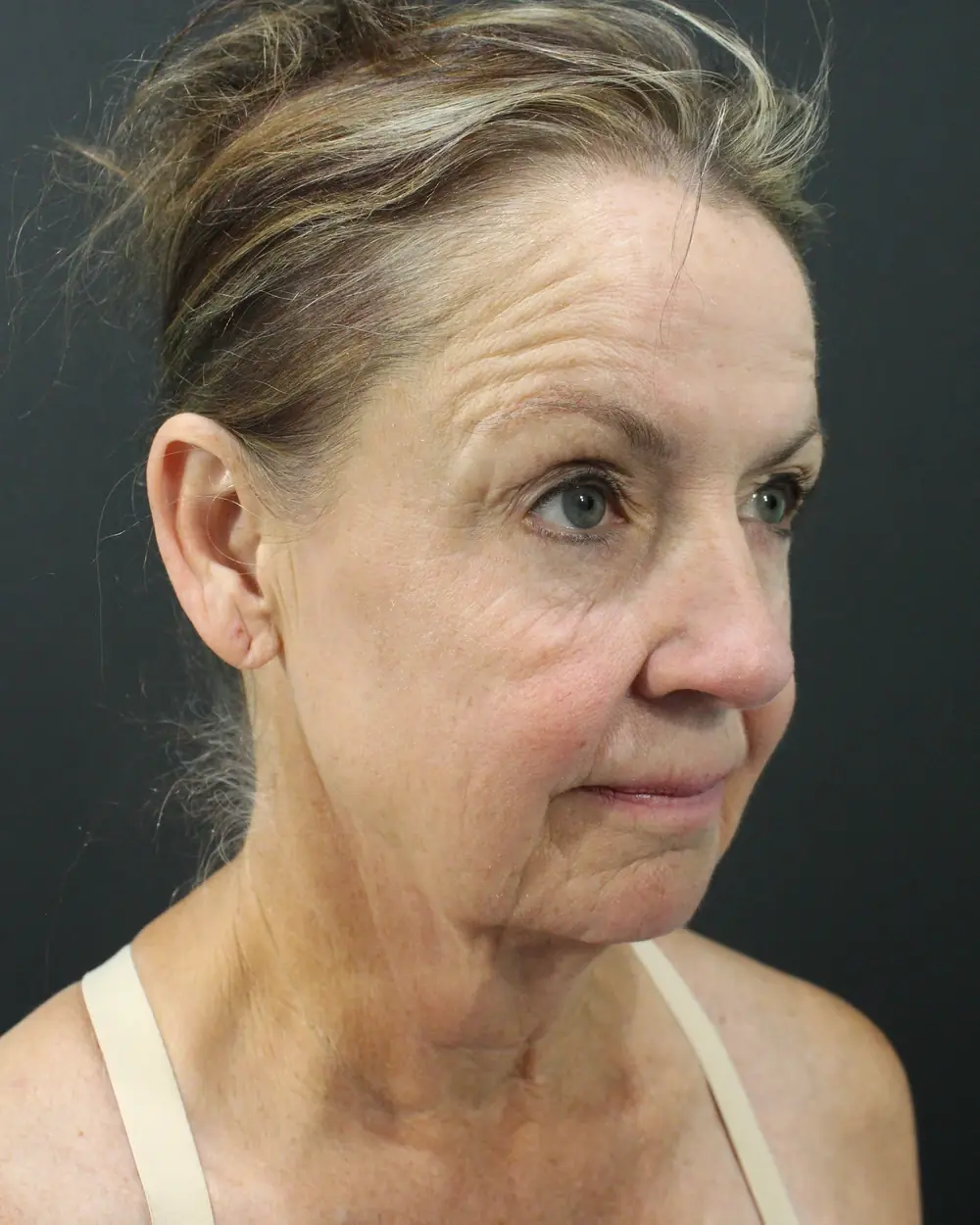
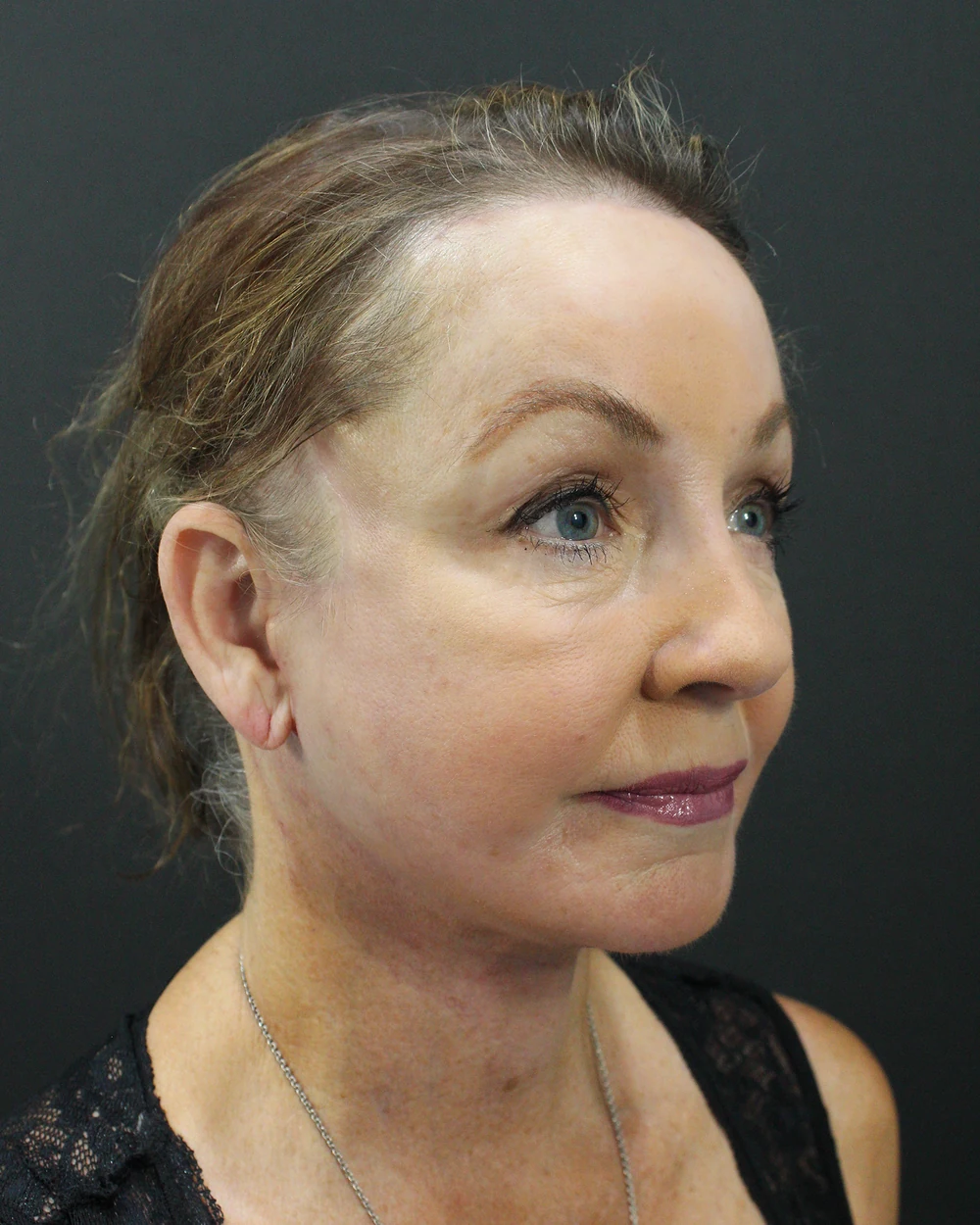 BeforeAfter
Drag to compare. The jawline is the border: what changes below it is neck work, what changes at and above it is face. A real result, photographed with consent. Individual results vary.
Match the ingredient to the operation
Here is the matching, ingredient by ingredient.
- Mostly fat, with skin that still snaps back: a submentoplasty may be enough, a smaller procedure through a short incision hidden under the chin that addresses the fat and the platysma without touching the ears. How it compares to the full operation is covered in submentoplasty vs neck lift.
- Muscle bands at the front of the neck: platysmaplasty, in which I suture the separated edges of the platysma to sharpen the cervicomental angle, the chin-to-neck transition surgeons use to judge a crisp neckline. What healing from that looks like is covered in platysmaplasty recovery time.
- Loose skin: a full neck lift. Skin laxity cannot be corrected through a small incision under the chin. Redraping skin requires the incisions around and behind the ear, and pretending otherwise leads to disappointment.
- A jowl or a blurred jawline: you have left neck territory. That is the lower face, and the operation is the deep plane facelift.
Recovery scales with the operation. A smaller neck procedure is generally quicker to recover from than a full lift, though I say that carefully because individual recovery varies. The full arc for the larger operations, drains typically out at 48 to 72 hours, sutures out about day seven, socially presentable near fourteen days, lives on the facelift recovery page.
Which operation do I actually need?
The photographs that reach my desk rarely show one ingredient in isolation. Fat, muscle, and skin age together in most necks, and the jawline above them is usually somewhere in the story too. So the honest answer to which operation you need is almost never read off a menu. It is read off your face.
Two misreadings account for most of the wrong self-diagnoses I see. The first is the patient who asks for a neck lift when the real problem is a jowl, which needs the lower face operated on, not the neck. The second is the reverse: the patient bracing for a full facelift whose aging lives entirely below the jaw, whose skin still has good tone, and who may be served by something smaller. If that second person sounds like you, read can you get a neck lift without a facelift.
And if what you are actually weighing is surgery against injectables along the jawline, I compare those two roads honestly, over years rather than months, in jawline surgery vs filler. If you are weighing a smaller facelift against a full one, that comparison lives at mini facelift vs deep plane facelift. I would rather point you to the smaller operation when the smaller operation is the honest one. After more than 3,000 facelifts, I do not need to sell you the bigger procedure. I need to match you to the right one.
Can a neck lift and a lower facelift be combined?
Yes, and for many faces they should be, planned together as one face and neck lift, because the two territories share the jawline and usually age together. One combined operation means one anesthesia, one recovery, one stay at the in-house Recovery Boutique, rather than two of each, and either way the surgery takes place at VIDA Wellness & Beauty with anesthesiologist Dra. Nadiezhda Garcia Bonilla present. Whether a deep plane facelift already includes the neck, and when the neck deserves a plan of its own, is a question I have answered at length in does a deep plane facelift include a neck lift, so I will not repeat it here. The short version: the border between face and neck is real for diagnosis and imaginary for surgery. I diagnose the territories separately, and I frequently treat them together. Individual results vary.

What I look for in your photographs
I learned to read necks from Bruce F. Connell in Santa Ana, California, during my fellowship with him, and Connell was a master of the face and neck lift. He taught me that the neck is diagnosed long before it is touched: you decide from the study of the face what each layer needs, and only then do you choose the operation. Not the other way around.
That is still how I work. When your photographs arrive, I look first at the angle between your chin and your neck. Then at where the descent begins, in the midface sliding toward the jawline or in the neck itself. Then at how the skin behaves, whether it drapes or hangs. From those three readings comes the plan: submentoplasty, platysmaplasty, full neck lift, lower face, or a combination. My background, including 37 years in practice, is on the Dr. Quiroz page if you want to check who is doing the reading.
If you have done the mirror tests and you are still unsure which side of the jawline your problem lives on, that is normal. Borders are exactly where diagnosis gets hard. Send photographs through the consultation page, or call or text our San Diego coordination line at +1 (619) 738-2144, and I will tell you directly which operation your neck is actually asking for, including when the answer is the smaller one. Individual results vary.