
Almost every week, a patient sits across from me, grabs the soft tissue under her chin between thumb and forefinger, and asks some version of the same question. Can I just dissolve this? She has usually read about Kybella. Sometimes she has already had it, two or three rounds in a med spa north of the border, and she is in my office in Tijuana because the fullness is still there, or because it is gone and the neck somehow looks worse.
I have been doing facial surgery for 37 years, and I can tell you the honest answer begins long before anyone names a treatment. It begins with what “this” actually is. A double chin is not one thing. It is a label we hang on at least five different anatomic problems: fat above the neck muscle, fat below it, skin that has lost its elasticity, muscle bands that have loosened and separated, and, in some necks, salivary glands that sit low and push outward. Kybella treats exactly one of those five. Surgery can address all of them. So the useful question is never which treatment is better. It is which problem you have.
Let me teach you how I sort that out, starting with two tests you can do at your bathroom mirror tonight.
Two tests you can do in the mirror tonight
Stand in good light, ideally light coming from above, the most unflattering kind. You want unflattering. Flattering light is how people postpone this diagnosis for years.
First, the pinch. Take the fullness under your chin between your thumb and the side of your bent index finger and lift it gently away from your neck. Pay attention to two things. The first is what you are holding. A soft, pillowy roll that comes away easily from the deeper structures is superficial fat, the layer that sits just under the skin and above the platysma muscle. The second is what happens when you let go. Skin with good elasticity snaps back against the neck almost instantly, like a fresh rubber band. Skin that has lost its elastic fibers settles back slowly, the way a bedsheet settles after you lift a corner, and it may hold a faint crease where your fingers were.
Second, the grimace. Look at your neck straight on and say a long, forceful “eee,” pulling the corners of your mouth down like a mask of effort. Watch for two vertical cords running from under the chin down the front of the neck. Those are the edges of your platysma muscle. If they pop up sharply, or if you can already see them at rest when you are tired, you have platysmal bands. Hold that thought, because it matters more than almost anything else in this decision.
While you are there, do one more thing. Tilt your chin up toward the ceiling and look at your profile in a hand mirror. If your neck suddenly looks a decade younger with your head tilted back, gravity and loose tissue are doing most of the damage, not fat. Fat does not disappear when you change posture. Slack does.
None of this replaces an examination. I have had patients arrive certain they had a fat problem and leave with a diagnosis of low salivary glands, and the reverse. But the pinch and the grimace will put you in the right neighborhood before you spend money in the wrong one.
What a double chin is actually made of
Think of the front of the neck as a stack of layers. On top, skin. Under the skin, a layer of superficial fat. Under that fat, the platysma, a thin sheet of muscle that drapes from the jaw down across the neck like a scarf. And beneath the platysma, a compartment most people have never heard of: deep fat, the digastric muscles, and the submandibular glands, which are salivary glands roughly the size of a walnut sitting under the back half of the jawline on each side.
Every layer ages differently. Superficial fat can accumulate with weight, or simply be inherited; I see 25 year olds at a healthy weight with a genuine fat pocket their mother and grandmother also carried. Skin loses elastin and collagen with sun and time. The platysma loosens at its center seam and its edges bow into bands. Deep fat can be generous from birth. Glands can sit low. And underneath all of it, the skeleton sets the stage: a short chin or a low hyoid bone, the small U-shaped bone the neck muscles hang from, makes even a lean neck look full.
When you understand the stack, the marketing fog clears quickly. An injectable that dissolves fat can only help you if fat, and specifically the superficial fat above the muscle, is your main problem. It cannot reach the deep compartment safely, it cannot shorten skin, and it cannot repair a muscle. This is not a criticism of the product. It is simply its job description.
Does Kybella tighten loose skin?
No. It has no mechanism to. I want to be plain about this because it is the single most common misunderstanding I correct in consultation.
Kybella is the brand name for injectable deoxycholic acid, a synthetic version of a bile acid your own digestive system uses to break down fat. Injected into the fat under the chin, it ruptures the membranes of fat cells, and your body clears the debris over the following weeks. The FDA approved it in 2015 for improving moderate to severe fullness under the chin in adults. It is, for that specific target, legitimate medicine, not a gimmick. In REFINE-1, the pivotal phase 3 trial, 70 percent of treated patients improved by at least one grade on the clinician scale, against about 19 percent with placebo injections. Those are real numbers from a properly controlled study.
But read the fine print of who was studied, because it answers the loose skin question better than any advertisement. The trials that earned Kybella its approval enrolled patients with submental fullness and without excessive skin laxity. The manufacturer and the FDA both understood that dissolving fat under skin that cannot retract is not a result anyone wants to photograph. Deoxycholic acid destroys adipocytes. It does not build collagen in any clinically meaningful way, it does not shorten skin, and it does not touch the platysma. If your pinch test showed slow, reluctant recoil, the drug is aimed at the wrong layer of your neck.
There is one genuinely good piece of news in the data worth passing along. Fat cells destroyed by deoxycholic acid do not grow back, and follow-up of the phase 3 trial patients found improvements maintained up to three years. When the diagnosis is right, the result is durable. Individual results vary, and the fat cells that remain can still enlarge if your weight climbs, but this is not a treatment you repeat annually the way you would a wrinkle relaxer.
How many sessions, honestly
Here the brochures and the arithmetic tend to part ways. The FDA label permits up to six treatment sessions, spaced at least one month apart. In my experience talking with patients who have been through it, a small, well-selected pocket usually needs two to four sessions before both patient and injector are satisfied. Each session involves a grid of small injections across the area, and each one triggers real inflammation, because inflammation is how the treatment works. Expect meaningful swelling for several days, what patients ruefully call the bullfrog phase, plus numbness and firmness that can linger for weeks. You judge the result of one round only after a month or more, then decide about the next.
So the honest timeline for a Kybella result is not an afternoon. It is a season, sometimes two, of treat, swell, settle, reassess. For a young patient with an isolated pocket and a flexible schedule, that trade can be perfectly reasonable. I only insist that you make it with your eyes open, because I meet too many people who were quoted one session and are surprised to be booking a fourth.
The honest dividing line
Nearly every consultation for a double chin comes down to the same fork, and you can see most of it in the mirror tests you already did. Here is how I would sort the findings.
- The fullness is a soft, pinchable roll you can lift away from your neck
- Your skin snaps back the instant you release the pinch
- No vertical cords appear when you grimace, and none show at rest
- Your jawline is still crisp at the sides, with no jowls forming
- The pocket has been there since your twenties at a stable weight
- You can accept several sessions and a week of swelling after each
- The skin settles back slowly, or holds a crease after the pinch
- Vertical bands pop with a grimace, or have started showing at rest
- The fullness sits under the back of the jaw and feels firm, not soft
- Jowls have begun to blur the corner of your jawline
- Your neck looks dramatically better the moment you tilt your head up
- The skin itself looks crepey, sun-damaged, or finely wrinkled
If your findings live mostly in the first half of that list, deoxycholic acid deserves a place on your shortlist, and you may not need a surgeon at all. If they live mostly in the second half, no volume of injections will get you where you want to go, and the kindest thing anyone can tell you is to stop paying for the wrong tool.
What happens when Kybella meets loose skin
I want to describe the failure mode, because I see its aftermath in my office several times a year, and it is preventable.
Picture a pillow that has lost its firmness, inside a pillowcase that has stretched. The fullness bothers you, so you remove some of the stuffing. The case does not shrink to match. It hangs. That is what happens when fat is dissolved under skin that has lost its recoil. The neck gets smaller in volume and looser in appearance at the same time. Worse, the fat that was quietly padding the platysmal bands is gone, so the cords become more visible than before. The patient has paid for several rounds of treatment and arrived at a neck that now needs surgery anyway, occasionally with tissue that is slightly scarred and less pleasant to work with, though in fairness to the product, prior injections rarely make a lift impossible. They just make the detour expensive and demoralizing.
The drug did its job in these cases. The diagnosis failed. Every one of these patients had slow skin recoil or early bands that someone should have noticed, and I would rather you notice them yourself, tonight, at your mirror, for free.
Side effects worth respecting
Kybella’s side effects are mostly the honest cost of its mechanism: swelling, tenderness, bruising, numbness, and firmness where the fat is being cleared. Two deserve special mention.
The first is temporary weakness of the marginal mandibular nerve, the small branch that lets you pull your lower lip down when you speak or smile fully. In REFINE-1, about 4 percent of treated patients had an episode of this weakness, and reassuringly, essentially all cases were mild and resolved on their own. The nerve runs close to the jawline, and deoxycholic acid does not distinguish nerve insulation from fat, which is exactly why injection technique and anatomic training matter far more than the price per vial. There are also rare reports in the literature of skin injury and ulceration when the drug is placed too superficially.
The second is not on any label. It is the side effect of misdiagnosis, the one I just described, and it does not resolve on its own.
I say all of this without hostility toward the product. In the right neck, injected by someone who genuinely knows the anatomy, it works and the safety record is acceptable. My quarrel is only ever with the selling of it to the wrong neck.
The freezing question, briefly
Patients researching Kybella almost always ask about its cousin in the same breath: the small cryolipolysis applicators that freeze the under-chin pocket instead of dissolving it. I will not referee the two here, because the entire point of this article applies to both equally. Freezing fat and dissolving fat are the same idea delivered differently, and both answer only a fat problem sitting under elastic skin. Every disqualifier on my checklist disqualifies them together. If a device or a syringe is being offered for your loose skin or your bands, the delivery method is a detail. The diagnosis is already wrong.
When the problem is structure, the fix is structural
Loose skin, separated platysmal bands, sagging deeper tissue: these are mechanical problems, and mechanical problems have mechanical answers. This is what a neck lift actually does, and it is worth understanding as more than a word.
Through incisions tucked around the ears, and usually a small one hidden in the crease under the chin, I lift the skin, repair the platysma at its center seam so it once again acts as a single supportive sheet, reposition the deeper tissue upward along the direction it descended from, and redrape the skin without tension, trimming only what is genuinely extra. The muscle repair is the part no injectable and no energy device can imitate, and it is the difference between a neck that is smaller and a neck that is young. When jowls have started to soften the jawline, that is a related but separate conversation, because jowls belong to the face rather than the neck, and I have written about whether a neck lift fixes jowls in its own right.
Recovery is more demanding than an injection appointment, and I will not pretend otherwise. Most of my patients are presentable in social settings within about two weeks, with tightness and patches of numbness that fade over months. Individual results vary, and I tell every patient that the neck they get depends on the neck they bring me: skin quality, bone structure, and healing all have a vote.
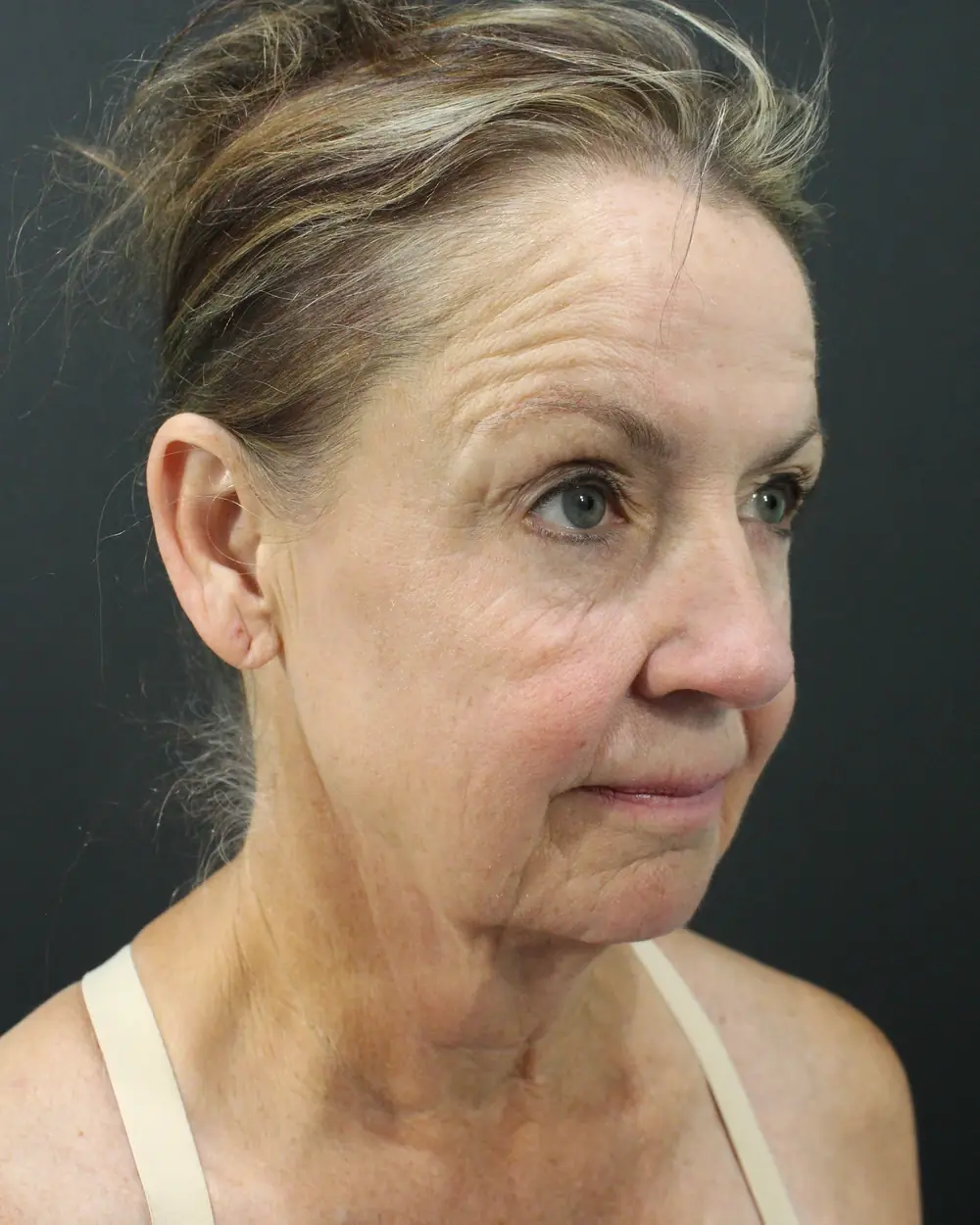
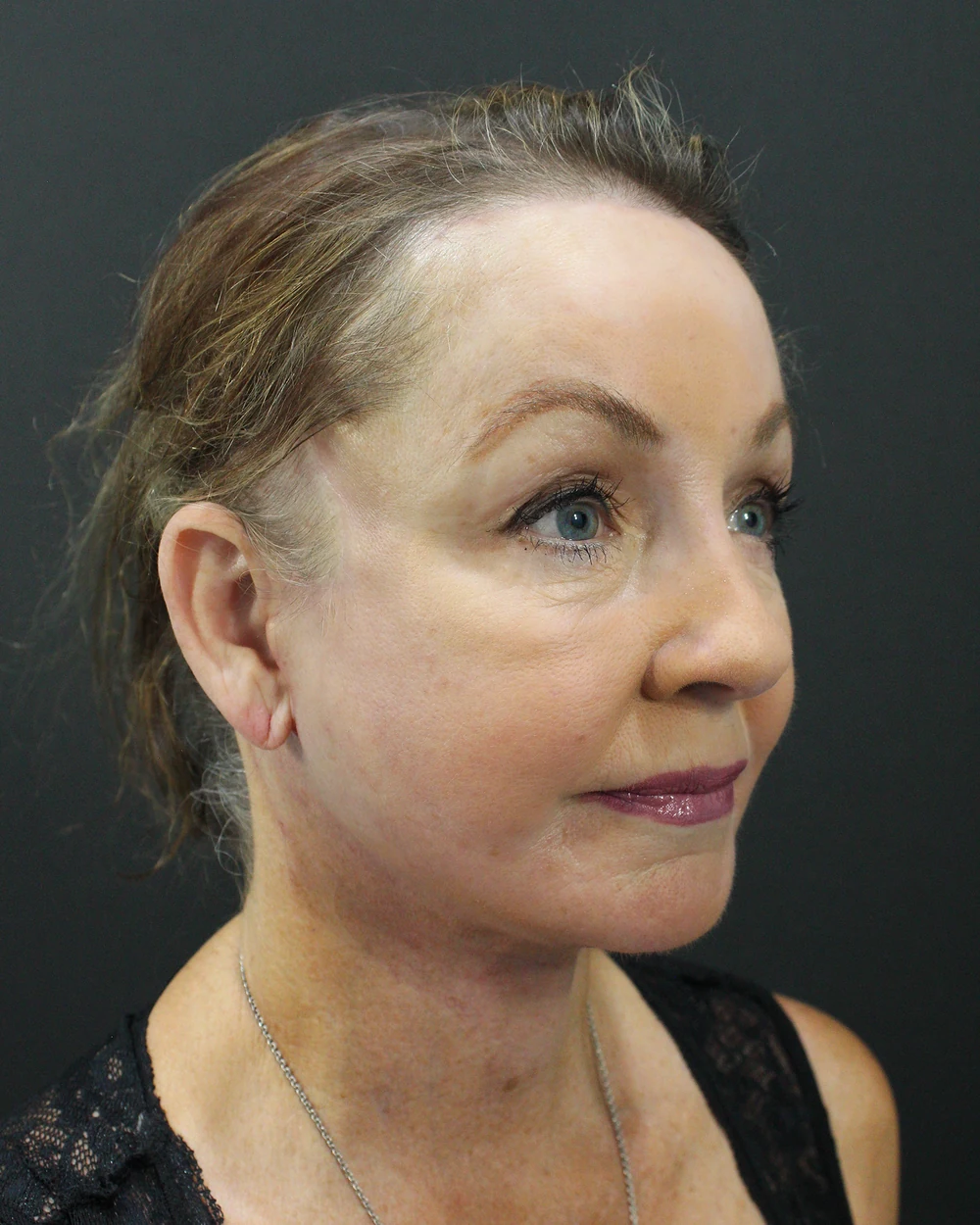 BeforeAfter
What surgery buys you that a syringe cannot, in the end, is completeness. One operation, one recovery, and every layer of the stack addressed in a single sitting, in proportion, by the same pair of hands.
The fullness that is not fat at all
Now and then the pinch test fails a patient in an interesting way. She pinches, and there is not much there. The fullness sits deeper, under the back half of the jawline, and it feels firm, almost rubbery, not like fat at all. Often it is one of two things: deep fat below the platysma, or a submandibular gland sitting lower than it should.
This matters enormously for our question, because deoxycholic acid must never be aimed at a gland, and even most surgeons choose not to go below the platysma. The deep compartment of the neck is intimate with nerves, ducts, and vessels, and working there demands specific experience. A recent systematic review of gland reduction in neck lift surgery, pooling 51 studies and nearly 3,000 patients, reported an overall complication rate of about 15 percent, with temporary marginal mandibular nerve injury the most common event. Those numbers are exactly why this is a judgment call and not a routine add-on.
I do perform deep neck work, including submandibular gland reduction and management of the digastric muscles, when the anatomy in front of me genuinely calls for it. That is a minority of necks, and I decide from a hands-on examination and photographs, never from a phone call. When a low gland is the true cause of the bulge, no amount of superficial treatment, injectable or surgical, will erase it, and pretending otherwise wastes the patient’s money and hope. When the gland is fine, I leave it alone. Most full necks do not need deep work, and an operation should never carry more risk than the problem it solves.
If a provider proposes injecting or operating on your neck without ever pressing their fingers under your jaw while you swallow, they have skipped the layer where these surprises live.
The middle path most people skip
Between a series of injections and a full neck lift sits an option that gets far less attention than it deserves, especially for patients in their thirties and forties: a submentoplasty. Through the same small hidden incision under the chin, I can remove the stubborn fat pocket directly and precisely in one session, and, if early bands are present, repair the platysma at the same time, all without lifting or trimming skin at the ears, because a younger patient’s elastic skin will shrink to the new contour on its own.
For the right candidate, this splits the difference beautifully. It is definitive where injections are incremental, and modest where a full lift would be excessive. I have compared submentoplasty with a full neck lift in detail elsewhere, but the shorthand is this: submentoplasty treats the content under the chin, a neck lift treats the content and the envelope. Your pinch test, again, tells you which conversation you belong in. Liposuction of the neck lives in this same family, a fine tool for a purely superficial fat problem in elastic skin, and subject to the same disqualifiers as the syringe.
If you already had Kybella and you are unhappy
A note for the reader who found this article a few sessions too late, because she writes to me often.
First, nothing about prior injections closes the surgical door. I operate on previously injected necks regularly. The treated fat layer can feel a little firmer and more adherent than untouched tissue, which asks for more patience during the dissection, but it does not change what is achievable. If your problem all along was laxity or bands, the lift that would have served you two years ago will still serve you now.
Second, timing matters. I prefer to wait until the neck has fully settled from the last session, meaning the swelling is gone, the firmness has softened, and the tissue moves freely under my fingers again. For most patients that means at least three to six months after the final round. Operating into inflamed tissue helps no one, and the wait also gives you a clear-eyed look at what the injections truly accomplished.
Third, be gentle with yourself about the decision. You were sold a reasonable product for an unreasonable indication, usually by someone who never pinched your neck. The money is spent. The anatomy is still there, still fixable, and a proper diagnosis now is worth more than the regret.
A word about the arithmetic
I promised myself when I began writing this journal that I would never quote prices in it, and I will not start now, because a figure without an examination is a guess dressed up as an answer. But I will teach you how to think about the money, because patients consistently compare the wrong quantities.
There are two currencies in this decision, and only one of them is money. The other is time, and patients forget to count it. A series of injection sessions means a series of swollen weeks, spread across months, each one scheduled around work, photographs, and social life. An operation concentrates its downtime into one block, once. Depending on your job and your calendar, one of those shapes will suit your life far better than the other, and that is a legitimate reason to prefer either path. Count both currencies before you decide.
As for the money itself, an injectable is priced per vial, per session. A meaningful pocket takes more than one vial, and, as we covered, more than one session. Whatever the number on the menu, the real cost is that number multiplied out to the finish line, plus the sessions nobody mentioned at the start. Surgery is priced once, for one event and one recovery. So when you compare, compare totals against totals, and completed outcomes against completed outcomes, never a single session against an operation. And hold onto this above everything: the cheapest treatment that cannot fix your problem is the most expensive thing you will ever buy, because you pay for it twice, once at the register and once more when you finally treat the real diagnosis.
Patients I send away from my operating room
Candor runs both directions, so let me tell you who should not book surgery with me.
The 27 year old with a small inherited pocket, taut skin, and a flawless grimace test does not need a surgeon. She needs deoxycholic acid or a conservative liposuction, done by someone skilled, and she will likely be delighted. Operating on her would be using a crane to lift a coffee cup.
The patient whose neck fullness rises and falls with the bathroom scale needs weight stability before anyone touches the area, injector or surgeon. Treating a neck mid-descent is sculpting sand at low tide.
The patient who wants surgery to fix crepey texture and sun damage will be disappointed, because a lift repositions tissue and cannot resurface skin. The patient managing an uncontrolled medical condition, or unable to pause nicotine, has healing risks I will not accept on her behalf. And the patient shopping purely on price, who wants me to win a bidding war rather than make a diagnosis, is better served elsewhere, with my genuine good wishes.
Notice what is missing from that list: a birthday. Age by itself never decides this. I have operated on necks in their late thirties that truly needed it and declined necks in their sixties that did not. Elasticity, bands, and anatomy decide, not the calendar.
How I decide when you are in my chair
The consultation for a double chin is quieter than people expect. I do with my hands what you did at your mirror, only with more information behind it. I pinch and release, watching the recoil. I ask you to grimace, and I feel how the bands travel. I press under the back of your jaw while you swallow, feeling for the size and position of the glands. I look at your chin projection and where your neck breaks in profile, and I take photographs from angles no one uses on themselves, because the camera holds still and mirrors do not. For my out-of-town patients, most of whom come from California, this begins with photographs and a video conversation, and the hands-on examination confirms the plan before anything irreversible happens.
Then I tell you which of the five problems you have, in what proportion, and which tool fits. Sometimes that is a syringe someone else holds. Sometimes it is a small operation, sometimes a complete one, and sometimes it is the advice to wait a few years. Patients occasionally seem surprised that a surgeon would talk them out of surgery. I am not sure why. A surgeon who has done this for decades has nothing to prove with your neck and everything to lose by choosing the wrong tool for it.
What most people are actually afraid of, I have learned, is not the operation. It is the idea of looking operated on, tight and altered and unlike themselves. That fear deserves respect, and the answer to it is the same answer as everything else in this article: diagnosis and proportion. A neck treated according to its true anatomy, whichever tool that requires, looks like you after a long vacation. A neck treated according to a menu looks like the menu.
Bring me the problem, not the prescription
So, Kybella or a neck lift? Wrong first question, and by now you know why. Ask instead: is my double chin a fat problem or a skin problem, or something deeper than both? Pinch, release, grimace, tilt. Be unsentimental about what you see, because the mirror is trying to save you months and money.
If the pinch is soft and the snap is quick, the syringe deserves a fair hearing. If the skin lingers and the cords stand up, come talk to someone who repairs structure, whether that is me or a surgeon nearer to home. Either way, walk into the room with a problem to be diagnosed rather than a product to be purchased. Every good result I have produced in 37 years began exactly there.