
A neck lift is genuinely different for a man, and not for the reasons the internet usually offers. The goal is the same in either case, a clean jawline and a firm neck, but a man’s tissue behaves differently under my hands, his risk profile is different, and the result I am aiming for is different in kind, not only in degree. Men are now among the fastest growing group of patients asking me about facial surgery, a shift the American Academy of Facial Plastic and Reconstructive Surgery has tracked in its annual survey, and most of the trouble I see in male necks operated elsewhere comes from one error: treating a man’s neck as though it were a woman’s. Over my 37 years I have studied and operated on a great many male necks, and three things truly separate them, thicker and more vascular beard-bearing skin, a higher risk of bleeding, and a goal that is a strong neckline rather than a delicate one. This page is about those three things. It is not the general map of whether you need a neck lift, a lower facelift, or both, which I have drawn in neck lift or lower facelift, and the full anatomy of the operation lives on the neck lift page. Here I am staying with what is specifically male.
Is a neck lift different for men?
Yes, in three concrete ways: a man’s skin is thicker and more richly supplied with blood, a man carries a meaningfully higher risk of a hematoma, and the neckline I am building is meant to read as strong rather than soft. The individual steps of the operation rhyme with a woman’s. The platysma, the broad sheet of muscle across the front of the neck that runs under the jaw and joins the support layer of the face, is tightened. The fullness under the chin is addressed. The skin is redraped. But each of those three differences reaches back and changes a decision along the way, from where I set the incisions to how I control the bleeding to how far I take the tightening. Miss any one of them and you get a neck that healed poorly, bled, or worst of all looks like it belongs on someone else’s face.
The male neck is thicker, more vascular, and it grows a beard
Run a finger along your own jaw. Under a man’s skin sits a denser, more fibrous layer than I find in most women, and threaded through the beard is a supply of small blood vessels feeding every follicle. That single anatomical fact shapes much of what follows. The flap I raise in a man is thicker and better supplied with blood, which in one sense is a gift, since it tends to heal robustly and resist the poor circulation that troubles thin skin. The surgical literature on the modern male facelift, including Rohrich and colleagues writing in Plastic and Reconstructive Surgery, describes exactly this well-vascularized male flap. In another sense that same rich blood supply is precisely why a man’s neck is more likely to bleed after surgery.
Thicker skin also hides a result differently. A heavy male neck does not spring back to a sharp line the way thin skin can, so I plan the tightening around the tissue I actually have, not around a picture of someone whose skin was never this substantial. This is one reason I insist on studying standardized photographs before I say a word about technique. Individual results vary.
Why do men have a higher risk of hematoma?
A hematoma is a collection of blood that gathers under the lifted skin, and being male is one of the strongest predictors of it after a facelift or neck lift. In an analysis of more than 11,300 facelift patients published in the Aesthetic Surgery Journal, male sex carried close to four times the relative risk of hematoma compared with female patients, an independent predictor even after everything else was accounted for. Two forces combine: the dense blood supply of the beard I just described, and the reality that men more often run higher and more variable blood pressure around the time of surgery.
So the male neck is not a place to be casual, and I am not. I take my time with hemostasis, the meticulous sealing of every small vessel before I close. I keep the blood pressure steady rather than letting it swing, the perioperative blood pressure control that reviews of facelift complications, such as the one by Sinclair and Zins in the Aesthetic Surgery Journal Open Forum, credit with reducing hematoma in men. I use drains, which typically come out at 48 to 72 hours. And I operate only at VIDA Wellness & Beauty, where the anesthesiologist Dra. Nadiezhda Garcia Bonilla is present for the entire procedure and the Recovery Boutique nursing watches you around the clock, because the hours right after surgery are when a hematoma tends to declare itself. What the warning signs look like, and why speed matters, I cover in facelift warning signs and hematoma. None of this eliminates the risk. It respects it. Individual results vary.

A strong neckline, not a feminized one
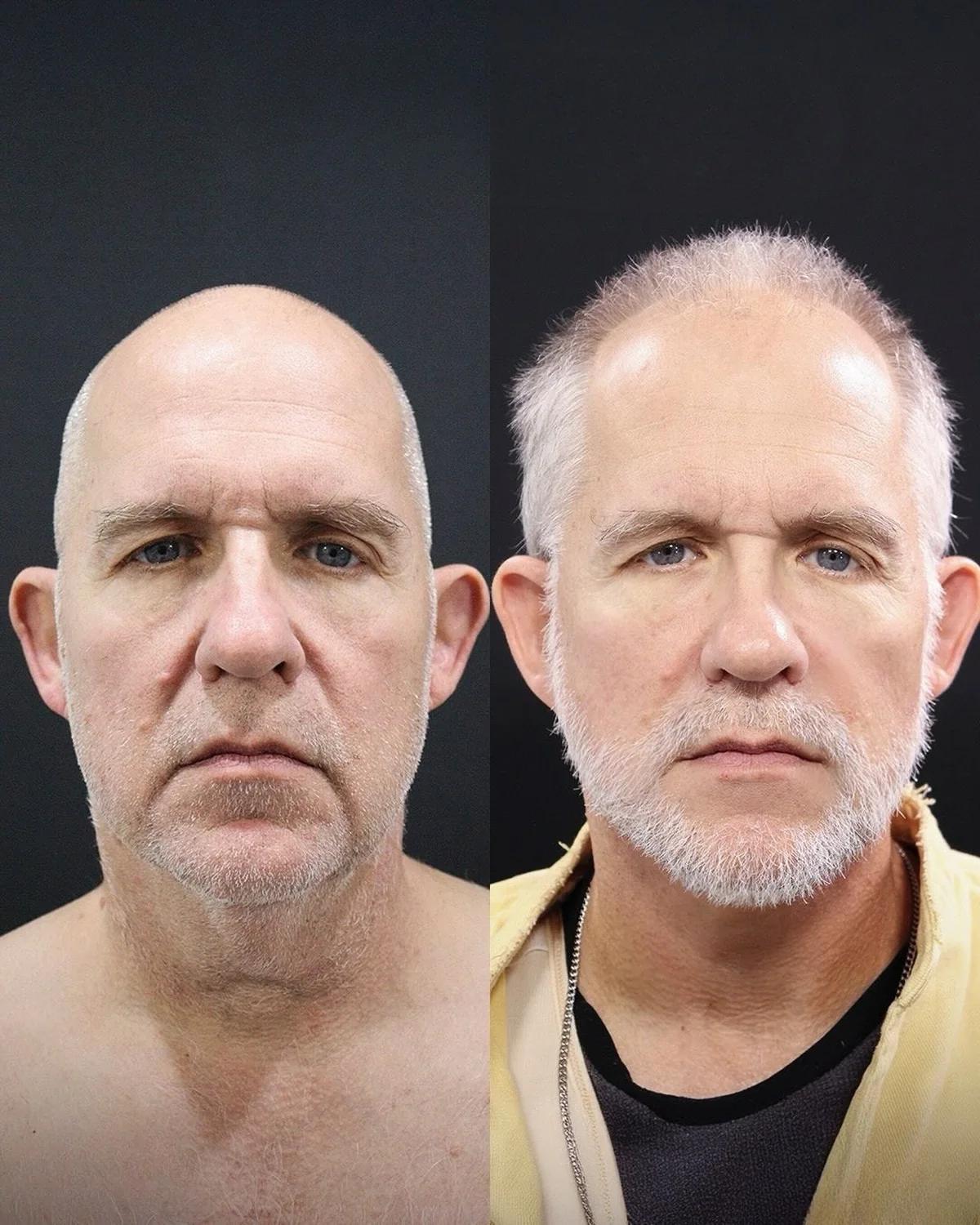
This is the difference I care about most, because it is the one a man cannot easily undo. A neckline has a sex. In a woman, a very sharp, almost right-angled line between the chin and the neck reads as youthful and feminine. In a man, chasing that same acute angle can hollow and thin the neck until it no longer looks male. So I aim for a clean, defined neckline that keeps a masculine breadth and a slightly stronger, less scooped angle, the cervicomental angle, which is simply the angle where the chin meets the neck. I resist over-tightening. I keep the sideburn where it belongs rather than sweeping it up and back into a feminine arch. The complaint that brings most men to me is not fine lines, it is the heavy fold under the chin and the blur where the jaw used to be, and my job is to clear that without erasing the architecture that makes the face read as a man’s. Restoration, not redesign. Individual results vary.
Does beard hair change where I place the incisions?
Yes, and it is one of the most distinctly male decisions in the whole operation: every incision has to respect where your beard grows, so that hair is never carried to a place it does not belong. When I redrape and tighten, the skin moves, and if I am not deliberate, beard-bearing skin can be pulled behind the ear or into an area that was previously bare, leaving a man shaving skin behind his ear or staring at a patch of hair where none should be. Rohrich and colleagues make the point plainly: incision design in men is guided first by the pattern of hair-bearing skin. So I plan around your sideburn, your hairline, and the front edge of the beard, often keeping the incision just in front of the ear where a man’s skin creases naturally, so the sideburn is not dragged toward the ear.
There is a second, plainer wrinkle. Many men keep short hair, and short hair hides scars less generously than the long hair many women can drape over them. That raises the standard for where I place every incision and how I close it. How I think about incision lines and how they mature is a longer subject, and I have written it out in facelift scars and incisions.
What a masculine result actually looks like
A man in his late fifties once told me on our video call that he did not want to look younger, he wanted to stop looking tired and heavy, to stop seeing his father’s neck when he shaved. That is the male brief, almost every time. He was not describing wrinkles. He was describing the loss of a jawline and the fullness under his chin, and when I studied his photographs the jowl, the soft descent that gathers at the jaw, was as much a part of the story as the neck.
That is the honest complication of the male request. A firm neck alone will not rebuild a blurred jaw, because the jowl comes from the face descending from above, not from the neck below, a boundary I lay out in does a neck lift fix jowls. For many men the strong result they are picturing needs the lower face addressed together with the neck, and in my hands that is the deep plane facelift, the approach Hamra described in 1990, which releases and repositions the deep support layer rather than pulling on the skin. A masculine result is a jaw with a border again and a neck that is firm but still broad and male. It should look like you slept well and stood up straight, not like you had surgery. Individual results vary.
Are you a good candidate for a male neck lift?
The best male candidate is easy to describe, and in my experience fairly common. He is bothered by a specific, structural change, the heavy neck, the lost jaw, and not by aging in the abstract. His skin still has some tone to redrape. His health is stable, his blood pressure controlled, and his expectations are anchored to his own face rather than to a photograph of a jaw he never had.
- You are troubled by a heavy neck, loose skin, or a jaw that has lost its line
- Your blood pressure is controlled and your health is stable for anesthesia
- You are a non-smoker, or willing to stop well before and after surgery
- You want your own jaw back, not a jaw you have never had
- Your real problem is a jowl or midface descent, which is a face operation, not a neck one
- Your blood pressure is uncontrolled, which sharply raises the bleeding risk
If most of the green lines are yours, you are the kind of man this operation serves well. If a red line is, that does not mean nothing can be done, only that the right plan may be a different one. Photographs settle it.
Who a male neck lift is not for
Some men should not have this operation, and I would rather tell you on a first call than in a follow-up. A man with uncontrolled high blood pressure is, until that is managed, the wrong candidate, because he carries the exact risk I spend the whole operation guarding against. A man still smoking is trading his skin’s blood supply for the very healing the flap depends on. A man whose neck is fine but whose real concern is a jowl or a sagging midface needs the face addressed, not the neck, and I would send him to read neck lift or lower facelift before he books anything. And a man who wants a jawline he was simply never born with is asking a lift to do something a lift does not do, because a neck lift removes what is in the way and repositions what has fallen, it does not build new bone or a new chin.
I keep a fuller inventory of the limits of lifting surgery in what a facelift does not fix. Saying no to the wrong operation is, after more than 3,000 facelifts, one of the more useful things I do.
What are the real risks for a man’s neck?
The honest short list starts with hematoma, then the ordinary risks any facelift carries, and for a man the hematoma sits at the top of the page for the reasons above. Beyond it, and without inventing numbers I cannot promise, a man should understand a handful of possibilities: temporary numbness of the neck and beard skin as small sensory nerves recover, changes in the direction beard hair grows near a scar, a scar that in thicker skin can take longer to settle, and, uncommonly, a temporary weakness at the corner of the mouth if the marginal mandibular nerve, the nerve that moves the lower lip, is bruised during the work near the jaw. Most of these are temporary when they happen at all, and I discuss the ones relevant to your anatomy before you decide.
The larger point is that a neck lift is real surgery with a real recovery: drains out at 48 to 72 hours, sutures about day seven, socially presentable near two weeks, and swelling that settles over months before the true result arrives. The full arc lives on the facelift recovery page. Individual recovery varies.
What we still do not know
I will be candid about the edges of the evidence. Most of the large facelift studies, including the ones I cite here, are built on cohorts that are overwhelmingly female, so the male-specific numbers, on longevity and on the finer complication rates, rest on smaller ground than I would like. The longevity figures often quoted, a deep plane result commonly described in published data at about ten to twelve years and surface techniques at about five to ten, come from mixed populations rather than from men alone. What I can tell you is grounded in 37 years of operating on male necks and in the direction the literature points, not in a large trial of men only, and I would rather you know that than pretend otherwise.
How I plan a man’s neck, from your photographs

Send me photographs, front and profile, relaxed and then with your neck tensed, and I will study them myself. From them I read the three male variables: how thick and heavy the skin is, where the beard sits against the lines I would need, and how strong an angle your face can carry without looking feminized. Then I tell you honestly whether the answer is a neck lift, a lower face and neck done together, or something smaller. If your problem lives above the jaw, I will say so. If it is the neck, I will tell you what I can and cannot promise, which is never a specific outcome, only a plan and the judgment behind it.
Our team coordinates U.S. patients from San Diego, and the surgery itself is in Tijuana at VIDA Wellness & Beauty, with a local stay of about six days so I can see you through the window when bleeding matters most. You can reach us by phone, SMS, iMessage, or email at +1 (619) 738-2144, and the consultation page explains how to send your photographs. My background, my training with Bruce F. Connell, and my 37 years are laid out on the Dr. Quiroz page if you want to know who is doing the reading. Bring me the hard version of your question. A man’s neck deserves a straight answer. Individual results vary.