You slimmed your jaw. For a while it was wonderful. The wide, square lower face you had fought with for years narrowed into something softer and more oval, the clenching eased, and photographs suddenly looked the way you always wanted them to look. Then, somewhere around the third or fourth round, you noticed something else in the mirror. A little heaviness along the jawline. A shadow where the edge used to be clean. And the thought arrives, quiet and unwelcome: did the thing I did to look better just make me sag?
I get versions of this message often, and I want to answer it honestly, because the honest answer is more interesting, and more reassuring, than the panic attached to it. In most people, masseter Botox did not manufacture jowls. What it can do, in a specific kind of face, is pull back a support the skin was quietly leaning on, so that descent already on its way becomes visible a little sooner. That is a real phenomenon with a real mechanism, and it is not the same thing as the drug destroying your face. Let me walk you through what actually happened, who it happens to, what comes back on its own, and what does not.
So did the Botox give you jowls, or reveal them?
This is the whole question, and the distinction matters, because the two situations call for completely different responses. A face that developed a jowl purely from muscle relaxation would be reversible almost by definition, because muscle relaxation is temporary. A face that had a jowl coming for years, held at bay by a big muscle acting like an internal shelf, is a different story: the injection did not create the descent, it just stopped hiding it.
Almost every case I see is the second kind. The masseter is a thick, powerful muscle at the back corner of the jaw, and when it is large it physically props the overlying cheek and jowl tissue outward and upward, the way a tent pole holds fabric taut. Shrink that muscle enough, in skin that has already lost some of its spring, and the fabric slackens over the smaller pole. What looks like new sagging is usually older laxity, finally uncovered. That is not a comforting sentence at first read, but it is the useful one, because it tells you the real problem was never the needle. It was the tissue the needle exposed.
The two versions of your worry point in opposite directions. If the muscle genuinely built the heaviness, patience alone repairs it. If the muscle was merely a curtain hiding an aging lower face, no amount of waiting rebuilds what has descended, and the honest next step is not another injector but a straight anatomical assessment. Getting that fork right is most of the value of talking to someone who does this all day, and getting it wrong is how people spend a year and a good deal of money treating the wrong problem.
What masseter Botox actually does to the muscle
Let me be precise about the mechanism, because half the fear here comes from not knowing what the drug is and is not doing.
Botulinum toxin does not dissolve fat, tighten skin, or touch collagen. It blocks the chemical signal that tells a muscle to contract, so the muscle goes quiet. A muscle that stops working shrinks from disuse, the same way a limb in a cast thins over weeks. That shrinkage, that the wasting of a muscle when it stops contracting, as its fibers lose bulk from disuse. It is why the toxin slims a jaw at all, and it is fully reversible once the muscle works again. of the jaw muscle, is the entire reason your face got narrower. Nothing was removed. The muscle simply got smaller because you stopped using it at full strength.
the broad, strong muscle at the back angle of the jaw that closes your mouth and does most of the work of chewing and clenching. When it is enlarged from grinding, it widens and squares the lower face. is genuinely large in people who clench and grind, and reducing it is a good, legitimate treatment. In a randomized, triple-blinded trial published in Scientific Reports in 2024, botulinum toxin measurably reduced masseter thickness on ultrasound. That study also noticed something the marketing rarely mentions: patients who received repeated injections showed lasting functional change in the muscle at six months, measured on electromyography, not just a slimmer muscle. So the drug works, and repeated rounds change the muscle more, and more lastingly, than a single round does. Hold onto that, because it is the seed of the whole sagging story.
It is worth pausing on why you started, because the reason changes the arithmetic. Many patients came to masseter Botox for a medical complaint, not a cosmetic one: jaw clenching, morning headaches, tooth wear, the aching fatigue of a jaw that never relaxes. For that person the slimming was a side effect they liked. But the person treating genuine, heavy bruxism tends to get the largest doses, the most frequent rounds, and the deepest atrophy over time, which is exactly the profile most likely to notice the trade I am describing. If your jaw was powerful enough to grind through night guards, the shelf it gave your lower face was substantial, and its loss is more noticeable.
The part nobody mentions at the injection appointment
Here is the mechanism in one image. Imagine a firm cushion under a fitted sheet. The cushion is your masseter. The sheet is the skin and soft tissue draped over it. When the cushion is plump, the sheet is stretched smooth and the edges are crisp. Deflate the cushion slowly, round after round, and the sheet has more fabric than frame. If that sheet is young and elastic, it contracts down to the smaller cushion and stays smooth. If it is older, thinner, sun-worn fabric, it does not contract. It hangs. And it hangs, of course, at the lowest point it can reach, which is the jawline.
That is the honest anatomy of “masseter Botox gave me jowls.” The muscle was doing a small, unadvertised second job of holding the tissue out. You paid it to stop doing its first job, chewing, and it quit both. This is not a rare freak reaction. A 2023 paper in Plastic and Reconstructive Surgery reported on a series of patients who developed facial flaccidity and sagging after masseter toxin injection, noting it happens especially in older patients with diminished skin elasticity, and describing a technique to soften it. When a complication is common enough to have a published fix, it is real. It is also, importantly, uncommon enough that most people never experience it.
One nuance the tidy cushion image leaves out: your face is not a single muscle in isolation. When the masseter is silenced, the neighboring chewing muscles, including the temporalis at your temple, take up some of the load. That is not alarming. It just means the lower face is a system balancing against itself and against gravity, and removing one player makes the others adjust. In the wrong skin the visible result is a softer jaw edge. In the right skin, nothing at all.
This builds over cycles, not overnight
The reason this catches people off guard is that it is not an accident on injection day. Nobody walks out of a jaw-slimming appointment with a new jowl. It accrues, quietly, across cycles, because each round of toxin deepens the atrophy and each round asks a slightly looser envelope to drape over a slightly smaller muscle.
- First roundPure upside. The clenching eases and, over four to six weeks, the muscle thins and the lower face narrows. The skin still fits the slightly smaller frame. Almost nobody notices any sagging at this stage, and if you stopped here you likely never would.
- Rounds two and threeThe muscle keeps shrinking. Repeated dosing drives the atrophy deeper than a single treatment does. The internal shelf that propped the cheek and jowl outward is now meaningfully smaller. In elastic skin, still no visible change. In thinner or older skin, the first faint softening of the jaw edge.
- A year or two inThe envelope stops keeping up. The skin has been asked to drape over a smaller and smaller muscle, and if it has lost its recoil it no longer contracts to match. Now there is a visible jowl or a heaviness where the clean line used to be, and it reads as sudden even though it built slowly.
- The mirror momentYou blame the last injection. It was not the last injection. It was the sum of them, meeting skin and a neck that were already drifting. This is the point where people write to me, and it is exactly the right time to stop and get an honest reading before doing anything drastic. Individual results vary.
Why did my face sag after jaw Botox?
Let me answer this one as bluntly as patients ask it, because “why did this happen to me” deserves a direct reply and not another diagram.
It happened because three things lined up. Your masseter was large enough that its shrinkage removed real structural support. Your skin had already begun to lose the elasticity it needs to shrink-wrap back over the smaller muscle. And you repeated the treatment enough times to drive the atrophy deep rather than shallow. Take away any one of those and you would probably never have noticed. It is the combination that produces the complaint, which is also the good news buried in the question: the fix is not mysterious, and part of what happened is reversible.
The neck and the deeper layer are usually in on it
Whenever a patient is certain the jaw muscle ruined their face, I make myself look two inches lower, because the jaw is rarely acting alone. The tissue that descends into a jowl is not just loose skin. It is the deeper layer coming down with it.
the superficial musculoaponeurotic system, a continuous sheet of muscle and fibrous tissue under the skin of the cheek that blends into the platysma of the neck. It is the layer a real facelift repositions. is the structural hammock of the lower face, first described by Mitz and Peyronie in 1976, and it is continuous with the broad, thin sheet of muscle across the front of the neck. When it slackens, the sharp angle under the jaw softens and fills with shadow, blunting the whole jawline. of the neck. When these have loosened with age, they hang at the jawline as a jowl regardless of what any muscle does. Masseter atrophy just removes one more thing that was holding them up. Very often the jaw a patient mourns was never lost at the jaw. It was lost in the deeper layer and the neck, and I explain that anatomy in more depth in what the SMAS is and why every honest facelift conversation starts there. If your jowl is really a neck problem in disguise, the neck lift is where that gets addressed, not another vial of toxin.
Who is actually at risk
Not everyone. This is the reassurance most patients need, and it is true: the great majority of people getting masseter Botox for a slimmer jaw will never see a hint of sagging from it. Risk clusters in a fairly predictable set of faces.
The further right your anatomy sits, the more likely masseter atrophy is to unmask sagging. Most people live on the left. Individual results vary.
The higher-risk face has some combination of these: skin that has already lost elasticity, whether from age, sun, or weight change; a genuinely large masseter being reduced by a large amount, so the shelf that disappears is substantial; many treatment cycles rather than one or two; and pre-existing early jowling that was there before the first injection and simply had not declared itself yet. A twenty-eight-year-old with tight skin getting a conservative dose is in almost no danger of this. A fifty-five-year-old with thin skin, a heavy grinding habit, an already-softening jawline, and years of aggressive dosing is a different conversation entirely.
Weight change deserves its own mention, because it is so common now. If you lost a meaningful amount of weight during your years of jaw-slimming, whether through diet, illness, or a GLP-1 medication, your skin envelope grew relatively large for its frame at the same time the muscle underneath it shrank. Those two deflations stack, the face reads as hollow and heavy at once, and it is hard to tell how much belongs to the toxin and how much to the pounds. It is one more reason not to pin the whole change on the last syringe.
Does masseter Botox cause midface volume loss?
Some patients describe the problem higher up, as if the cheek itself went flat and tired. Let me separate that out, because it is a common way this gets misread.
The masseter is a jaw muscle. It does not sit under your cheek fat, and relaxing it does not deflate the midface. What people usually see is not a hollow cheek but a heavier lower face beneath a cheek that stayed put, and that contrast, full above and soft below, makes the midface read as flatter than it is. Rapid changes in facial fat are their own subject, mapped compartment by compartment by Rohrich and Pessa in 2007, but they are not what a jaw injection does. If the true issue is deflation rather than descent, the answer is volume, not a lift, and forcing the wrong solution onto the wrong problem is how faces get overfilled. The distinction between a jaw that lacks projection and a jaw undone by sagging is the entire subject of how jawline filler and jawline surgery diverge over the long run.
There is one indirect way the toxin plays into a tired-looking midface, worth naming so you are not talked out of a real observation. The eye reads a face as youthful when the fullest point sits high on the cheek and the line tapers cleanly to the chin. Blur the taper with a soft jaw and the face looks bottom-heavy, which we register as older and, loosely, as flatter up top. You are not imagining a change. You are misassigning it. The cheek did not empty. The frame beneath it lost its edge.
Does stopping masseter Botox reverse the sagging?
Partly, and the part that reverses is the part that gives people the most hope, so let me be careful to separate it from the part that does not. The muscle atrophy is temporary. That is the good news and it is not a small thing. Botulinum toxin wears off, and once you stop treating the masseter, it starts working again and regrows over several months back toward its natural size. As the muscle rebuilds its bulk, the shelf it provided returns, and mild laxity that appeared purely because the shelf shrank will often improve right alongside it. Some patients simply stop injecting, wait, and watch a good part of the softening resolve on its own.
What does not reverse is any laxity that had crossed from “propped up” into “genuinely stretched.” Once a skin envelope has lost its recoil, or the platysma and the deeper layer have truly descended, muscle regrowth does not gather that tissue back up. The muscle can plump back to full size and the loose fabric over it is still loose fabric. So the honest expectation is a spectrum: the more of your sagging was pure muscle-shelf effect in decent skin, the more comes back; the more of it was pre-existing structural descent the muscle had merely been hiding, the more stays. This is precisely why I do not want you to panic and I do not want you to over-treat. The first move is almost always to stop, wait, and let the reversible part reverse before anyone judges what is left. Individual results vary.
How long is the wait? Give it a good stretch of months, not weeks, before you draw conclusions, because the muscle does not snap back on a fixed schedule and the last of the recovery is the slowest. There is a psychological trap in the interval too: you stare at your jaw every morning willing it to firm up, and progress that slow is invisible day to day. Take one well-lit photograph the day you stop, then a matching one every couple of months, and compare the photos rather than the mirror. It is the only honest way to see change that moves at the pace of muscle regrowth, and it keeps you from acting on a bad mirror day.
A related caution: some patients, alarmed by the softening, want to rush back for filler or an energy treatment while the muscle is still rebuilding, and I ask them not to. If you fill or resurface before you know how much of the jaw returns on its own, you are chasing a moving target and you will almost certainly overcorrect. Let the muscle finish first. Then the picture is honest enough to plan around.
How to fix jowls after masseter Botox
Now the practical question. Once the muscle has recovered and you can see clearly what remains, what actually helps depends entirely on which problem you are left with. Here is how I sort the good moves from the mistakes.
- Stop the masseter injections and let the muscle regrow for several months before judging the result
- Get a straight photographic assessment of how much is reversible muscle effect versus fixed laxity
- Use conservative filler only if the real deficit is lost projection in skin that still fits
- Use radiofrequency microneedling or a resurfacing laser to improve genuinely thin, crepey skin quality
- Consider a lower-face or deep-plane lift if the jowl is true descent of the deeper layer
- Chasing the sag with ever-higher doses of the same masseter toxin, which deepens the very atrophy that started it
- Piling filler onto a jaw that is sagging rather than deflating, which widens and heavies the lower face
- Expecting ultrasound tightening to re-suspend an established jowl
- Deciding anything permanent before the muscle has recovered and the picture has settled
The single most common error I see is the first red item: reading new heaviness as “the slimming wore off” and responding with more toxin. That deepens the atrophy, withdraws more of the shelf, and accelerates exactly the thing you are trying to reverse. If jaw Botox seems to be causing sagging, the answer is almost never more jaw Botox.
The second most common error is subtler, and it comes from a good injector trying to help. Faced with a soft jaw, the instinct is to add filler along the jawline to rebuild the edge. If the jaw is deflated, that works beautifully. But if the jaw is sagging rather than empty, filler adds weight to tissue that is already falling, and weight pulls down. Notably, the published surgical correction I mentioned takes the opposite tack, relaxing the muscles that pull the mouth corners and neck downward rather than bulking the jaw up, which tells you the experts fixing this are thinking about vectors and support, not volume. Be very sure which problem you have before anyone injects a jaw that already feels heavy.
Where devices honestly fit, and where they do not
I want to be fair here, because there is a lot of lazy scorn thrown at energy devices and some of it is unearned. I use these tools myself, so let me tell you plainly what they do.
For a patient whose real problem is skin quality, thin, crepey, texturally tired skin over a jawline that is otherwise fine, I reach for radiofrequency microneedling, and I use resurfacing lasers including CO2, both as a same-session complement when I operate and as maintenance afterward to protect and extend a result. These treatments genuinely improve the surface: texture, fine crepe, the way light sits on the skin. For the right complaint they are the right tool. A facelift repositions structure but does nothing for the quality of the skin draped over it, so pairing the two is often how a face ends up looking not just lifted but good. I would rather treat your skin quality directly than send you elsewhere for it.
The division of labor is clarifying once you see it. Structure is a surgical question: where the deeper layer sits, whether the jaw edge is clean, whether the neck angle is sharp. Surface is a skin question: texture, crepe, tone, the light-scatter that makes skin look either dewy or dull. The two are independent, and my devices own the surface column honestly and completely. What they cannot do is climb into the structure column and lift a jowl.
What I will not tell you is that any device lifts a true jowl. It cannot, and this is where I part ways with the marketing. Ultrasound tightening in particular, the microfocused ultrasound platforms sold for lower-face lifting, is a treatment I do not offer, and my reservations are grounded in the evidence, not in turf. A retrospective study of microfocused ultrasound for lower-face laxity found improvement in only about a fifth of patients by blinded investigator assessment, with most showing no change and a minority judged slightly worse. In my own hands, across many patients who arrived after trying it, the people it helps least are the ones with an established jowl or advanced laxity, the exact complaint they were sold on treating. For mild tightening in a barely-lax face, ultrasound is reasonable. For an established jowl, paying for it is, in my honest opinion, paying for very little durable lift. The mistake is not using a device. It is using a device instead of the operation the face actually needs. Devices belong as a complement and as maintenance, not as a substitute for structure, and the reasons a lift succeeds where energy fails are the ones I lay out in what a facelift does and does not fix.
When it is descent that needs a lift
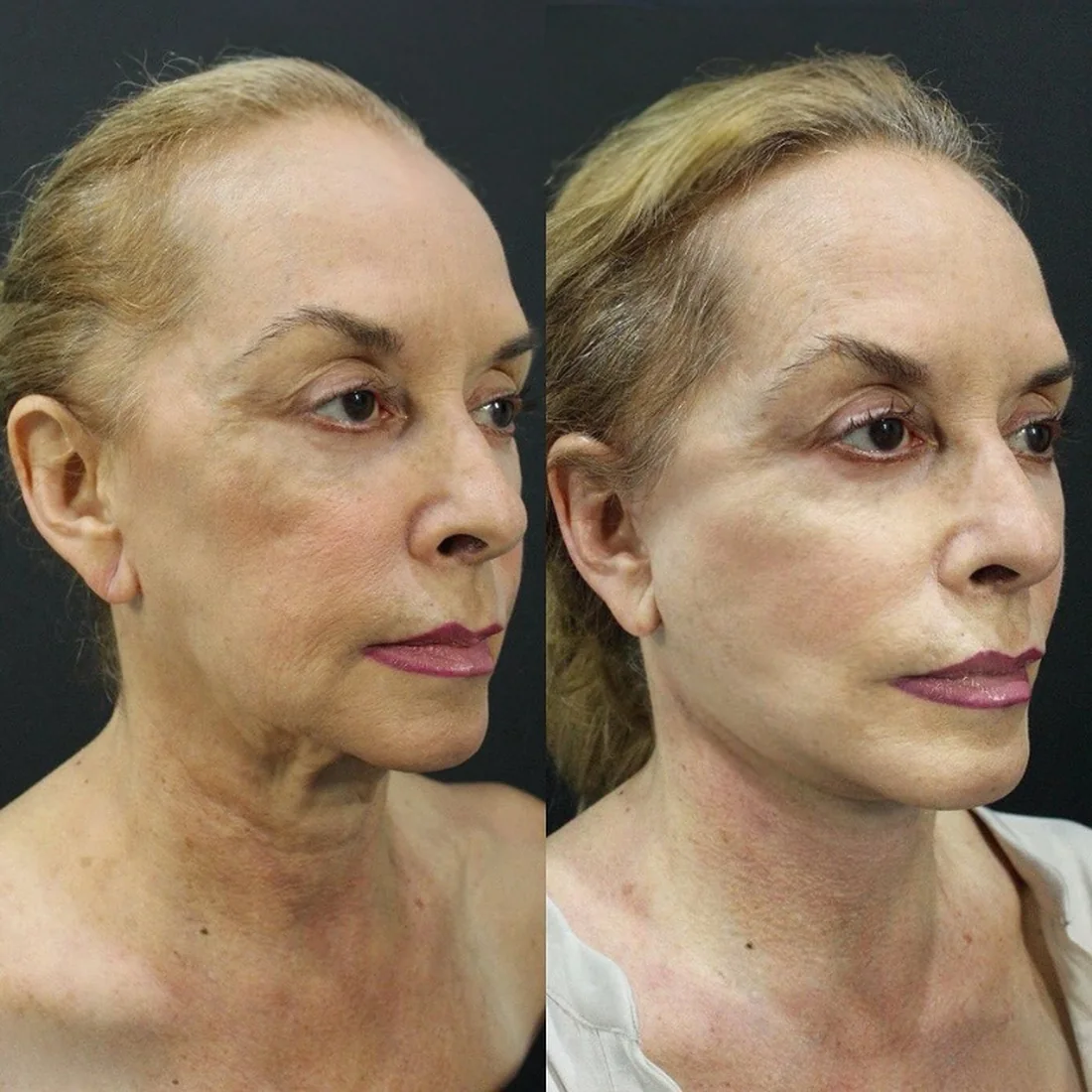
There is a point where the honest answer stops being “wait, adjust, resurface” and becomes “this is structural.” I reach it when the muscle has fully recovered and the jowl is still there, when the heaviness sits along the jaw as a distinct pad rather than a general softness, and when lifting the tissue gently upward and back in the mirror shows you the jaw you remember. That upward-and-back is the tell, what surgery does and what no injection can imitate.
Try it gently in a mirror. Place two fingers just in front of your earlobe and draw the skin up and back toward the top of your ear, not straight up. If the jowl melts, the neck sharpens, and a jaw you recognize reappears, you are looking at descent and at the vector a lift restores. If the skin just bunches and the heaviness barely moves, the problem is more about volume or surface than a fallen deeper layer. It is not a diagnosis, but it is the most useful thing you can do before a consultation, because it tells you which column your problem lives in.
At that stage the deeper layer has descended, and the treatment is to release and re-suspend it, which is the whole logic of a deep-plane approach: not tightening skin, which stretches and relapses, but repositioning the structural layer beneath the skin as a unit. That is what a deep-plane facelift actually repositions, and it is a categorically different intervention from anything you can inject. Whether you need the full operation or a more limited lower-face and neck procedure depends on how far the descent has traveled, which is a photograph-by-photograph judgment, not a formula. What surgery cannot promise is a specific number of years or a particular degree of change, because that depends on your skin and anatomy, and you can see honest ranges of what repositioning delivers on the facelift results page. Individual results vary.
The masseter after a lift, and whether you go back to Botox
Patients who do have surgery almost always ask the same thing afterward: can I still get my jaw-slimming injections? You can, and for many people it is the right combination. Your masseter is still large after a lift, because a facelift repositions the soft-tissue drape and does nothing to the chewing muscle underneath, so the toxin still has an honest job for width and for bruxism. The difference is that structural support has now been rebuilt surgically, so shrinking the muscle no longer withdraws the only thing holding your jawline up. The lift becomes the shelf, and the toxin goes back to being a slimming and comfort treatment rather than a load-bearing one. That is how these tools are meant to layer: surgery for structure, toxin for muscle bulk and clenching, resurfacing for skin.
Who this is not for, and what I will not pretend
Most people reading this do not need surgery, and I would be doing you a disservice to imply otherwise. If you are young, your skin is elastic, and you noticed a faint softening, the odds are excellent that spacing out or stopping the injections resolves it as the muscle recovers. If your only genuine complaint is skin texture, you need a resurfacing plan, not an operation. And even among people with a real jowl, some are better served waiting until the picture has fully settled than rushing a decision while the muscle is still rebuilding.
I also will not pretend to certainty I do not have. I cannot tell you from a paragraph how much of your softening is reversible muscle effect versus fixed descent, because that answer lives in your photographs and your skin, not in a general article. What I can offer is a straight reading of which one you are dealing with, and a refusal to sell you the operation if the honest answer is that you need time and patience instead. A surgeon who tells everyone they need a lift is not worth trusting, and neither is one who tells you a device will lift a jowl it cannot.
And there is a group whose right answer is to keep doing exactly what they are doing. If you love your slim jaw, your skin is holding up, and the softening is faint and stable, you do not have to stop injecting out of fear of some future jowl. Anxiety is not a treatment plan. Watch it honestly with photographs, keep your doses sensible rather than escalating, and act only if the trend genuinely moves the wrong way.
How I read your face
Send me standardized photographs, and I will tell you in plain language what I see: how much of your jawline change is the muscle shrinking, how much is the skin envelope no longer fitting, and how much is the neck and deeper layer coming down. Those three drivers call for three different responses, and naming the right one is the whole value of an assessment. It is a discipline I have kept across 37 years and more than 3,000 facelifts, and it starts with the anatomy that moved, not with a technique I want to sell.
The consultation begins with your images, before you travel anywhere. For patients coming from the United States, our team coordinates everything from San Diego, with the surgery itself at VIDA Wellness & Beauty in Tijuana, and most patients stay locally about six days before following up by phone, SMS, iMessage, or email. You can reach us at +1 (619) 738-2144. If you slimmed your jaw and now worry you traded it for a jowl, do not panic and do not double the dose. Let me look. Very often the news is better than you fear, and even when it is not, the first honest step toward fixing a face is naming what actually moved. Individual results vary.