
Before you decide anything about your face, lie down.
I mean that literally. Take a hand mirror into a room with soft, even light. Lie flat on your back, hold the mirror above your face, and look for a long moment. Then stand up and look again in the bathroom mirror, under overhead light, the way the world usually sees you.
If the reclining face looked meaningfully younger, fuller through the cheeks, cleaner along the jaw, softer around the mouth, then gravity is doing much of the work of aging you. Tissue that has descended slides back toward where it used to live when you lie flat. That is a descended face, and repositioning it is exactly what a facelift was designed to do.
If you lie back and very little changes, if the temples stay hollow, the under eye area stays shadowed, and the face still reads as tired and drawn, then your problem is not primarily gravity. You have not slid so much as you have deflated. And no facelift, however well executed, refills a deflated face.
That distinction sounds simple. In practice it is the most consequential fork in the road in all of facial rejuvenation, and it is the one patients are least equipped to navigate on their own, because so much marketing insists that every aging face needs the same fix. It does not. After 37 years in practice and more than 3,000 facelifts, I can tell you that the most common reason a result looks strange is not poor technique. It is a correct procedure performed on the wrong problem. A deflated face that gets pulled tight looks skeletal. A descended face that gets filled looks heavy. The corrections are close to opposites, which is why the diagnosis matters more than the brand name of any procedure.
This article is the diagnostic I walk my own patients through, in roughly the order I walk them through it.
A face ages in three ways, and they are not the same problem
When I examine a face, I am separating three processes that run on independent clocks. Two people the same age can be dominated by entirely different ones, which is why advice that worked beautifully for your sister can fail on you.
The first process is The downward migration of the deeper soft tissue of the face. The cheek fat and the muscular layer called the SMAS gradually slide off the facial skeleton as their ligament anchors stretch, and the displaced tissue gathers lower as jowls, heaviness beside the mouth, and fullness under the chin.. The deep structures of the cheek lose their ligamentous anchoring and migrate downward and forward. The midface empties from above and piles up below. That is why descent produces a very specific pattern: jowls along the jaw, deepening folds from the nose to the corners of the mouth, a blunted border between face and neck. The tissue is all still there. It is simply in the wrong place.
The second is True loss of facial volume. The fat compartments of the face shrink with age and weight loss, and the underlying bone of the eye sockets, cheeks, and jaw slowly remodels and recedes, so the same envelope of skin is draped over a smaller frame.. Here the face has not moved. It has shrunk. Anatomic work by Rohrich and Pessa established that facial fat is not one continuous sheet but a series of discrete compartments, and those compartments do not age together; some empty early and dramatically while their neighbors persist. The skeleton participates too. CT studies by Shaw and colleagues showed that the bony orbit widens, the midface loses projection, and the jaw loses height with age. When the frame recedes and the fat over it thins, the face reads as gaunt, tired, or severe even when nothing has sagged at all.
The third is A change in the quality of the skin itself. Collagen and elastin decline, so the skin becomes thinner, looser, and finely wrinkled, independent of where the deeper tissue sits or how much volume remains underneath it.. This is the crepe on the cheek, the fine crosshatching on the neck, the skin that no longer snaps back when you pinch it. Laxity is about material quality, not position and not quantity, and it has its own set of treatments that are neither lifting nor filling.
For most of the twentieth century, surgeons behaved as if descent were the whole story, which is why older facelifts pulled skin so hard. Then Val Lambros published something quietly revolutionary: he superimposed photographs of the same faces taken decades apart and found that key midface landmarks, including the junction between the lower eyelid and the cheek, stayed remarkably stable over the years while the contours around them changed. Much of what we read as sagging in the midface, his images suggested, is actually volume change. That study reset the field. It did not mean descent is a myth, the jowl and the neck descend very visibly, and I reposition descended tissue every week in the operating room. It meant that a thoughtful surgeon has to ask, region by region, how much of what I am seeing is position and how much is volume.
So the honest starting question is never facelift or filler. It is descent, deflation, or laxity, and in what proportions.
The mirror tests, step by step
You cannot get a diagnosis from a magazine, but you can get surprisingly far at home with three simple observations. I give these to patients before a first visit because a person who has done them arrives asking better questions.
Start with the reclining test I described above, and do it honestly. Lie fully flat, not propped on pillows, and give your tissues a moment to settle. What you are watching for is the difference between the upright face and the reclining face. Descent is gravity dependent, so it largely corrects when you lie down: the jowl flows back into the cheek, the folds beside the mouth soften, the neck cleans up. Deflation is gravity independent. A hollow temple is hollow in every position. Dark upper cheeks and a pinched look under the cheekbones do not improve when you recline, and sometimes they look worse, because lying back drapes tissue away from an empty area.
Second, the gentle lift test, and the word gentle is the whole test. Stand at the mirror and place two fingers just in front of your ear, at the level of your cheekbone. Lift the tissue up and back, along the diagonal, with only enough pressure to move it. Do not stretch your skin toward your ear like a windsock; no operation on earth reproduces that, and chasing it is how people end up frightened of surgery. If a soft, small redraping restores your jawline and softens the folds around your mouth, that is roughly the vector and magnitude a deep plane repositioning can achieve, because it moves the deep tissue rather than tensioning skin. If you have to pull hard to see any improvement, or if pulling flattens your cheek and makes you look stranger rather than fresher, volume loss is likely a bigger part of your picture than you thought.
Third, the photograph test. Find a picture of yourself from your late twenties or early thirties, in decent light, facing the camera. Do not study the wrinkles. Study the shape. Where was the widest point of your face then, and where is it now? A youthful face carries its width high, at the cheekbones, and tapers to the chin. Descent moves that width downward, so the face becomes bottom heavy, more square or jowly. Deflation shrinks the upper face without necessarily widening the lower face, so the face becomes narrower, longer, more drawn. Same age, opposite geometry, opposite corrections.
Here is how the signs tend to sort. Green items point toward descent, which is the surgical, lift responsive problem. Red items point toward deflation, which a lift alone will not touch.
- Jowls that interrupt what used to be a clean jawline
- Folds from the nose to the mouth corners that deepen when you are upright and soften when you lie flat
- A gentle upward redraping at the ear visibly restores your younger shape
- Fullness or blunting under the chin that was not there in old photos
- Your face has grown wider at the bottom than it used to be
- Hollowing at the temples or a visible dent under the cheekbones
- Under eye shadows and a tired look that persist even lying down and well rested
- Your face looks narrower and longer than in photos from your thirties
- Recent significant weight loss, whether from diet, illness, or GLP-1 medication
- Pulling the tissue back at the mirror makes you look flatter and stranger, not fresher
If you found yourself nodding mostly at the green list, keep reading with a facelift in mind. Mostly red, and volume restoration should be the first conversation. A real mixture, which is what I see most often after the mid fifties, means the plan needs both, and the order matters. We will get there.
Why does pulling a deflated face tight look skeletal?
There is a look everyone recognizes and nobody can quite name. The jawline is sharp, the neck is clean, there is not a jowl in sight, and yet the face reads as older, harder, somehow wrong. People reach for words like tight, pulled, or windswept. What they are usually looking at is a deflated face that was treated with tension.
Think about what the tissues are doing. A youthful cheek is a curve, and a curve needs volume to exist, the way a sail needs wind. If the fat compartments of the midface have emptied and the skeleton beneath them has receded, there is simply less material to shape. Pull the remaining envelope tight over that smaller frame and you do not recreate the curve. You erase it. The light stops landing on a rounded cheek and starts falling flat against bone, which is why over pulled faces photograph so poorly: flash photography finds every place where skin is stretched over skeleton with nothing soft in between. The mouth widens subtly. The eyes can take on a hollow, staring quality. Every wrinkle may be gone, and the face looks less alive than it did with the wrinkles.
The reverse error is just as common and just as recognizable. Take a face whose deep cheek tissue has genuinely descended, and instead of repositioning it, add filler on top, syringe by syringe, year after year. The volume goes in above tissue that is still sliding down, so the face gets heavier and wider without getting younger. Eventually the midface takes on a pillowy, front loaded look, the area beside the nose overfills, and the eyes appear smaller because the cheeks have risen up around them like dough. I meet these patients regularly, often after years of good faith treatment, and my first job is usually subtraction before anything else, dissolving what has accumulated so that surgery can begin from an honest, unfilled face that shows me what is actually there.
Neither of these outcomes comes from an incompetent injector or a careless surgeon, necessarily. They come from a wrong diagnosis compounded over time. The procedures did what they were designed to do. They were simply aimed at the wrong problem, and each round of the wrong fix makes the right one harder to see.
So, facelift or filler? Wrong question, but here is the answer
Patients rarely arrive asking about descent and deflation. They arrive asking whether they need a facelift or filler, so let me translate the diagnosis into that vocabulary.
If your tests point to descent, the answer is a lift, and filler is not a budget version of it. Filler cannot move a jowl back up onto the cheek; it can only build volume around the displaced tissue, and on a descended face that added weight works against you. Every syringe placed to camouflage descent makes the eventual honest correction a little harder to plan.
If your tests point to deflation, then some form of volume is right, and the real choice is between filler and your own fat. I think of it as a question of scale and duration. A small, localized deficit in a younger face, a slightly flat temple, a soft point at the front of the cheek, is reasonable territory for filler: it is precise, adjustable, and reversible, which are genuine virtues while a face is still changing. Diffuse deflation across multiple compartments is a different animal. Chasing it with filler means many syringes, refreshed indefinitely, in tissue planes that were never meant to carry that much product, and the maintenance arithmetic stops making sense long before the aesthetic does. Grafted fat is living tissue; the portion that establishes a blood supply behaves like the fat it replaced and ages with you, rather than sitting in the face as a foreign material. For the broadly deflated face, especially after weight loss, fat is usually the more honest instrument. Individual results vary, and grafting has its own judgment calls, which is exactly why it belongs in surgical hands.
And if your tests point mostly to skin, neither answer applies, which brings its own section shortly.
The gaunt face with good bones
A woman in her early fifties sat across from me recently and said something I hear more and more: my cheekbones have never looked better and my face has never looked worse. She had lost a significant amount of weight over eighteen months on a GLP-1 medication. Her health markers were the best of her adult life. And the face looking back at her in photographs seemed to have aged a decade: temples scooped out, cheeks flat beneath those newly prominent cheekbones, the skin around her mouth loose and finely lined, a softness under the jaw that confused her because she weighed less than she had in years.
Her case is the deflation story in its purest modern form, and it is worth walking through because it explains so much of what I see now. Facial fat is not exempt from weight loss. When the deep and superficial compartments of the cheek empty quickly, the face loses the scaffolding that kept the skin smooth and the midface full. High cheekbones make it look worse, not better, because strong bone with empty soft tissue over it is exactly the geometry of gauntness. Meanwhile the skin envelope, built for a fuller face, is suddenly oversized, so it drapes and folds. Some of that drape resembles descent, and some of it truly is descent unmasked, laxity that the fuller face had been quietly disguising.
This is a national phenomenon, not a boutique one. The American Academy of Facial Plastic and Reconstructive Surgery reported in its most recent annual survey that its members saw a sharp rise in facial fat grafting, a trend the academy tied directly to patients seeking to restore volume lost with rapid medication driven weight loss. I see the same pattern in my own practice, and I have written in more detail about facelifts after GLP-1 weight loss for patients in exactly this position.
Menopause runs a quieter version of the same program. Classic studies of postmenopausal women, going back to Brincat’s work in the 1980s, documented measurable declines in skin collagen and skin thickness in the years after menopause, changes that track with menopausal age rather than birthdays. Thinner, less elastic skin over shrinking fat compartments is deflation plus laxity arriving together, which is why so many women describe their face as having changed suddenly around that transition rather than gradually.
So what actually helps a gaunt face with good bones? Volume, restored with judgment. In my hands that usually means structural fat grafting: fat harvested from the patient’s own body, refined, and placed in small amounts into the specific compartments that emptied, the deep cheek, the temple, sometimes along the jawline. Done conservatively, it restores the curve that lets light move across the face again. And here I owe you an honesty that matters: a deep plane facelift repositions tissue, it does not inherently add any. But repositioning is not nothing for volume, because when I perform a high SMAS deep plane lift, the descended cheek fat is carried back up onto the cheekbone where it came from, and in some patients that repositioned fat restores enough midface fullness that grafting becomes unnecessary. In others, usually after major weight loss, the tank is genuinely empty and no amount of repositioning can fill it, so we graft. I cannot tell you which patient you are from a paragraph. That is decided by examination, compartment by compartment. Individual results vary.

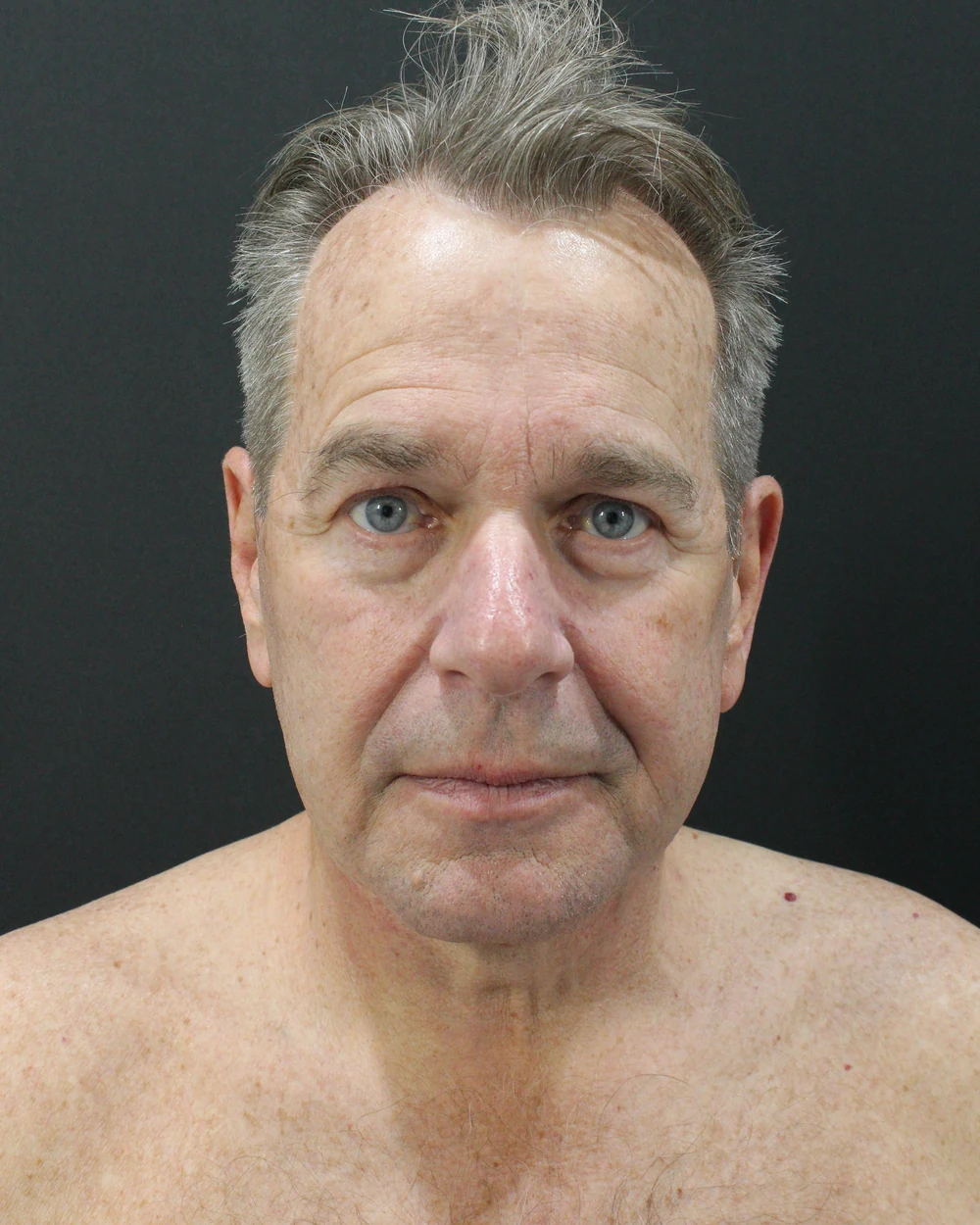 BeforeAfter
Most faces after the mid fifties are both, and the order matters
If you take one sentence from this article, take this one: descent and deflation are not rivals, they are roommates. The overwhelming majority of faces I examine past the mid fifties have some of each, plus a measure of skin laxity. The clinical question is almost never which one is present. It is which one dominates, and in which region of the face, because the treatment map is regional. A face can be deflated at the temple, descended at the jowl, and lax on the neck all at once, and usually is.
When both are truly present, my sequence is consistent. Position first, volume second. I reposition the descended deep tissue with a deep plane facelift, releasing the ligaments that tether the cheek and advancing the entire deep layer upward as one unit, without tension on the skin. Only then, with everything back where it belongs, do I judge what is genuinely missing, and add fat only there. Doing it in the other order is guesswork: filling a descended face means pouring volume into tissue that is about to be moved, so you are decorating furniture before rearranging the room.
The neck deserves its own sentence in this plan, because patients often blame volume for what is actually position, or position for what is actually anatomy. A blunted neck in a deflated patient is frequently descended platysma and lax skin rather than fat, and in some patients the deeper structures under the muscle contribute. This is exam territory again; I address the deep neck selectively, when the anatomy in front of me calls for it, not as a routine add on.
And one structural note that surprises people: sometimes the missing volume is not fat at all, it is chin. A weak or under projected chin shortens the jawline, deepens the shadow under the lip, and makes even a modest amount of submental fullness read as a double chin, because there is no bony shelf for the neck to hang from. In the right patient I place a chin implant, either alongside a facelift or on its own, to restore that projection. I want to be precise about the framing: this is not something I suggest to everyone, and it is not a trend. It is for the specific patient whose profile analysis shows the chin sitting behind where it should be, and in that patient it can do more for the neckline than any amount of tightening. Skeletal support is the third kind of volume, after fat and repositioned tissue, and it is the one most often overlooked.
Skin laxity is its own axis, and lifting does not treat it
A shorter section, because the point is short. If what bothers you is the texture of your skin, the crepe on your cheeks, the fine vertical lines around your mouth, the crosshatched quality of the neck skin itself, neither a lift nor a syringe of volume will fix it. A facelift moves tissue. It does not manufacture collagen, and it does not resurface anything. I tell patients bluntly that a facelift makes the skin you have sit in the right place; it does not give you different skin. The full list of things surgery will not do is long enough that I wrote it out separately in what a facelift does not fix.
For skin quality, the honest tools are the ones that remodel the skin itself: medical grade skincare with retinoids, radiofrequency microneedling such as Morpheus8, and laser resurfacing, including CO2, for etched lines and texture. In my practice these are often companions to surgery rather than alternatives, a resurfacing pass around the mouth at the time of a lift, for example, because the lift corrects position while the laser corrects surface. Matching each tool to its own axis is the entire game. Using an energy device to chase a jowl, or a facelift to chase crepe, disappoints in both directions.
When I tell a patient not to have a facelift
I turn away candidates in this category regularly, and the conversations follow a few patterns worth sharing, because one of them might be yours.
The first is the purely deflated younger face. A woman of 42 who has lost weight quickly, whose reclining test changes nothing, whose jawline is actually intact under good light, does not need her tissues repositioned; they have not gone anywhere. Operating on her would trade a volume problem for a tension problem. She needs fat, or time, or sometimes simply the weight stabilization that lets her face settle before anyone judges it. Patients often ask me the best age for a facelift, and the honest answer has never been a number; it is the year descent becomes the dominant finding, whenever that year arrives for you.
The second is the patient chasing the hard pull. If someone shows me the windsock maneuver, both hands dragging the face toward the ears, and says that is the goal, I explain why I will not build that, and why the surgeons who will are not doing them a favor. A deep plane lift restores your own geometry from underneath. It does not exchange your face for a tighter stranger’s.
The third is the patient whose real complaint is skin or expression, etched smile lines, a heavy brow feeling, crepey texture, and who has been told a lift fixes everything. It does not, and saying so before surgery costs me a booking but saves the patient a disappointment that no revision can cure.
And the fourth is anyone medically unready: unstable weight still dropping fast on a GLP-1 medication, uncontrolled health conditions, active smoking. Surgery rewards patience here. A face grafted or lifted mid free fall will not look right when the weight curve finally flattens.
What I actually measure when you sit in my chair
By now you can probably predict my examination, because it is the formal version of the tests you did at home. I look at the face upright and animated, then at rest. I palpate the cheek to feel where the fat compartments actually are, full, empty, or displaced. I perform the redraping maneuver myself, gently, along the true surgical vector, and I watch what improves and, just as importantly, what does not. I study the chin and jaw in profile. I look at old photographs whenever a patient brings them, and I ask them to; a picture from your early thirties is the single most useful document you can bring me, because it shows me your face’s own architecture rather than an ideal borrowed from someone else. My goal is never to make you look like a different person. It is to move your own tissue back to its own address.
Then I say out loud what percentage of what I see is descent, what percentage is deflation, and what percentage is skin, region by region, and I attach a tool to each: lift for position, fat or skeletal support for volume, resurfacing and skin treatment for texture, and nothing at all for the findings that do not warrant treatment. Patients tell me this five minute breakdown is the first time anyone has explained their own face to them, and I believe it, because most consultations start from a procedure and work backward to a justification. A diagnosis has to run the other direction. If you want to see how I structure that first visit, I have laid out how I run a facelift consultation in detail.
Recovery and outcome honesty belongs here too. A repositioned face needs weeks to settle, grafted fat does not fully declare its survival for around three months, and swelling briefly gives everyone the volume they came in asking about, which is why judging any result early misleads you in the flattering direction. Individual results vary, and anyone who tells you otherwise is selling certainty that biology does not offer.
Diagnosis before procedure, always
Here is the whole article in one place. Lie down with a mirror: if your face comes back, gravity took it, and a lift returns it. If your face stays hollow, volume left, and only volume restores it. Pull gently at the ear: if a small redraping restores your shape, you are watching a preview of surgery; if you must pull hard to see anything, stop pulling and start thinking about fat. Compare your face’s geometry, not its wrinkles, with a photograph from your thirties: width migrating downward is descent, a face growing narrower and longer is deflation, and texture changing while the shape holds is skin.
Most faces past a certain point hold all three, so beware of anyone whose answer is always the same procedure regardless of the face in front of them. The hammer sees nails. A surgeon should see descent, deflation, and laxity as three separate findings, tell you plainly which ones you have, and be equally willing to lift, to graft, to resurface, to add skeletal support, or to send you home untreated. Ask the person examining you to name the proportions in your face. If they cannot, or will not, keep looking. Your face is not a procedure waiting to happen. It is a diagnosis waiting to be made, and once it is made correctly, the right procedure tends to become obvious to everyone in the room, including you.