
No. If what you see in the mirror is a true jowl, a pocket of tissue that has descended below your jawline and stays there when your face is completely at rest, then neither Ultherapy nor Sofwave is going to lift it. I want that answer in the first two lines, because you have probably already heard something softer, and on this particular subject the soft answers cost people years and a great deal of money.
Now let me earn the bluntness, because a strong claim from a facelift surgeon deserves scrutiny. I do not offer Ultherapy or Sofwave in my practice, and you should know that before you read another word, since it means I arrive with a point of view. But I am not a surgeon who believes every device is nonsense. I own and use Morpheus8, CO2 laser, and several other energy-based tools, and I use them nearly every week alongside surgery. My argument is narrower and, I believe, far more useful to you: every technology has a stage of facial aging where it genuinely works, and ultrasound tightening applied to an established jowl is a reasonable tool at the wrong stage. The published evidence supports that position, and I would rather walk you through it than ask you to take my word for anything.
First, let us be sure we are talking about the same thing
A woman from San Diego sat in my consultation room and used a phrase I hear more often than any other. She said her face was “melting.” She had done two full rounds of Ultherapy over the previous three years at a reputable medical spa, and she was not angry about it, just genuinely confused. Her skin looked cared for. It had a healthy texture that I complimented sincerely, because somebody had been doing good work on it. And yet her jawline carried two soft pockets sitting below the border of the mandible, in exactly the position they had occupied before her first session.
Those pockets are jowls, and it matters enormously that we define them correctly, because almost every disappointment I see in this area begins with a definition problem.
A jowl is not loose skin. A jowl is deep tissue that has moved. Over the decades, the fat compartments of the cheek slowly descend. The retaining ligaments of the face, the fibrous anchors that once held everything up against gravity, stretch and loosen. The SMAS, the superficial musculoaponeurotic system, a firm fibromuscular layer beneath the skin and fat that gives the face its structural support, loses its tautness, and the entire soft tissue envelope slides down and forward until it piles up against the jawline, where the mandibular ligament stops it and forms that familiar bulge. The skin, for the most part, is the wrapper around this process.
Ultrasound devices treat the wrapper.
So there are really two different problems being sold to you under the single word “sagging.” The first is skin quality and early laxity: fine lines, crepe texture, a jawline that is slightly softer at 45 than it was at 35. The second is structural descent: tissue that has physically relocated to a lower position on your facial skeleton. Energy devices live inside the first problem. A jowl belongs entirely to the second.
What Ultherapy and Sofwave actually do under your skin
Both are ultrasound. Both are legitimate, cleared medical devices with real published data behind them. And both do precisely what their physics allow, no more.
Ultherapy uses microfocused ultrasound with visualization. It concentrates acoustic energy into tiny points of heat at depths of 1.5, 3.0, or 4.5 millimeters, and at the deepest setting it can reach the level of the SMAS in some regions of the face. Each focal point briefly reaches temperatures high enough to make collagen contract, and that controlled micro-injury provokes the skin to manufacture new collagen over the following two to three months. The result, when it comes, arrives slowly and peaks at around day 90.
Sofwave takes a different route toward a similar destination. Instead of focusing energy deep, it delivers high-intensity, high-frequency parallel beams that heat the mid dermis at a depth of about 1.5 millimeters, deliberately staying superficial. Its advocates consider the shallower depth a feature: treatments are faster, generally more comfortable, and the energy stays in the layer where the device intends to work.
I want to be very clear about something, because it is where my honesty has to run in both directions. The biology here is real. Thermal injury genuinely stimulates new collagen. Treated skin often does become measurably firmer and better in texture. The serious question was never whether these devices do anything. The question is the magnitude of what they do, and whether that magnitude is anywhere near the range a true jowl requires. That is a question you answer with published numbers, not with brochures, so let us look at them.
The published numbers, placed next to the marketing
In peer-reviewed studies, the lift produced by ultrasound skin tightening is measured in single millimeters, and sometimes in fractions of one millimeter. That sentence is the center of this entire article, so I will support it carefully.
The best-known early study of microfocused ultrasound was a rater-blinded prospective trial published in the Journal of the American Academy of Dermatology in 2010 (PMID 20115948). Blinded expert raters judged that 86 percent of the 35 evaluated patients showed a clinically significant brow lift at day 90. That sounds impressive until you read the objective measurement in the same paper: the average brow elevation was 1.7 millimeters. Real, detectable, and honestly reported. Also tiny. And note where it was measured: the brow, which carries the thinnest, lightest tissue on the face, the easiest possible test for a lifting technology.
A 2023 systematic review in the International Journal of Environmental Research and Public Health pooled the available trials of microfocused ultrasound for facial tightening (PMID 36674277). Across studies, measured brow lift ranged from 0.47 to 1.7 millimeters, and submental improvement amounted to a reduction of roughly 26 to 45 square millimeters on profile photographs. The authors’ own conclusion was that the technology is effective for mildly to moderately lax skin. Just as telling, the trials they reviewed commonly excluded patients with severe laxity from enrolling at all. The very people most likely to be reading this article were, in many cases, screened out of the evidence base before it was built.
Then there is the lower face specifically, which is where your jowl lives. A prospective trial from UT Southwestern published in Aesthetic Surgery Journal in 2014 treated the cheeks, jawline, and submental region with microfocused ultrasound and had masked reviewers compare photographs at day 90 (PMID 24990884). Blinded reviewers detected improvement in 58.1 percent of patients, which means that in roughly four out of ten patients, trained observers could not see that anything had happened. About 65 percent of the patients themselves perceived improvement. And among patients with a body mass index over 30, more than half showed no detectable change at all. Heavier tissue swallowed the effect.
Now hold those numbers next to what a jowl demands. When I correct a jowl in surgery, I release the retaining ligaments and move the descended deep tissue back up along a controlled vector, and the repositioning is on the order of a centimeter or more in most of my patients. The best documented ultrasound result, at the most favorable site on the face, was under two millimeters. That is not a small gap a stronger session might close. It is a gap of roughly an order of magnitude, and it exists because heating a wrapper cannot relocate what is inside it. Individual results vary, but they vary within that physical ceiling, not above it.
Where these devices genuinely earn their place
It would be easy, and cheap, for a surgeon to stop at the last paragraph. I will not, because the honest picture has a second half.
For a patient in her late 30s or 40s with early laxity, decent skin thickness, no true jowl, and realistic expectations, ultrasound tightening can deliver exactly what the literature describes: subtle firming, a modestly crisper brow or jawline, better texture, results that build gently over three months and read as “rested” rather than “treated.” The Sofwave pivotal data is a fair example of the category doing what it does well: in a multicenter trial, 86 percent of subjects improved by one to three units on a validated wrinkle scale, with no device-related adverse events (PMID 34417390). Notice, though, what was measured there: fine lines and wrinkles. It is a wrinkle result and a skin quality result. It is not a jowl result, and the manufacturers themselves do not claim to reposition descended deep tissue.
The American Society of Plastic Surgeons puts the boundary well in its own patient material on facelifts: minimally invasive rejuvenation treatments cannot achieve the same results as surgery, but they may help delay the point at which surgery becomes appropriate. Delay is a legitimate, valuable job. I say this as a surgeon with no ultrasound device to sell you: if you are early on the curve, energy-based treatment is a rational choice, and the person who tells you that you need an operation at that stage deserves your suspicion just as much as the person selling ultrasound to a heavy jowl.
The whole question is where you sit on the curve.
The shaded zone is where energy-based tightening can meaningfully help. Once a jowl is present with the face at rest, only repositioning surgery moves it. Individual results vary.
Sofwave versus Ultherapy, since someone will offer you both
Patients often arrive believing this is the decision that matters, so let me compress it honestly into one paragraph. Ultherapy goes deeper, up to 4.5 millimeters, uses focused energy with ultrasound visualization of the layers being treated, tends to hurt more, and has the longer track record. Sofwave stays at about 1.5 millimeters in the mid dermis, treats faster and usually more comfortably, and its strongest published evidence is for fine lines and wrinkles rather than lift. Both stimulate collagen. Both peak around three months. Both produce their best results in younger patients with milder laxity, and both carry meaningful per-session costs that recur, because the effect is not permanent. But if your question is “which one will lift my jowls,” the differences between them are irrelevant, because the honest answer is the same for both: neither. Choosing between Sofwave and Ultherapy for an established jowl is choosing between two tools that were built for a different job than the one you are hiring for.
The neck deserves its own honest paragraph, so here are three
Much of the marketing for both devices leans hard on the neck, and I understand why: neck laxity is the complaint that brings more people to my consultation room than any other single finding, and it is also the one people most want to solve without surgery.
Here is what the evidence supports. Both platforms are cleared for lifting lax submental and neck tissue, and the trials behind those clearances show genuine, measurable change. But look at the units again. In the 2023 systematic review, submental improvement after full treatment amounted to a reduction of roughly 26 to 45 square millimeters on a profile photograph (PMID 36674277). To put that in perspective, that is an area smaller than your smallest fingernail, redistributed across the whole under-chin region. For a patient with early submental softening and good skin, that can be a visible, worthwhile refinement. It is honest improvement at the margin.
What it cannot address is what most aging necks are actually made of. A heavy neck is usually a layered problem: fat above and often below the platysma muscle, the platysma itself separated into the loose vertical bands you can see when you grimace, and skin that has expanded over years to accommodate all of it. Heat delivered into the dermis does not reduce deep fat, does not reunite separated muscle edges, and cannot take up genuinely excess skin. Those are anatomical events, and every one of them has a specific surgical answer. So my rule for the neck mirrors my rule for the jowl: if you can pinch only a little softness under the chin and your neckline is mostly intact, a device may polish it, and I will say so. If you can gather real tissue in your hand, or you see bands at rest, the device is decoration on a structural problem. Individual results vary, but anatomy does not.
Why there is no ultrasound tightening device in my practice
I could give you a diplomatic answer, but you came here for the real one.
After 37 years and more than 3,000 facelifts, my practice attracts a particular patient: someone with real descent, a real jowl, real neck laxity, who has usually already tried the noninvasive route. For that patient, the published ultrasound data shows modest, variable tightening that does not touch the actual problem. If I installed one of these machines, I would feel the quiet institutional pressure every clinic owner knows: the machine must justify itself, so the machine gets recommended. I have watched that dynamic distort clinical advice in our industry, and the simplest protection is to not own the conflict of interest.
There is also the arithmetic of value, which I can discuss without quoting a single price. Ultrasound tightening is not one purchase. The effect fades, so the model is a session, then another in a year or two, then maintenance after that, and each session is far from cheap. For a patient with early laxity, that recurring spend buys something real. For a patient with a true jowl, it buys three-month cycles of hope, and over a few years the accumulated total climbs toward a meaningful fraction of what definitive surgery would have cost, while the jowl continues its slow descent and the eventual operation gets bigger, not smaller. Surgery in the United States is genuinely expensive, and I understand why patients look for any alternative to it. Part of why my California patients cross the border to Tijuana is that they pay a much lower share of that burden here for the same operation done properly. But the answer to an expensive correct treatment is rarely an affordable incorrect one.
To be fair to my colleagues in dermatology and aesthetic medicine: many of them draw this line exactly where I do, decline to treat heavy jowls with ultrasound, and refer those patients to surgeons. The problem is not the specialty and it is not even the devices. The problem is any setting, medical spa or surgical office alike, where the tool on hand determines the diagnosis.
”At what age does Ultherapy stop working?”
I get asked this constantly, and the question contains a hidden mistake: it assumes the calendar is the variable. It is not. Stage is the variable, and age only correlates with stage.
I have examined patients of about 40 with genetically early, well-formed jowls who were already past the point where any energy device would satisfy them. I have examined patients in their early 60s with light tissue, strong bone structure, and skin laxity so mild that I told them, honestly, that they were not yet facelift candidates and that a skin-directed treatment was the smarter spend. The literature echoes this: the trials show weaker responses as baseline laxity increases and in patients with higher body mass index, where in one lower-face study more than half of higher-BMI patients showed no detectable change at all (PMID 24990884). Heavier, more descended tissue simply outmatches what a thermal effect in the skin can hold.
So the honest reframe is this. Ultrasound tightening does not stop working at 50 or 55 or 60. It stops working when descent replaces laxity as your main finding, whenever that happens on your particular face. For many people those two events happen within a few years of each other, which is why the age version of the question feels intuitive. But I would never clear you for, or steer you away from, a treatment based on your birth year, and you should be wary of anyone who does. Individual results vary because faces vary, and stage, not age, is what an examination is for.
If you have already spent the money
Some of you are reading this after two or three rounds of Ultherapy or Sofwave, doing that bitter math in your head, and I want to speak to you directly, because you deserve better than either a sales pitch or a told-you-so.
You probably did not waste your money, and here is the honest accounting. If your skin texture improved, that was real. If your laxity progressed more slowly than it otherwise might have, that was real too, even though neither of us can measure the counterfactual. What the device could never do, at any number of sessions, was reposition tissue that had already descended, so if you bought it hoping your jowls would lift, you were sold the wrong stage, and the failure belongs to the recommendation, not to you and not really to the machine.
The trap to avoid now is the sunk-cost session. A third or fourth round will not accomplish what the first two could not, because nothing about the physics changes with repetition. I watch the same pattern with injectables along the jaw, where each round of filler adds volume to a region that is failing from descent, and the arithmetic over the long run tells the same story I lay out when I compare jawline filler with surgery over the long term. Money already spent is gone. The only question that matters is whether the next dollar goes toward the mechanism that actually addresses your finding.
One practical suggestion if you are weighing another session: ask the provider to show you their own before and after photographs of a patient your age, with your degree of jowling, at rest, taken in matching light and matching head position, at least six months after treatment. That request is fair, it is specific, and the response will tell you almost everything. A provider with honest results for your stage will have them ready. A provider selling collagen stimulation to a structural problem will offer you younger faces, angled poses, or the brochure.
What it actually takes to move a jowl
Since I have spent this many words on what does not lift a jowl, I owe you a clear picture of what does.
A jowl is corrected by going under the descended tissue and putting it back. In a deep plane facelift, I enter beneath the SMAS and platysma, release the retaining ligaments that tether the descended tissue in its fallen position, and reposition the entire deep layer upward along the vector of its original descent. The critical detail is where the tension lives. All of the holding force is placed on that strong fibromuscular layer, not on the skin. The skin is simply laid back down without pull, which is why a properly done deep plane result does not look tight or windblown, and why the jawline is actually clean rather than merely stretched. The jowl does not shrink or firm. It relocates, back to where it lived years earlier.
That structural difference is also why the result is durable in a way no collagen stimulation can approach. Collagen remodeling from a thermal device softens over months to a couple of years. A repositioned deep layer heals in its new position, and while nothing stops aging itself, the correction endures for many years. You can see the nature of the change in the photographs below, and I would encourage you to look specifically at the jawline shadow, because that is what no device in the noninvasive category produces.
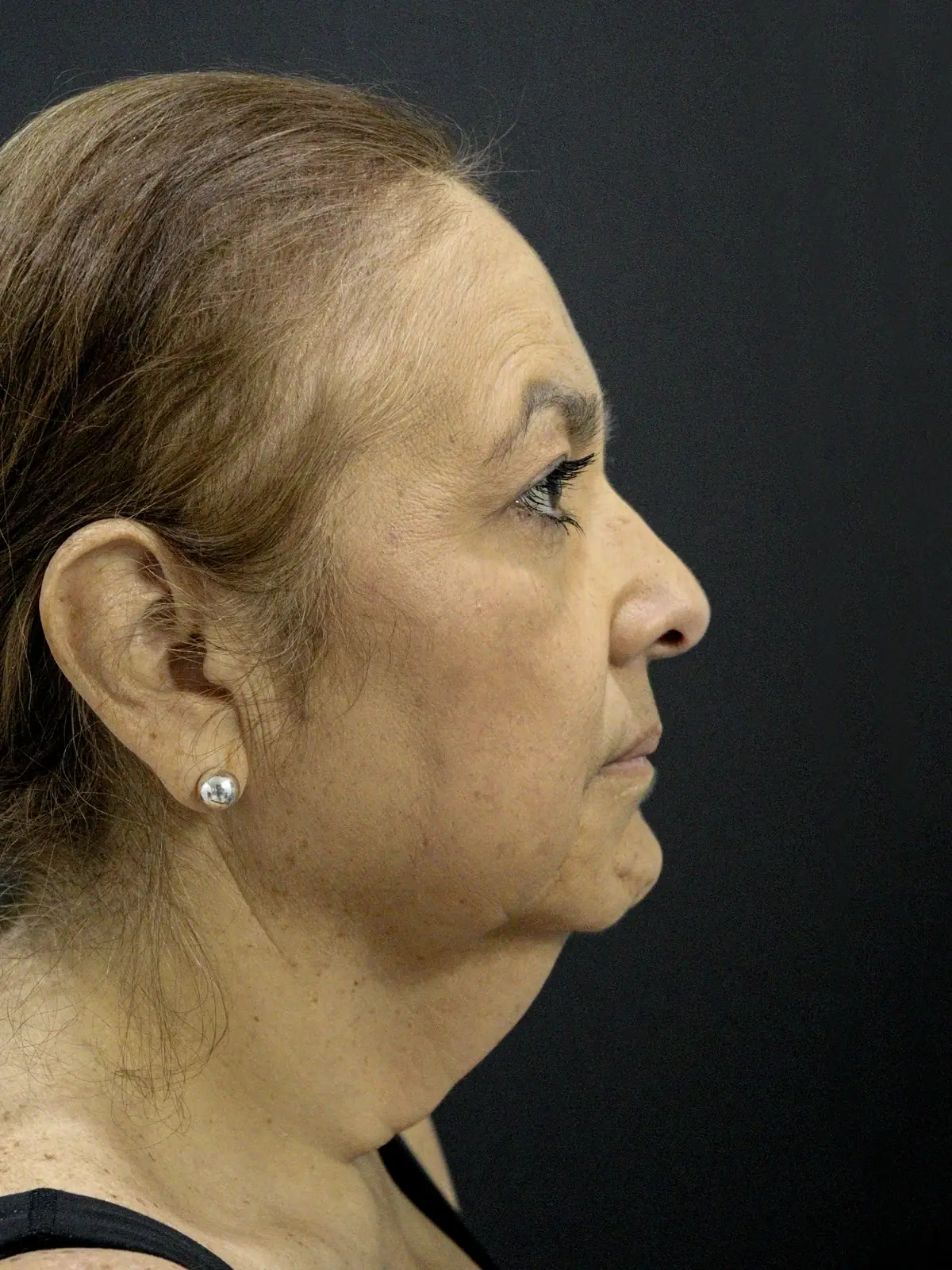
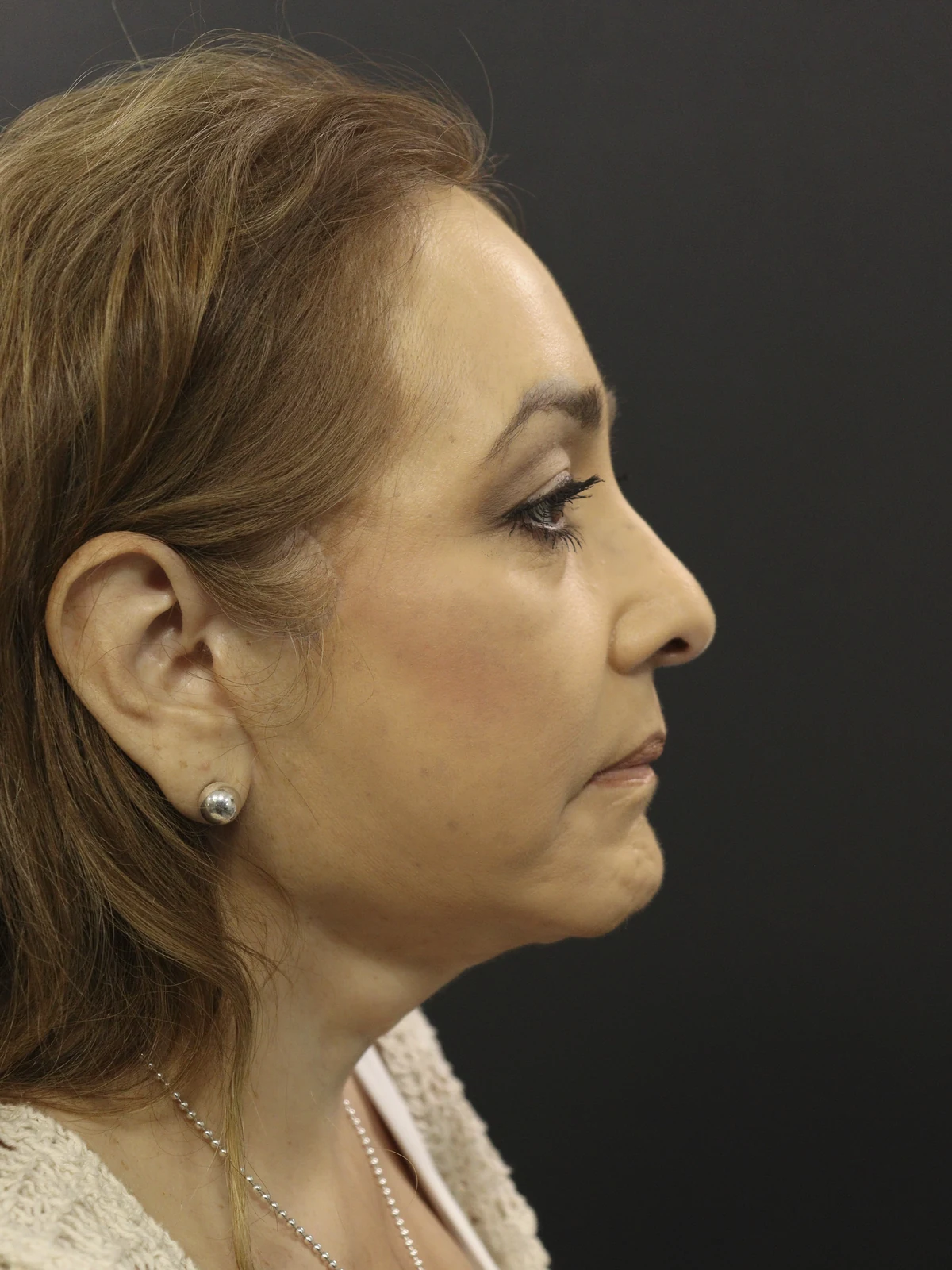 BeforeAfter
Is it a bigger commitment than an ultrasound session? Of course. It is real surgery under anesthesia, and most of my patients need about two weeks before they feel comfortable at dinner with friends, with residual settling that continues quietly for months. Individual results vary, and I would never minimize the decision. But it is a commitment made once, against the correct mechanism, rather than a subscription to a mechanism that cannot reach the problem.
The devices I keep, and the job I give them
Here is where I have to defend the other half of the device world, including from readers now tempted to swear off machines entirely.
A facelift moves tissue. It does nothing to the quality of the skin itself. If your skin carries sun damage, etched vertical lip lines, crepe texture, enlarged pores, or that overall weathering that California sunshine writes into a face over decades, repositioning the deep layer will not erase any of it. Lifted skin is still the same skin. I keep an honest list of what a facelift does not fix, and skin quality sits near the top of it.
That is precisely the job I give to the energy devices I do own. Morpheus8 delivers radiofrequency through fine microneedles to thicken and smooth the dermis. CO2 laser resurfacing rebuilds the skin’s surface, softening etched lines and sun damage in a way no lift can. I frequently perform these in the same session as a facelift, while the patient is already comfortable and already committed to recovery, so that the repositioned face and the resurfaced skin heal together into one coherent result. And afterward, these same tools become maintenance: periodic, lighter treatments that protect skin quality and, I believe, help a surgical result age gracefully rather than abruptly.
Notice the logic, because it is the through-line of everything I have told you. Radiofrequency microneedling and lasers in my operating room are not a contradiction of my skepticism about ultrasound tightening. They are the same principle applied consistently: each tool assigned to the job the evidence says it can do. Skin quality tools for skin quality. Surgery for descent. The patients who end up disappointed are almost never the ones who used a device. They are the ones who used a device instead of the operation their face was asking for.
Place yourself on the spectrum, honestly
You cannot examine yourself the way I would examine you, but you can get surprisingly far with three honest checks in a mirror, in daylight, with your face fully at rest. Do not smile, do not lift your chin, do not do the little unconscious jaw-tightening we all do in mirrors.
First, the rest test. Look at your jawline straight on and at a three-quarter angle. Is there a distinct pocket of fullness sitting below the line of the jawbone that is present without any expression? Second, the motion test. Tilt your chin up slightly. If the pocket disappears the moment the skin draws taut, gravity and descent are doing the work, not swelling. Third, the redraping test. With one finger, gently, without stretching, ease the tissue in front of the jowl up and back toward the top of the ear. If the jawline becomes clean with that small repositioning, you have just demonstrated the mechanism of a facelift on yourself, and you have also demonstrated why heat cannot replicate it.
Roughly speaking, these checks sort people into three groups. If your jawline is clean at rest and your complaint is texture, dullness, or early softness, you are in device territory, and ultrasound or radiofrequency treatment is a defensible spend. If your jawline blurs at rest but a light touch fully restores it, you are in the borderland where I would want photographs and an honest conversation, because you may still buy useful time, or you may be an early surgical candidate depending on your tissue. And if you see a true pocket at rest that only repositioning erases, then you already know what I am going to tell you, and more importantly, you now know why every device session you buy from this point forward is aimed at the wrong layer.
The question underneath the question
In my experience, most people who ask me whether Ultherapy or Sofwave will fix their jowls already suspect the answer. What they are really asking is something more human: is there any way to avoid surgery? And underneath that: is surgery as frightening as I imagine?
Those are fair questions, and they deserve straight answers rather than a machine positioned between you and the truth. Sometimes the answer genuinely is that you can wait, maintain your skin, and revisit the conversation in a few years; I tell patients that regularly, and it costs me surgeries to do so. Sometimes the answer is that waiting is only making the eventual operation larger. What I can promise is limited and specific: if you send me your photographs or sit across from me during a consultation, I will tell you which stage you are actually in, even when the honest answer is that you do not need me yet.
Ultrasound tightening is not a scam. It is a modest technology that performs a modest job well, and an entire marketing apparatus has been built to let you believe it performs a bigger one. A jowl is a structural event, and structure is moved by surgery. Match the tool to the stage, spend your money at the layer where your problem actually lives, and be politely skeptical of anyone whose answer to every face happens to be the machine in the next room. That skepticism should include me. It is why I have shown you the numbers, and it is why they are worth more than my opinion or anyone else’s brochure.