
“Will the lift be enough, or do I also need fat?” A woman asked me exactly that last month, sitting across from me with two mirrors, one in each hand, tilting her face toward the window light. She had done her reading. She knew a deep plane facelift lifts. What she could not tell, and what almost no one can tell about their own face, was whether the tiredness she saw was her tissue falling down or her tissue disappearing. Those are two different problems. They have two different answers. And confusing them is the single most common reason people end up disappointed after an otherwise well done operation.
So let me answer the real question honestly, the way I would at your consultation, before we ever talk about scheduling anything. Sometimes the lift alone is more than enough, and adding fat would be a mistake. Sometimes the lift is necessary but not sufficient, and skipping the fat would leave you looking rested but still oddly empty. The only way to know which one you are is to understand what a facelift actually does to your face, and then to look honestly at what your face has lost.
What a deep plane facelift actually moves
Here is the sentence that changes how most people think about this: a facelift repositions the volume you already have. It does not manufacture new volume out of nothing.
When I perform a A facelift that lifts the skin and the underlying muscle layer as one connected unit, releasing the ligaments that tether the face down, rather than pulling on skin alone., I am working underneath the SMAS, the fibromuscular layer that carries your cheek fat and drapes over the deeper structures. I release the ligaments that tether that layer to the bone, the zygomatic and masseteric and mandibular retaining ligaments, and then I shift the whole composite flap upward and back, to where it sat when you were younger. Andrew Jacono’s anatomic work on the extended deep plane technique describes this well: once those retaining ligaments are released, the deep plane flap can be repositioned to revolumize the midface and the jawline, because the tissue that used to sit high on your cheek is carried back up to the cheekbone where it belongs.
Read that again, because the important word is reposition. The cheek fat that has slid down toward your smile line does not vanish when you age. A great deal of the time it simply migrates south. A deep plane lift catches that fallen fat and moves it home. To your eye, the result can look exactly like added volume, a fuller, rounder upper cheek, because volume did return to that spot. But no new material entered your face. I borrowed from where the fat pooled and gave it back to where it drained from.
That is why I am careful with the phrase “a facelift adds volume.” It restores volume by relocation. When the raw material is still there and just misplaced, relocation is elegant and permanent and uses nothing but your own tissue. When the raw material is genuinely gone, relocation has nothing to work with, and that is where fat grafting enters the conversation.
It helps to know that facial fat is not one soft mass. It is organized into discrete compartments, superficial and deep, each with its own boundaries and its own behavior over time. Rohrich and Pessa’s dissection study of the fat compartments of the face showed that these pads are separated by septae and age at different rates, some sliding, some thinning, so that the face does not deflate evenly but zone by zone. That anatomic fact is the whole reason I cannot answer the fat question with a single yes or no for your entire face. Your jawline may be purely a descent problem while your temple, two inches away, is purely a volume problem. A good plan treats each compartment on its own terms.
Descent, deflation, and skin laxity are three different problems
The aging face changes in at least three ways at once, and they are worth separating in your mind because each one has its own repair.
The first is descent. Ligaments loosen, tissue slides downhill, and the youthful fullness that lived over your cheekbone ends up bunched along your jawline as a jowl. Descent is a geometry problem. You still own the tissue; it is in the wrong place. A lift fixes geometry.
The second is deflation. This is loss, not migration. The deep and superficial fat pads do not just fall; some of them shrink. Bone resorbs too, particularly around the eye socket and the jaw, so the scaffolding under the soft tissue quietly recedes. When the temples go hollow, when the cheek loses its front projection, when the tear trough deepens into a dark trench, that is deflation. A lift cannot fix deflation, because there is nothing to reposition. You cannot move volume that no longer exists.
The third is skin laxity, the envelope itself stretching and thinning and losing its recoil. Skin gets managed at the end of a facelift by redraping and removing the excess, but skin quality is its own axis, and no lift and no fat makes crepey sun damaged skin behave like young skin.
Almost nobody is purely one of these. Most faces I examine are a blend, heavier on descent in some regions and heavier on deflation in others. The forty-eight year old who lost weight fast is often more deflated. The sixty year old with strong jowls and good cheek fullness is often more descended. Your job, and mine at the exam, is to weigh the mix in each zone of your face and then match the repair to it. That is the whole discipline hiding behind the simple question of whether you need fat.
I would go further and say that most of the ugly, obviously operated results you have seen in your life come from a surgeon treating only one of these three axes and ignoring the others. The face pulled tight but left hollow. The face inflated with volume but never lifted, so it grew heavier and sadder. The face lifted and filled beautifully but with skin so damaged that the surface still betrayed the age. Natural rejuvenation is not one heroic move. It is the correct combination of moves, in the correct proportion, for the specific face in front of me.
So will the lift be enough?
Blunt answer: for a real percentage of my patients, yes, the lift alone does it, and I talk them out of the fat they came in asking for.
If your fullness has fallen rather than disappeared, a deep plane lift that carries your own cheek fat back over the cheekbone frequently restores the front projection you thought you had lost. I have finished operations where the patient’s midface looked so replenished on the table that any fat I had tentatively planned would have tipped a natural cheek into a heavy, overdone one. In a high SMAS deep plane in particular, where the flap is released high and shifted a long way, the repositioned fat pad does a lot of the volumizing work that a surgeon using a more limited technique might try to fake with a syringe.
Here is how I sort the two situations when I study your photographs and your face in motion.
- Your jowl carries obvious fullness that used to live on your cheek, tissue that has clearly fallen rather than vanished
- When you smile, your midface plumps up convincingly, which tells me the fat pad is present and simply low
- Your temples and under eyes are reasonably full and your problem is mainly the lower face and neck
- You lift the skin in front of your ear with two fingers and most of what bothers you improves
- Your temples are hollow enough to show the underlying bone and vessels even at rest
- Your cheeks stay flat when you smile, with no fat pad rising to fill them
- Your tear troughs read as dark hollows that persist no matter how you tilt your head
- You lost a significant amount of weight recently and your face emptied along with your body
If you are mostly green marks, the lift is very likely enough, and I would rather do a clean, well positioned facelift and let you settle than add fat you do not need. If you are collecting red marks, the lift is still necessary, but it will leave the hollows untouched, and that is precisely the patient for whom I add fat. And if you are honestly split, green in the lower face and red in the upper, then the answer is both, and I will lift the parts that fell and graft the parts that emptied. That mixed patient is the most common of all.
When volume genuinely has to be added
Let me describe the patient the fat is for, because she is real and increasingly common.
She has lost meaningful weight, sometimes through a GLP-1 medication like semaglutide, sometimes through menopause and a decade of gradual change. Her face did not just sag; it emptied. The temples caved. The cheeks flattened from the front so that in profile her midface looks concave rather than convex. When I lift her, I will restore her jawline and her neck and I will reposition what cheek fat remains, but there is simply not enough tissue left to fill the upper face by relocation alone. If I lift her and stop, she will look tighter and still tired, because a tight empty face is still an empty face. For her, fat grafting is not an upsell. It is the other half of the correct operation.
The facial plastic surgery societies have watched this demand climb. In its 2024 member survey, the AAFPRS reported that facial plastic surgeons saw roughly a fifty percent rise in the average number of fat grafting procedures performed over the prior year, a shift the academy tied directly to patients addressing volume loss from weight loss medications. I mention that not to sell you a trend, but because it confirms what I am seeing in my own consultations: more faces arriving genuinely deflated, where a lift without volume would be the wrong prescription.
Menopause deserves its own line here, because it is quieter than a GLP-1 story but just as real. In the years around menopause the skin loses collagen quickly, the deep fat thins, and the bony support around the eyes and jaw continues to recede. The result is a face that is both descending and deflating at once, on two different clocks. Many of the women who come to me feeling that they aged 5 years in eighteen months are describing exactly this overlap, and it is the reason I so often end up combining a lift with modest, targeted volume in this group rather than choosing one.
When I do graft, I harvest your own fat, usually from the abdomen or the inner thigh, process it gently, and place it in small amounts through tiny cannula passes into the specific deficits my exam identified: the temple, the front of the cheek, sometimes the tear trough, occasionally the jawline or chin region if the lower face needs support. Because it is your own living tissue, the portion that survives becomes a permanent part of your face. That permanence is the beauty of it and also the reason for my caution, which I will get to.
How much survives is the honest question, and the honest answer is that it varies and no one can promise a number.
A 2021 systematic review and meta analysis in Aesthetic Plastic Surgery, pooling twenty seven studies and over a thousand patients, found an average facial fat graft retention near half of what was placed, with individual studies reporting anywhere from about a quarter to over eighty percent survival depending on technique and measurement. StatPearls, summarizing the same reality, notes that surgeons commonly plan a slight overcorrection because resorption is expected and unpredictable. Translation for you: I place a bit more than the final volume I want, knowing some will fade over the first months, and I tell every fat grafting patient plainly that a touch up is sometimes needed and that the exact result cannot be dialed in like a thermostat. Individual results vary, and anyone who tells you otherwise is selling certainty that the biology does not support.
Where the fat comes from, and why the harvest matters
Patients rarely think about the donor site, but it is part of the operation and you deserve to understand it. I take the fat with gentle, low pressure suction from a place where you have some to spare and where the tissue tends to graft well, most often the lower abdomen or the inner thigh. It is not liposuction for contouring, though a small refinement of the donor area is a pleasant side effect for some people; it is a careful harvest of living fat cells that need to survive a transplant.
The way fat is handled between harvest and injection matters more than its origin. Fat cells are fragile. Rough suction, aggressive processing, or forcing the graft through too large a volume in one place all reduce how much survives. So I harvest gently, process to concentrate the healthy fat, and inject in tiny aliquots through fine cannulas, laying down small threads of fat in many passes rather than depositing one big pocket. Small threads sit close to a blood supply and stand a better chance of taking; a large clump in the center outruns its blood supply and turns into a firm nodule or simply melts away. This is why the same amount of fat, placed two different ways, gives two different results. Technique is not a marketing word here. It is the difference between fat that becomes your face and fat that becomes a problem.
Fat transfer or filler, and why I want your filler gone first
Patients often use “fat transfer” and “filler” as if they were the same tool in two brands. They are not, and the difference matters at the time of a facelift.
Filler is a temporary gel, usually hyaluronic acid, placed in the office and gone in a matter of months to a couple of years. Fat is your own tissue, placed once, during surgery, and permanent in the fraction that takes. During a facelift I work with fat, not filler, for reasons that go beyond permanence.
The bigger reason is diagnostic. If you arrive with old filler in your cheeks and tear troughs, I cannot see your true anatomy. Filler migrates, lingers far longer than people expect, and can make a deflated face look artificially full, which would fool me into under grafting, or make a normal face look overfilled, which would fool me into over resecting. So for many patients I ask that existing filler be dissolved before the facelift, weeks ahead, so that when you sit in front of me I am looking at your face and not at a gel someone injected two years ago. Then, and only then, can I judge whether you are descended, deflated, or both, and decide honestly whether you need a single gram of added volume.
There is also a mechanical reason to prefer repositioning over injecting into a descended face, and it is the quiet thesis under this whole topic. A descended face needs a lift. A deflated face needs volume. But adding volume to a face whose problem is descent makes it heavier, drags the tissue further down, and blurs the very jawline and cheek border you were trying to sharpen. This is the trap of chasing an aging face with filler year after year: each syringe adds weight to a structure that is falling, so the face grows fuller and older at once. The correct move for descent is to lift it back up, not to inflate it in place. I would rather reposition your own tissue with a lift, and reserve added volume for the specific spots that are truly empty.
The risk nobody warns you about: overfilling
I want to spend real words here, because the enthusiasm for volume has a shadow side, and it is one of the harder problems I am asked to revise.
Fat that survives is permanent. That is wonderful when it is placed correctly and a genuine burden when it is not. An overfilled cheek, a pillowy over projected midface, a tear trough packed too full so it bulges instead of smooths, these do not fade the way filler does. You can massage, you can inject a fat dissolving agent in some cases, you can even liposuction or surgically remove overgrafted fat, but every one of those is a second operation on a problem that should not have existed. The StatPearls review of autologous fat grafting lists contour irregularity and overcorrection among the recognized local complications precisely because overfilling is a known and avoidable error, not a rare freak event.
This is why my instinct at the table runs conservative. I graft to a natural fullness, not to a magazine fullness, and I place fat only in the compartments my exam flagged as deficient. There is a version of the overfilled face that has become almost a look of its own, the very round, very forward cheek that reads as “work” from across a room, and it is often the result of adding volume to a face that mostly needed lifting. The face that ages most gracefully is usually the one that was restored, not the one that was maximized. A facelift should make you look like a rested version of yourself, not like a different, fuller person.
There is a subtler failure too, worth naming because it is not about too much fat but about fat in the wrong plane. Fat placed too superficially, especially in thin skinned areas like the lower eyelid, can show as lumps or a bluish shadow, or move visibly when you smile. That is why the under eye is the region I approach most cautiously of all, sometimes declining to graft it at all and addressing the tear trough by other means. Adding volume is easy to promise and hard to do gracefully, and the eyelid is where that gap shows most.
What changes about recovery when fat is part of the plan
Adding fat changes your recovery in ways worth knowing before you decide, because it is not simply a facelift with a small extra step.
The grafted areas swell more, and they settle more slowly, than the lifted areas. In the first weeks the fat is intentionally placed a little full, so you will look rounder in the cheeks or temples than your final result, and that fullness can be unsettling if no one prepared you for it. Then, over the following months, a portion of the graft resorbs and the swelling recedes together, so the face gradually declares its true, settled volume. The lifted lower face and neck often look presentable well before the grafted upper face has finished its slower story.
- FIRST 2 WEEKSEverything is swollen, grafted areas most of all. The cheeks and temples look overfull on purpose. This is not your result; it is the graft and the swelling together. The donor site is tender but minor.
- WEEKS 3 TO 6The lift starts to read; the fat is still deciding. Jawline and neck sharpen as facelift swelling drops. Grafted volume remains fuller than final while the graft establishes its blood supply.
- MONTHS 2 TO 4The graft resorbs to its surviving volume. The portion of fat that did not take fades, and your true, settled fullness emerges. Most of the exaggerated roundness is gone.
- MONTHS 4 TO 6 AND BEYONDWhat remains is essentially permanent. The surviving fat behaves like your own tissue from here. If a deficit persists, this is when I would consider a small touch up. Individual results vary.
Because of that slower arc, I ask fat grafting patients to be patient with the upper face in particular and not to judge their cheeks at three weeks. I also make clear that if, after everything has settled, a specific area is still under full, a second small session is a normal option rather than a sign that something went wrong. Fat grafting is a bit of a partnership with your own biology, and biology does not read schedules.
Why you might still look tired after a facelift
This is worth its own section because it is one of the most searched worries, and the answer is almost always the same missed diagnosis.
Someone gets a facelift elsewhere. The jawline is cleaner, the neck is better, the skin is snug. And yet in photographs they still look tired, and they cannot understand why they spent the recovery for a result that did not quite land. Nine times out of ten, when I examine that face, the lift treated descent and ignored deflation. The hollow temples were never addressed. The flat front cheek was never filled. The dark tear trough was left dark. Tightening skin over an empty upper face does not make the upper face look rested; it can even accentuate the hollows by removing the last bit of slack that softened them.
Tiredness in the face lives disproportionately in the upper third, the temples and the periorbital region, and those are exactly the zones a lower face and neck lift does not reach. So if your central complaint is that you look exhausted rather than that you look jowly, that is a strong signal that volume, not just lifting, belongs in your plan. It is also a reason to be honest at consultation about what bothers you most, because “I look tired” and “I look saggy” point to different operations, and I need to hear which one you actually mean.
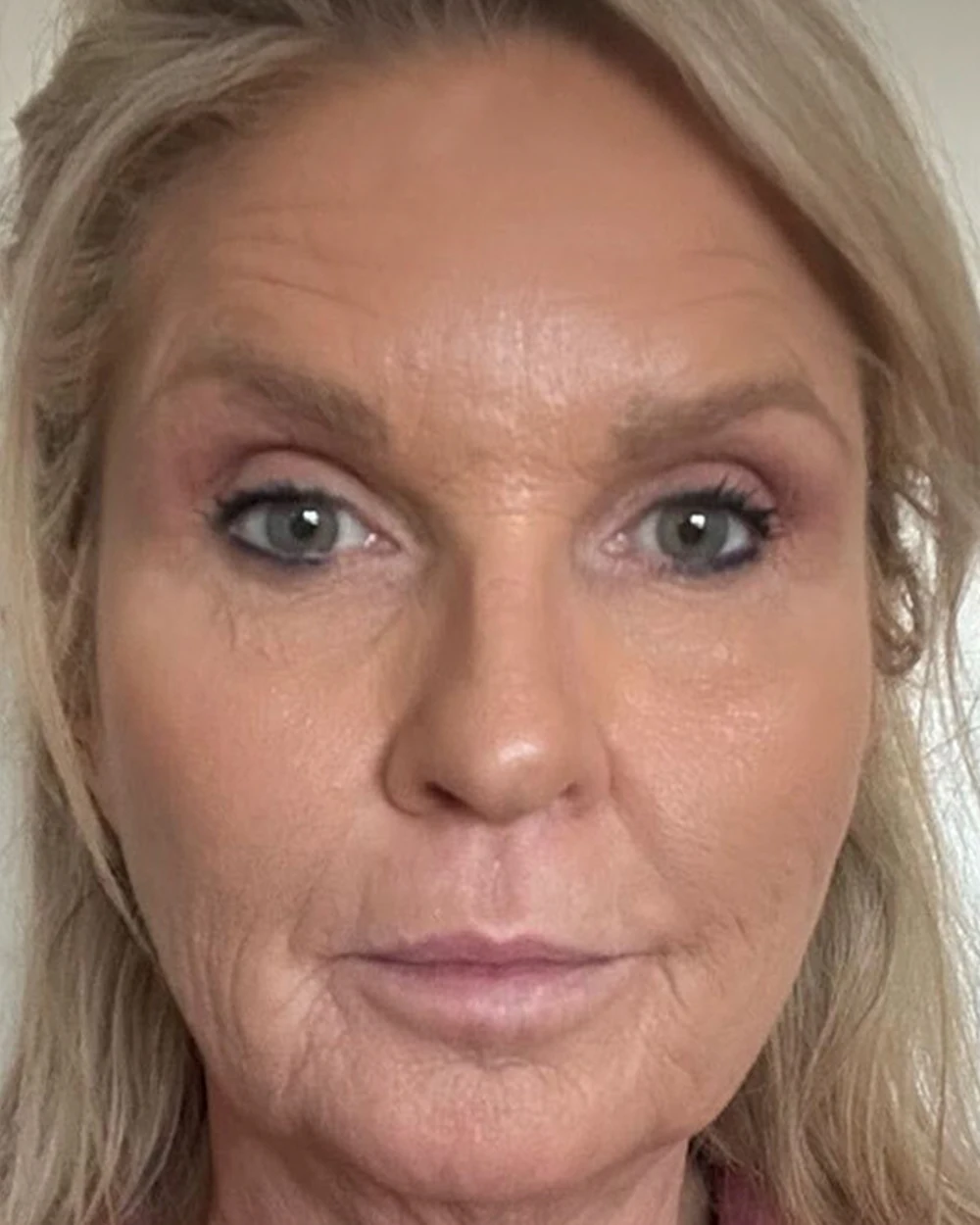
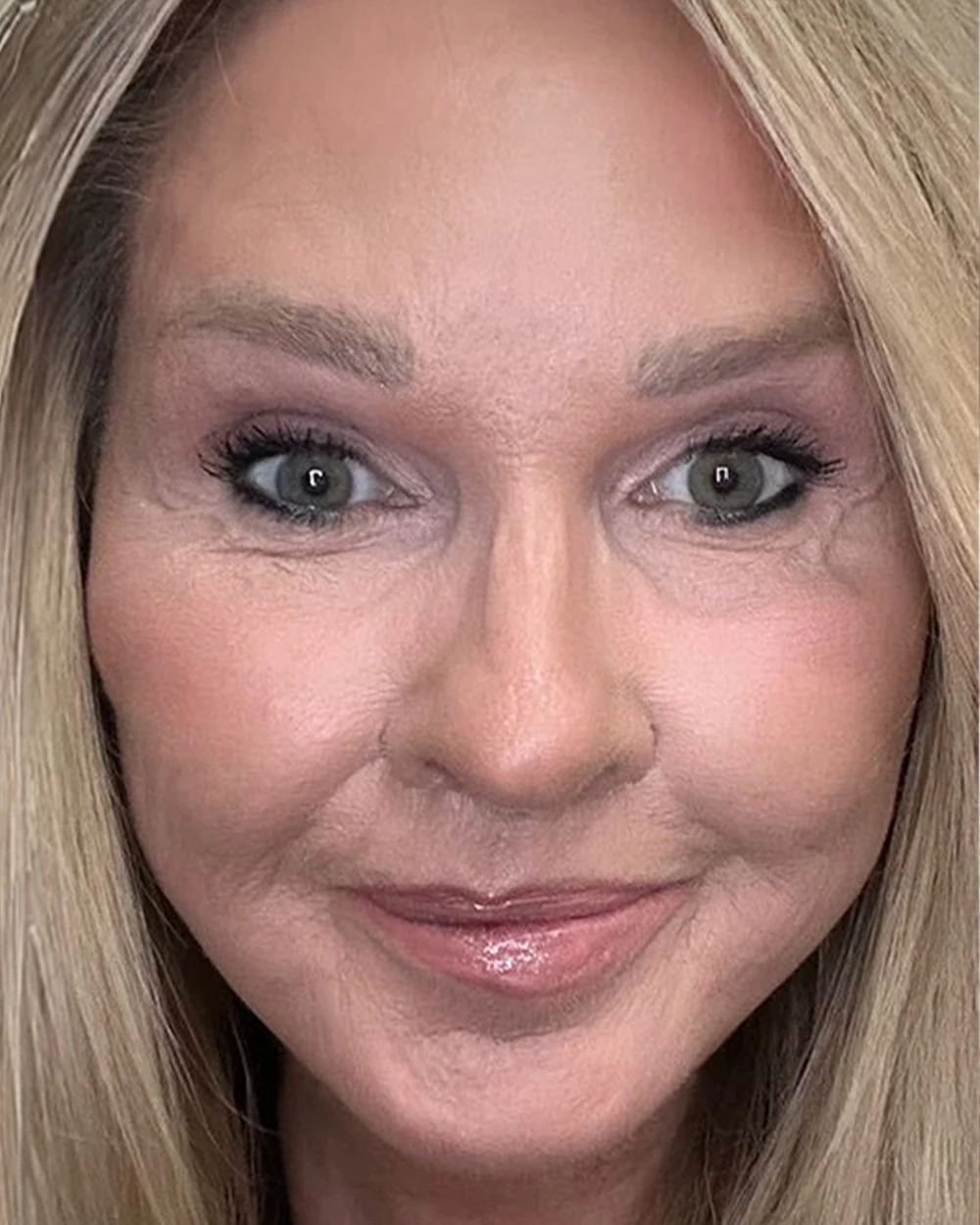 BeforeAfter
How I actually decide, at your exam
There is no formula I can apply from a photograph alone, though photographs help. I decide by combining several things, and I want you to see the reasoning so you can hold me to it.
I look at you at rest and in animation. I watch what your cheek does when you smile, because a cheek fat pad that plumps on smiling is present and repositionable, while a cheek that stays flat has likely deflated. I do the two finger test, lifting the tissue in front of your ear up and back to preview roughly what the lift will restore, and I watch whether the hollows fill or persist as I do it. If lifting the tissue brings your midface back to life, you are descended and the lift will carry you. If lifting leaves the temple and under eye still sunken, you are deflated there, and that is where fat is earned.
I ask your history. Recent significant weight loss, whether from a GLP-1 medication or anything else, pushes me toward expecting deflation, because the face empties along with the body. This is the same physiology behind the so called Ozempic face and the softening jawline people notice after rapid weight loss: the fat leaves the face too. Menopause and the collagen and bone changes around it push the same direction over a slower timeline. A stable weight and a heavy jowl push the other way, toward pure descent.
I also look at the light. Photography under even, front lighting flatters and hides hollows; harsh overhead light in an elevator or a restaurant is where deflation announces itself. I sometimes ask patients to bring a photo taken in unkind light, because that is the face they actually walk around in, and it tells me more about their volume than a careful studio portrait ever will.
And I stay willing to change the plan on the table. I may tell you before surgery that I anticipate grafting your temples and front cheeks, then find once I have released and repositioned the deep plane flap that your midface has volumized so well that grafting the cheek would overdo it, and graft only the temple. That flexibility is a feature, not indecision. The exam and the intraoperative reality together decide, not a package I sold you in advance. When we sit down at your consultation, I will show you on your own photographs which zones I read as fallen and which as empty, so the plan is something you understand rather than something you are handed.
When I would tell you to skip the fat entirely
I turn patients away from fat grafting more often than they expect, and I want to name those situations plainly so you can locate yourself among them.
If your face is full and your problem is purely descent and skin, you do not need fat, and adding it risks the heavy look I described. If you are a person whose face was always on the fuller side and stays full, a lift alone will almost certainly serve you better than any volume. If you have a lot of old filler in place, I do not want to decide anything until it is dissolved and I can see the truth. And if your expectations are set on a dramatic, obvious plumping, I would rather have an honest conversation about restraint than send you into the world with a face that announces its surgery.
There is also the patient for whom neither a lift nor fat is the right first move at all, someone whose skin quality is the dominant issue and who might be better served by resurfacing before or instead of surgery. My practice offers energy based resurfacing such as Morpheus8 and CO2 laser for skin texture, and honesty requires me to say that no facelift and no fat pad improves the surface quality of the skin itself. I do not offer or promise devices I do not use, and I would rather match you to the right tool than talk you into the operation I happen to perform.
What we still do not know, honestly
I would be overstating my field if I told you fat grafting were a solved science. It is not. We still cannot predict, for a given patient, exactly what fraction of a graft will survive, which is why the research range is so wide and why I plan for a touch up rather than pretend one will never be needed. We know that gentle harvest, small aliquots, and healthy recipient tissue help survival, but the biology of why one person’s graft thrives and another’s fades is not fully mapped. There is active study of enriching fat grafts to improve retention, and I follow it, but I do not build your plan on techniques that are still proving themselves. When something moves from promising to proven, I adopt it; until then I use what I can stand behind. Telling you the honest edge of the knowledge is part of the consent you deserve.
The short version, if you skim nothing else
A deep plane facelift moves the volume you have back to where it belongs, and for many people that repositioning is the entire answer, which is why I sometimes talk patients out of the fat they arrived requesting. But a face that has truly deflated, from weight loss, from menopause, from the slow shrinkage of the fat and bone that hold your face up, cannot be repaired by moving nothing around, and for that face fat grafting is the honest other half of the operation rather than an add on.
The decision is a diagnosis. Descent wants a lift. Deflation wants volume. Skin laxity wants the skin managed, and often the skin resurfaced separately. Most faces are a blend, and the art is weighing the mix zone by zone and then resisting the urge to overfill, because fat that survives is permanent and a heavy face is difficult to walk back. Individual results vary, fat retention is genuinely unpredictable, and I plan for both of those honestly rather than promising a number I cannot deliver.
So when you ask me whether the lift will be enough, my real answer is that I will not know for certain until I have studied your face at rest and in motion, taken your history, and watched what your tissue does when I lift it. What I can promise is the reasoning: I will add volume where you are empty, reposition where you have fallen, and leave alone what does not need touching. That, and not a default toward more, is how a face ends up looking rested instead of worked on.