
A patient sat across from me last winter and said something I have now heard hundreds of times, almost word for word. “I looked in the mirror one morning and my mother was looking back. It happened in a year. Maybe less.” She was 53. She brought photographs, the way I ask patients to, and we laid them out on the table in order: a beach picture at 48, a work headshot at 51, a phone selfie from the month before she came to see me. And she was right. The change between the last two was not subtle, and it was not slow. The jawline that had been clean at 51 had softened into two small jowls. The corners of her mouth had deepened. The whole lower third of her face seemed to have slid down half a size.
She wanted to know if she had done something wrong. She had not. What she had done was go through menopause, and her face had told the truth about it faster than she expected.
I have been operating on faces for more than 35 years now, thousands of them, and if there is one story I could take off the shelf and hand to women in their early 50s, it would be this one: your face did not betray you, and you did not neglect it. Something measurable happened in your skin, and it happened on a steep part of the curve. Let me explain the biology honestly, tell you what surgery can and cannot do about it, and then talk about the part everyone actually wants to know, which is timing.
Did menopause really do this to my face?
Yes, in large part, and the reason it feels so abrupt is that the collagen you lose does not leave at a steady pace. Estrogen is one of the signals that keeps the fibroblasts in your skin building collagen, the protein scaffold that gives skin its thickness and its snap. When estrogen falls during the menopausal transition, two things happen at once. New collagen production slows down, and the enzymes that break down existing collagen become more active. You are making less and losing more, at the same time.
The numbers behind this are worth knowing, because they explain the “overnight” feeling. Research on postmenopausal skin has found that collagen content declines with the number of years since menopause rather than with chronological age, at a rate of roughly 2% for each postmenopausal year, and studies estimate that women can lose close to 30% of their skin collagen within about the first five years after menopause. That is the crucial detail. The loss is front-loaded. The steepest part of the drop is right at the transition and in the years just after it, which is exactly when so many women feel their face change almost between one photograph and the next. It is not your imagination, and it is not vanity. It is a real slope, and you happened to be standing on the steep part of it.
There is a second, quieter fact underneath the quantity of collagen, which is its quality. The collagen your skin lays down after menopause tends to be thinner and less well organized than the dense, springy collagen you built in your 20s and 30s. So even the tissue you keep is not quite the same tissue. Skin that is both thinner and less structured drapes differently over the bone and fat beneath it. It holds a jawline less firmly. It creases more readily and recovers more slowly. When patients tell me their skin suddenly feels like it does not fit them anymore, they are describing this precisely, and they are more right than they know.
Three different problems wearing the same name
Here is where I have to slow patients down, because “my face fell” is one sentence describing at least three separate problems, and they do not have the same solution. If you get the diagnosis wrong, you spend money and recovery on the wrong fix and end up disappointed. Getting this distinction right is most of what a good consultation is for.
The first problem is descent. Tissue that used to sit high on the cheek and along a crisp jaw has physically dropped. The fat pads of the midface, which are organized into distinct The face is not one uniform layer of fat. It is a mosaic of separate fat pockets separated by tissue walls, and they age and descend at different rates, which is why aging looks lumpy rather than uniform., slide downward and inward, and they collect along the jawline as jowls. The neck loosens. This is a problem of position, and position is exactly what a facelift addresses.
The second problem is deflation. This is loss of volume, not loss of position. The face looks emptier, flatter, more skeletal at the temples and under the eyes and in the cheeks. A deflated face is a face that has lost stuffing, and no amount of lifting will put stuffing back. That takes volume, either your own fat transferred from elsewhere or, for modest cases, a filler.
The third problem is skin quality. This is the collagen story I just told you, expressed on the surface as fine lines, crepiness, thinning, a loss of the light-catching smoothness younger skin has. This is a problem of the envelope itself, and it responds to skin care, sun protection, resurfacing, and energy devices, not to surgery.
Menopause tends to make all three worse at once, which is part of why the change looks so dramatic. But they are still three problems, and I treat them with three different tools. I have written more plainly elsewhere about what a facelift does not fix, because the honest boundaries of the operation matter as much as its powers.
The arc, from perimenopause onward
Patients find it easier to make decisions when they can see the whole arc rather than the single frightening frame they are standing in. So this is roughly how the collagen story and the facial change unfold over time. Every woman’s timing is her own, and individual results vary, but the shape is consistent.
- PERIMENOPAUSE, MID TO LATE 40sThe quiet slope begins. Estrogen starts to fluctuate and trend down before periods stop. Many women notice skin feels a little drier and less bouncy, and makeup sits differently. The jawline is usually still intact. This is where good sun protection and skin care earn their keep, because you are protecting collagen you still have.
- THE FINAL YEARThe signal drops. Around the last menstrual period, estrogen support for the skin falls off more sharply. The fibroblasts get quieter. Nothing dramatic is visible yet in most faces, but the underlying rate of collagen loss is accelerating in the background.
- THE FIRST ONE TO TWO YEARS AFTERThe steep part. This is where the largest share of that early collagen loss concentrates. Skin thins and loosens fastest here. Women who felt fine at the transition often feel the change arrive suddenly in these two years. This is the "my mother in the mirror" window.
- YEARS TWO TO FIVEJowls and neck declare themselves. As the envelope keeps loosening, descent that was subtle becomes visible. The jawline blurs, the neck softens, folds around the mouth deepen. Many of the women I operate on first seriously consider surgery somewhere in this stretch.
- THE LONG TAIL, YEAR FIVE ONWARDA slower, steady grind. The dramatic early loss settles into that roughly 2% per postmenopausal year decline. Change continues, but the cliff is behind you. This is why the face can feel like it "settled" into a new normal, even though slow drift continues for decades.
I show patients this arc not to frighten them but to do the opposite. If you understand that the early 50s sit on the steep segment, the sudden change stops feeling like a personal failure or a disease and starts feeling like what it is, a predictable biological transition that happens to be visible on the one part of the body you cannot hide.
Why the jowl, specifically
Patients often ask why the change shows up as jowls in particular, rather than as an evenly older but still smooth face. The answer is that your jawline was never held up by skin alone, and skin is only one of the things menopause weakens.
Beneath the skin lies a continuous layer of muscle and fibrous tissue that surgeons call the The superficial musculoaponeurotic system, a strong sheet of tissue under the skin that carries the fat and connects to the muscles of facial expression. It is the layer a deep plane facelift repositions.. That layer, along with a set of true ligaments that tether the face to the bone, is what gives a young jawline its crisp edge. Over time those ligaments relax and the fat compartments they organize slide downward. The midface fat that once sat high on the cheek migrates toward the jaw and pools just in front of and behind the ligament that anchors near the corner of the mouth. That pooled, descended fat is the jowl. The clean line you had at 45 is not gone, it is buried under tissue that fell onto it.
Now add menopausal skin to that mechanical story. A firmer, thicker skin envelope can resist and partly mask early descent. A thinned, collagen-depleted envelope cannot. So the same amount of underlying drop shows through far more on postmenopausal skin than it did five years earlier. The jowl was forming quietly all along. Menopause pulled back the curtain that was hiding it. This interplay between the deep structure and the skin over it is the entire reason I favor a deep plane facelift for the right candidate, because it addresses the descended deep layer directly rather than just pulling the tired skin tighter, which ages poorly and looks pulled.
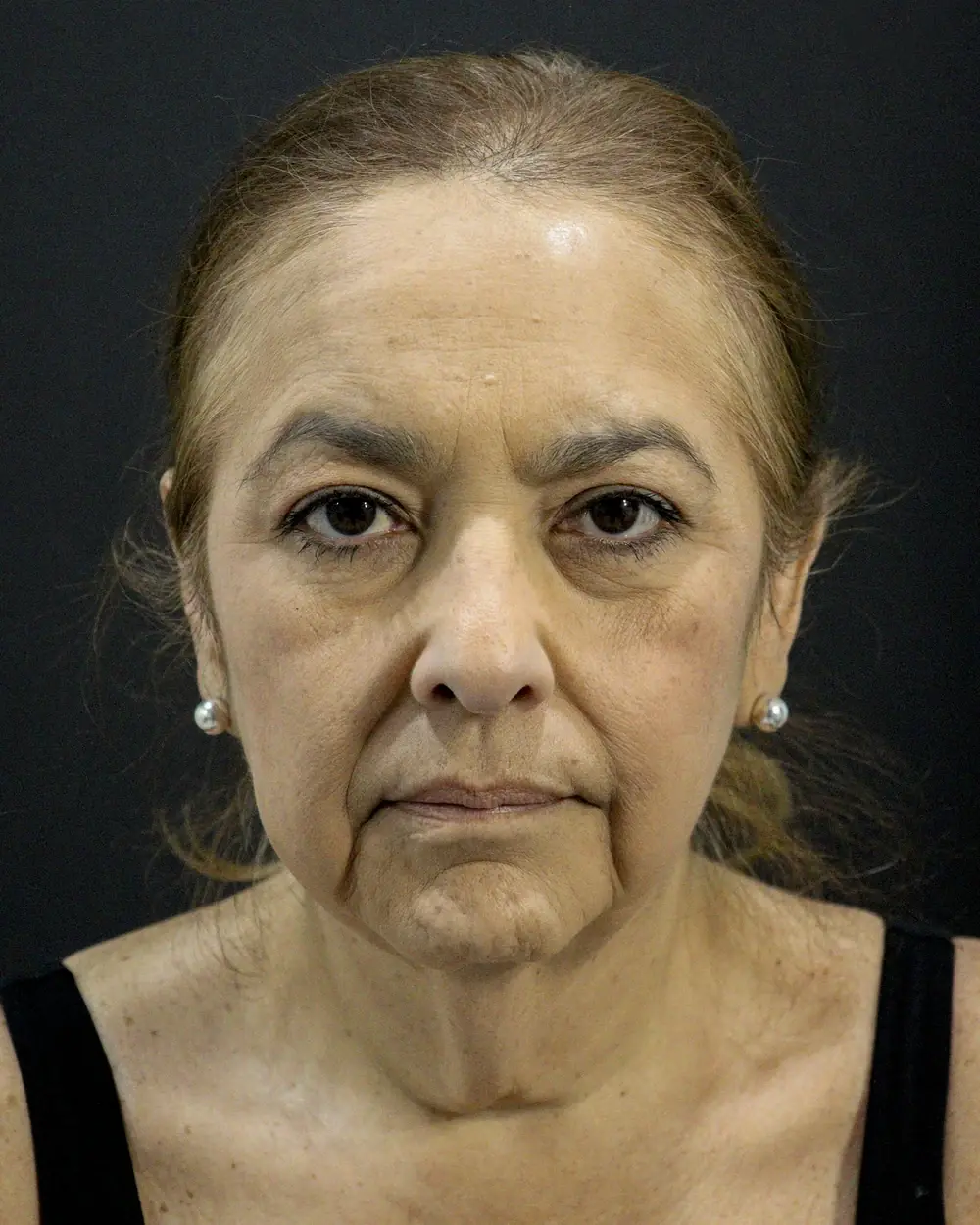
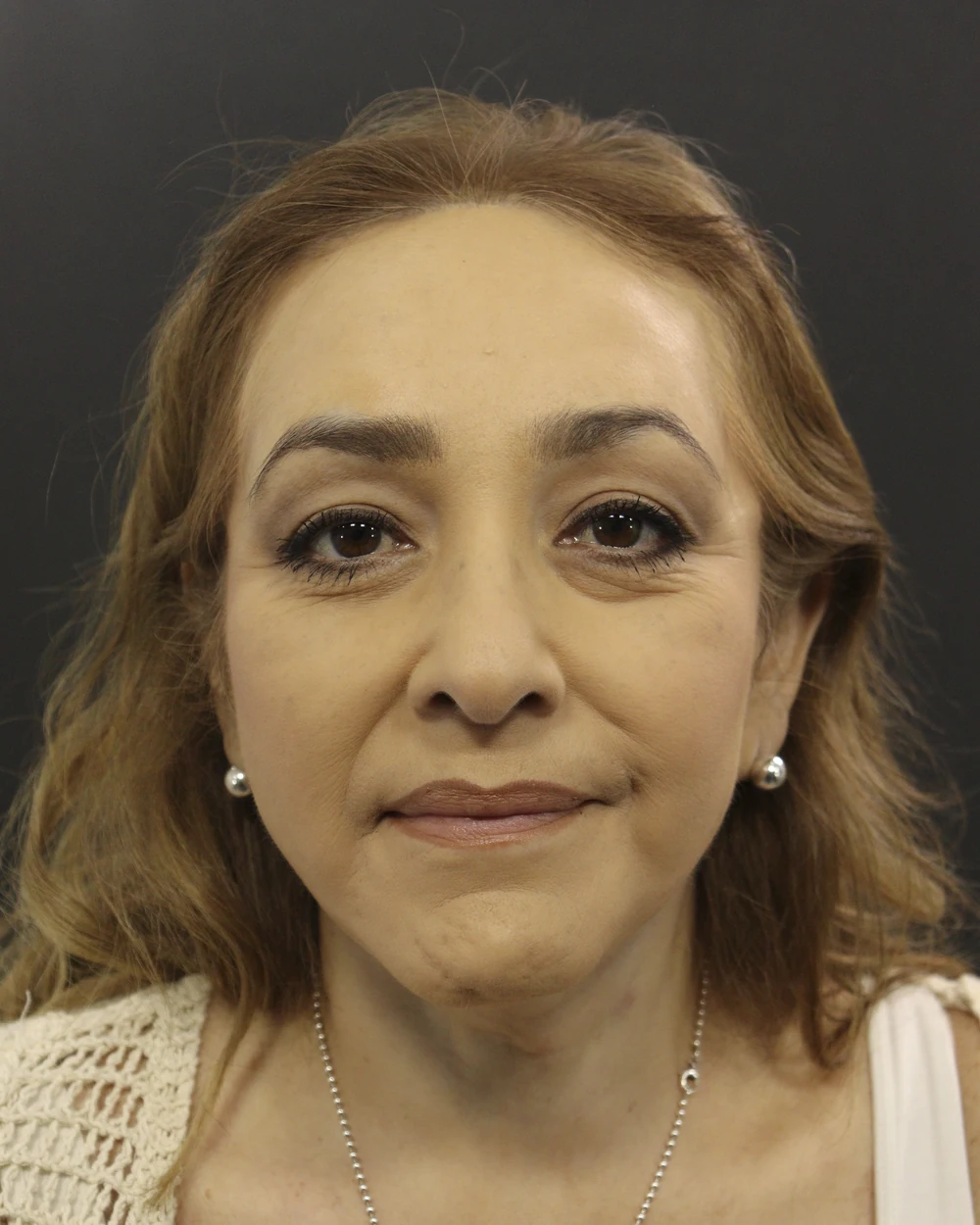 BeforeAfter
Will hormone therapy fix any of this?
This is the question I get most, and it deserves a careful, honest answer rather than a slogan in either direction.
The research is genuinely encouraging on one narrow point. Estrogen does support skin, and hormone therapy can partly restore skin collagen content, thickness, and hydration in postmenopausal women. Studies going back decades, including work summarized in a well-known dermatology review, show that estrogen replacement can be both preventive and, to a degree, restorative for skin collagen levels, with the effect proportionate to how depleted the skin was to begin with. So if you are already taking hormone therapy for the accepted medical reasons, better skin quality can be a real and welcome side benefit.
But here is where I have to be straight with you, because the marketing around this has gotten loud. A large 2025 narrative review looking specifically at menopausal skin and hormone therapy found that while most studies reported positive associations between hormone therapy and skin quality, the findings were inconsistent, and current clinical guidelines do not support prescribing hormone therapy for skin reasons alone. Skin benefit is not a strong enough or reliable enough effect to justify systemic hormones on its own, and any physician managing your menopause is weighing much bigger factors than your jawline.
More important for the question in front of you: even in the best case, hormone therapy improves the quality of the skin envelope. It does not reposition tissue that has already descended, and it does not take up an envelope that has already stretched. It works on problem three from my list, skin quality, and only partly. It does nothing for problem one, descent, which is the problem that actually produces the jowl and the loose neck that send women to my office. So the honest framing is this. Hormone therapy, chosen with your physician for the right reasons, may help your skin feel more supple and may slow some of the ongoing loss. It is not a facelift, it will not reverse sagging that has already happened, and no one should sell it to you as one.
So when is the right time to operate?
There is no perfect date on the calendar, and I distrust anyone who gives you one. I decide from the tissue, not from your birthday or your years since menopause. I have written at more length about how the tissue, not the birthday, decides the right age for a facelift, and menopause is a large part of why that is true for women.
That said, menopause does shape the practical timing, and here is how I think about it. During the steep early period, right around and just after the transition, the face is changing quickly. Operating in the middle of a fast slide can mean the tissue keeps moving underneath a result you were happy with, and you feel like you did not get your money’s worth even when the surgery was excellent. For many women, letting the early cliff pass and operating once the descent has declared itself and stabilized somewhat, often somewhere in the years after that first sharp drop, produces a result that feels more settled and lasting. This is a general pattern, not a rule, and individual results vary.
On the other end, extreme delay has its own cost. If you wait until the skin is very thin, very sun damaged, and deeply deflated, the surgery is still worth doing, but the envelope you are working with is a weaker material, and the result, while real, is working against poorer raw skin. Waiting is not automatically wiser. There is a broad, comfortable window in between, and reading where your face sits within it is exactly the judgment a good consultation exists to provide.
Two health notes belong here as well, because they are part of timing and no one likes to mention them. First, your overall health and recovery bandwidth matter. Menopause sometimes arrives alongside blood pressure changes, sleep disruption, and other shifts, and I want those in a stable place before an elective operation. Second, this is elective surgery. If life is chaotic, if your support at home is thin, or if you cannot protect the recovery time that healing honestly requires, then even a face that is anatomically ready is not ready. The tissue is one vote. Your life is the other.
The volume question, and where fat transfer honestly fits
Because menopause deflates as well as drops, many of the faces I see need volume as well as a lift, and this is where I want to correct a common misunderstanding. A deep plane facelift does not simply pull skin. It lifts and repositions the deep fat and tissue back to where they belong, and in doing so it often restores a surprising amount of apparent fullness to the cheek, because it is putting your own descended volume back up where it used to sit. In a well-executed high lift, the face can look re-inflated without a single milliliter of anything added.
That is the honest first point: sometimes repositioning is enough, and adding volume on top of a good lift would overfill a face and cost it its elegance. I decide this on the operating table as much as in consultation, because until the deep tissue is repositioned I cannot always see how full the face will read.
But sometimes the deflation is genuinely beyond what repositioning can solve, especially in a face that has lost real volume through menopause, aging, or significant weight change. In those faces, transferring some of your own fat to the temples, the upper cheek, or around the mouth at the same time as the lift is a legitimate and powerful complement, not an upsell. The lift solves descent, the fat solves emptiness, and together they can produce something neither does alone. The distinction between a face that needs lifting, a face that needs filling, and a face that needs both is precisely the diagnosis I keep returning to, and it is the same logic I use when I counsel patients on jawline surgery versus filler over the long term. Adding volume to a face that has descended, rather than lifting it, makes the face heavier and older, not younger. Getting that call right is the whole game.
What about the chin and the jawline’s foundation?
There is one more piece of the lower face that often goes unexamined, and it surprises patients when I raise it. A meaningful number of the women who come to me convinced their neck is the problem actually have a chin that is set a little too far back, a chin that is under-projected. This matters more after menopause than before, because a weak chin gives the descending soft tissue of the neck less of a shelf to drape over. The result is a fuller, less defined neck and a jawline that reads as softer than the actual amount of sagging would suggest.
When the exam shows a genuinely weak or under-projected chin, I will sometimes recommend a chin implant, either on its own or as a complement to a facelift and neck work. A well-chosen implant restores the projection the jawline is missing and gives the lifted tissue a firmer foundation to sit against, so the neckline looks cleaner than a lift alone could make it. I want to be careful here: this is not something I suggest to everyone, and it is not a default add-on. It is an answer to a specific finding on a specific face. If your chin projection is fine, we leave it alone. If it is weak, saying so and addressing it honestly is part of building a jawline that actually lasts, and I would rather diagnose it than let you go home wondering why your neck still looks heavy after a good neck lift. For patients whose main complaint is the neck itself, I go deeper into that in my writing on what a neck lift does and does not correct.
What surgery will not touch, and what will
I promised honesty about limits, so here it is plainly. A facelift is the most durable, most powerful thing I can offer for descent. It is not a treatment for the quality of your skin. If your skin is thin, crepey, sun freckled, and finely lined from decades of California sun and the collagen loss we have been discussing, a lift will make it sit in the right place, but it will still be that skin. The texture problem needs a texture tool.
- Jowls forming as descended fat collects along the jawline: a lift addresses this directly
- A loosening neck and a blurred jaw angle: this is descent, and surgery is the durable answer
- A midface that has slid down and flattened: repositioning restores position and often apparent volume
- A genuinely weak chin undermining the jawline: an implant can rebuild the foundation
- Fine lines, crepiness, and thinned skin quality: these need resurfacing or energy devices, not a lift
- Sun spots and uneven tone: a facelift does nothing for pigment
- Whole-face deflation and hollowing: this needs added volume, not tightening
- The wish to look like a different person: I restore your face, I do not replace it
For skin quality, I offer resurfacing and energy-based devices, including fractional CO2 laser treatment and Morpheus8 radiofrequency microneedling, which can genuinely improve texture and stimulate some new collagen in the envelope. I want to be equally honest about what I do not offer and do not oversell: I do not use ultrasound-based tightening, and I do not pretend any device on the market lifts a truly descended jawline the way surgery does. Devices improve the skin. Surgery repositions the structure. They are partners, not substitutes, and a clinic that blurs that line to sell you the less invasive option is not doing you a favor. If you want to see how I think about the durability of these results side by side, my patients tend to find honest before and after facelift results more useful than any promise I could make in prose.
When I would tell you not to do this yet
I turn patients away, and I want you to know the shapes of the no, because they protect you.
If you are in the middle of the steep early collagen slide and your face is visibly changing month to month, I may ask you to let it settle rather than chase a moving target. If your main problem is deflation or skin quality rather than descent, I will steer you toward volume or resurfacing first, and sometimes that is all you need for now. If you are on a significant weight-loss journey that is not finished, I usually wait, because the face is still deflating and I would be operating on a shape that is about to change again. And if your expectation is that surgery will hand you back the exact face you had at 35, or make you look like someone else entirely, I will spend that consultation managing expectations rather than scheduling, because a technically perfect operation on a mismatched expectation is still an unhappy patient.
None of these is a door closing. Each one is me telling you the truth about your particular face at this particular moment, which is the only thing that lets you make a good decision. When the tissue is ready and the expectations are sound, I am glad to be the surgeon who does the work, and everything I recommend, from the depth of the lift to whether we add volume or address the chin, comes out of that first honest reading in the consultation.
There is also an honest answer to the question every patient in the wait asks, which is what to do in the meantime. The skin-quality tools I use myself, radiofrequency microneedling, a CO2 laser, and other resurfacing, genuinely help the collagen and the texture, and thoughtful volume can soften a hollow without adding weight. I offer these, and I recommend them when they fit your face. What I will not tell you is that they stop the descent, because they do not. They are a way to hold the line and look your best while the tissue settles and the timing becomes clear, not a way to avoid the operation the face will eventually need. Used honestly and in the right order, they are worth doing.
A last word to the woman in the mirror
Let me return to my patient from last winter, the one who saw her mother in the glass. We did not rush. We looked at her photographs, we mapped what had descended versus what had thinned versus what had emptied, and we made a plan that fit her actual face rather than her fear. Some of what troubled her was descent, and a lift was right for that. Some of it was skin quality, and we handled that separately. And a small part of it was simply the shock of the steep slope, which eased once she understood that her body had done something normal, not something wrong.
If you are somewhere on that early slope right now, I want you to hear the same thing I told her. Your face changed quickly because the biology changes quickly, not because you failed it. The collagen loss is real and measurable, the descent beneath it is a mechanical problem with a mechanical solution, and the skin quality is a third thing we treat on its own terms. Sorting those three apart, patiently and honestly, is the whole art of doing this well. There is no rush and no shame in it, only a good decision waiting to be made once you can see clearly what is actually happening. Individual results vary, but clarity does not, and clarity is where every good outcome I have ever produced began.