
Yes. A neck lift without a facelift is a real operation, I perform it on its own, and for the right neck it is the honest recommendation rather than a consolation prize. The question that actually decides your case is a different one: is your aging truly confined below the jaw? When it is, the neck can be treated alone and the result reads as natural. When it is not, sharpening the neck beneath a face that has already moved creates exactly the mismatch people fear. I have answered the mirror image of this question, whether the facelift includes the neck, in a separate article. This page belongs to the neck alone: who qualifies, what the operation cannot fix, how it is done, and how I make the call from your photographs.
Who is a good candidate for a neck lift by itself?
The good candidate for a neck lift alone carries all of the visible aging below the jaw: a softened or blunted angle under the chin, vertical bands down the front of the neck, loose neck skin, while the jawline above is still clean and the midface still holds. That pattern is real, and I see it regularly. Some necks give up before the face does, and managing the aging neck in isolation is a recognized, documented approach rather than an improvisation.
The anatomy explains why. The platysma is a broad, thin sheet of muscle that wraps the front of the neck, and below the jaw it is continuous with the SMAS, the structural layer that Mitz and Peyronie defined in 1976 and that I have written about separately. With age the platysma slackens, and the crisp angle between chin and neck, what surgeons call the cervicomental angle, one of the visual criteria Ellenbogen and Karlin set out for a youthful neck in 1980, quietly fills in. Its inner edges can separate and stand out as the two vertical cords people notice in their own photographs long before anyone else does. When that is the entire story, when the muscle and skin of the neck have aged but the face above them has not, the neck lift is the entire answer, and adding a facelift to it would be treating a problem you do not have.
Over my 37 years I have learned to trust that pattern only after I have seen it in standardized photographs, never over the phone and never from a patient’s own description. People are hard on their necks and generous with their cheeks. The camera is neither.
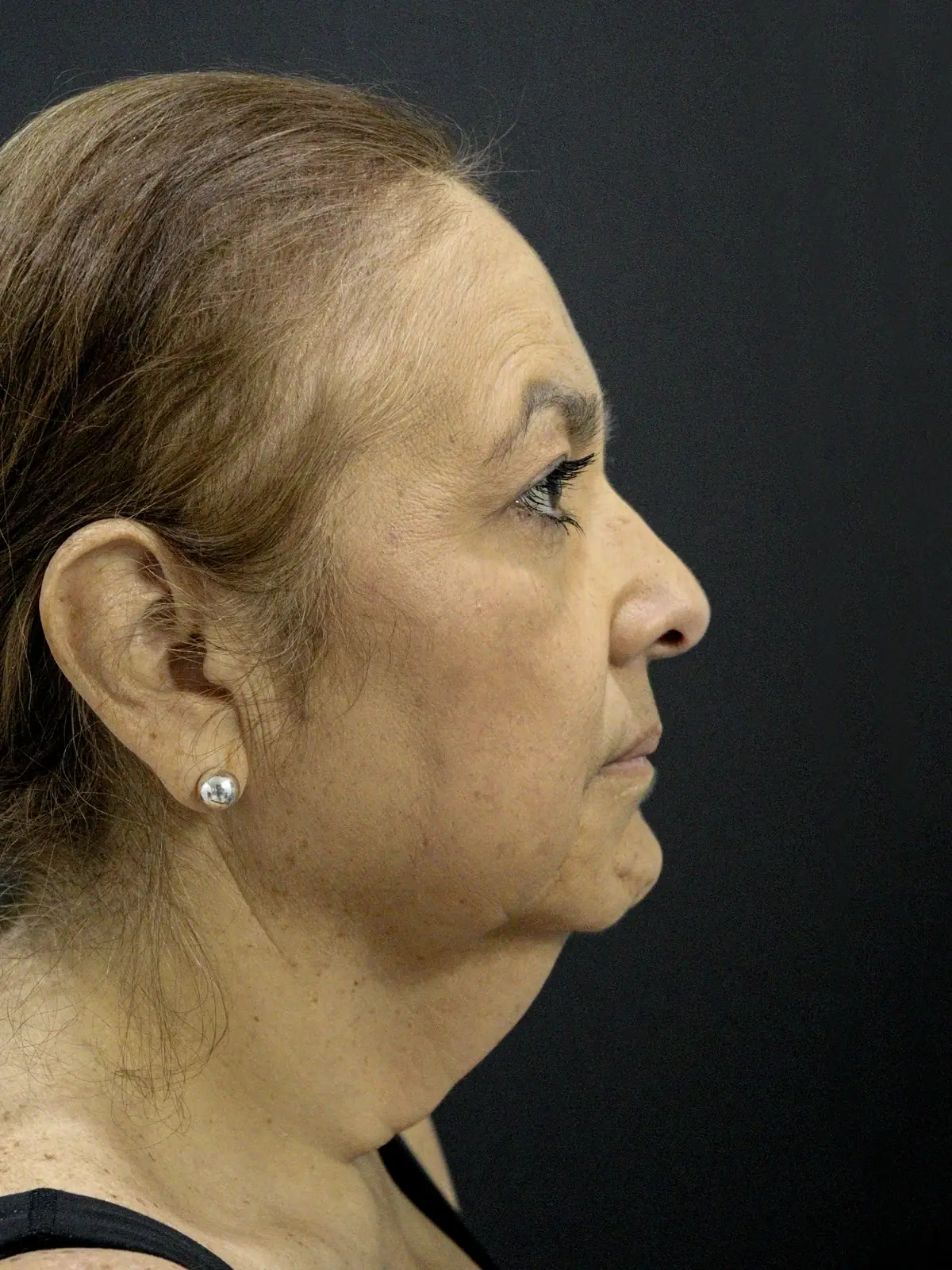
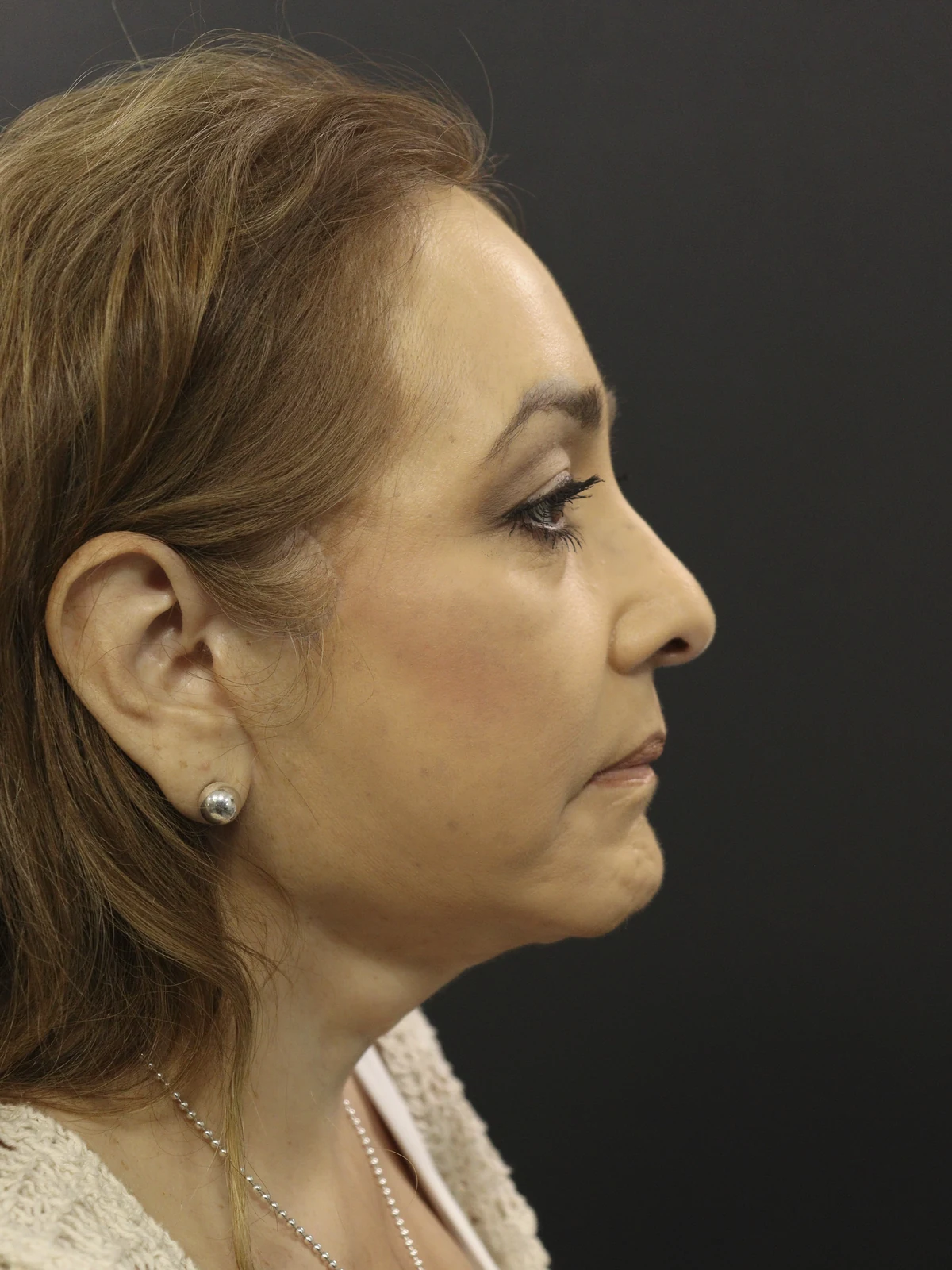 BeforeAfter
Drag to compare. A real result photographed with consent. When the neck is the whole problem, treating it alone can be enough. Individual results vary.
Three findings I want in your photographs
Photographs decide this question, not preference. Before I agree to treat a neck alone, I look for three things:
- The aging confined below the jaw. The bands, the blunted angle, the loose skin, all of it inside the neck’s territory.
- A clean jawline. No jowl beginning to gather at the corner of the jaw, because the jowl belongs to a different operation.
- A midface that still holds. Cheeks sitting where they should, so the refreshed neck will match the face above it.
When all three are present, I am comfortable recommending the neck alone. When one is missing, we talk honestly about what that means. The fuller examination of the neck itself, finding by finding, lives on the neck lift page.
What can a neck lift alone not fix?
A neck lift does not fix jowls, because jowls do not start in the neck: they come from descent at the jawline and the midface, above the territory a neck operation treats. This is the boundary most patients have never been told about, and it decides more neck consultations than any other single finding. A beautifully sharpened neckline under a jowled jawline does not hide the jowl. It points at it.
The operation that corrects the jowl is a lower face lift or a deep plane facelift, the deep plane release Hamra described in 1990, because those operations reposition the descended structure that created it. If you want the technique argument, how a deep plane release differs from a SMAS lift and why it matters, that debate has its own page at deep plane vs SMAS, and I will not repeat it here. And because the jowl question comes up so often in neck consultations, I have given it its own article as well.
A neck lift also does not resurface skin, restore lost volume, or change the quality of sun-damaged skin. Those are the same boundaries I mapped for the face in what a facelift does not fix, and they apply just as firmly below the jaw.
Will a neck-only lift look mismatched with the rest of my face?
Stand in front of a mirror and look at yourself in profile, then straight on. If the line of your jaw is clean from both views and what bothers you sits underneath it, then no: treating the neck alone will not create a mismatch, because you are returning the neck to the age your face already shows. Balance is the whole point of choosing the smaller operation for the right patient.
The mismatch people fear runs the other way. It appears when a neck is tightened beneath a face that has already descended, a crisp neckline under a heavy jawline, and every eye that looks at that face is pulled straight to the part that was left behind. That is not the operation failing. It is the selection failing. In my experience the way you prevent it is simple and unglamorous: you read the photographs honestly before surgery, and you are willing to tell a patient that the operation she asked for is not the operation her face is asking for. Individual results vary, but selection is the part I control, and I hold it tightly.
One name, several operations
Part of the confusion around this question is vocabulary. Patients say neck lift and mean at least three different things, and the differences matter.
A submentoplasty works through a small incision hidden under the chin. It addresses the fat under the chin and the platysma muscle, and it suits patients whose skin still has good tone. A platysmaplasty is the muscle repair itself: the platysma is tightened, or its separated inner edges are sutured back together, the repair Feldman detailed as the corset platysmaplasty in 1990, to rebuild the angle between chin and neck. It is the engine inside nearly every serious neck operation. A full neck lift adds the third element, loose skin, and treating skin requires access, which is why its incisions typically sit around and behind the ear.
The looser the skin, the longer the operation’s reach has to be.
Choosing between the smaller and fuller versions is its own decision, and I have written about it directly in submentoplasty vs neck lift, about how the muscle repair heals in platysmaplasty recovery, and about the harder boundary case, when the jawline itself is in question, in neck lift vs lower facelift.
- The problem lives below the jaw: loose neck skin, muscle bands, or fullness under the chin
- The jawline and midface above are still holding their shape
- A jowl or a heavy midface: that is face, and a neck lift alone would look mismatched against it
- Expecting a neck lift to lift the whole face
How is a neck lift done without a facelift?
Through incisions placed for the problem being solved: a small one hidden under the chin when the work is fat and muscle, and incisions around and behind the ear when loose skin also has to be treated. The inner edges of the platysma are reached under the chin and repaired to rebuild the cervicomental angle, and the skin is then redraped without tension. The correction comes from the repair underneath, never from pulling skin tight, which is the same principle that governs everything I do in the face.
That principle is not an accident of preference. I did my fellowship with Bruce F. Connell, and the surgery he mastered and taught was never the face in isolation. It was the face and the neck, read as one territory, which is exactly the training that teaches you to recognize the rarer case where only one part of that territory needs work.
Whether your operation is a full neck lift or a smaller one, it happens in the same operating room under the same standards: VIDA Wellness & Beauty in Tijuana, the first Quad A (AAAASF) accredited facility in Mexico, licensed by COFEPRIS, with our anesthesiologist Dra. Nadiezhda Garcia Bonilla present for every procedure. A smaller operation never means a smaller safety setup, and the details live on the facility and anesthesia page.
What is recovery like after a neck lift alone?
Gentler than a full facelift, usually. Plan seriously anyway.
For patients traveling from the United States I ask for the same disciplined first week I ask of my facelift patients: a minimum local stay of about six days, spent at our in-house Recovery Boutique with nursing 24 hours. When drains are used they typically come out at 48 to 72 hours, and sutures come out at about day seven. Social recovery, the point where most patients feel comfortable in a restaurant or on a video call, sits near fourteen days for the fuller lifts. A smaller procedure such as a submentoplasty is generally quicker than that, but I would rather you plan generously and be pleasantly surprised than book a flight against a calendar your tissues have not agreed to. Individual recovery varies.
And no honest surgeon promises a smooth course. Most patients heal without incident, but numbness under the chin, temporary firmness, and small asymmetries while the tissues settle can happen, and I would rather you hear that from me before surgery than meet it afterward.
One more piece of honesty about time. The neck you see at two weeks is not the result. Swelling settles over months, and the true neckline shows itself at several months, the same slow reveal I describe for the face in facelift recovery. Patience is part of the operation.
When I say no to the neck-only plan
A patient will sometimes ask me for just the neck because the word facelift feels like a bigger step than she is ready to take. I understand the instinct. Then I study her photographs and find a jowl already gathering at the corner of the jaw, and now I owe her the truth: the operation she is asking for will sharpen her neck and leave the thing that bothers her most exactly where it is.
At that point there are two honest paths. One is the combined face and neck lift, planned as a single operation with a single recovery, which is how I approach most faces and which I explain in the article on whether a deep plane facelift includes a neck lift. The other is to wait, if the changes are early and she is not ready. What I will not do is perform the wrong small operation because it was the easier conversation. After more than 3,000 facelifts, I can tell you that the wrong small operation is still the wrong operation, and it costs a patient more peace than the honest conversation ever would.

What we still don’t know
I want to be candid about the edges of the evidence. How long a neck-only result lasts, set against a full lower face and neck lift, has not been settled by large long-term studies; the honest answer is that a well chosen neck can hold its improvement for years, and that the platysma bands treated at surgery can, in some patients, slowly return as the muscle ages again. That is not a reason to avoid the operation. It is a reason to choose it for the right neck, and to keep your expectations tied to what the tissue can actually do rather than to a number no one can honestly promise.
The answer for your neck, specifically
Everything above is the pattern. You are not a pattern. Send me your photographs through the consultation, which we coordinate from San Diego, and I will study them myself and tell you plainly which operation your neck is asking for, even when that answer is smaller than the one you expected, and even when it is none at all for now. You can reach us at +1 (619) 738-2144 by phone, SMS, iMessage, or email. Individual results vary, but a straight answer never does.